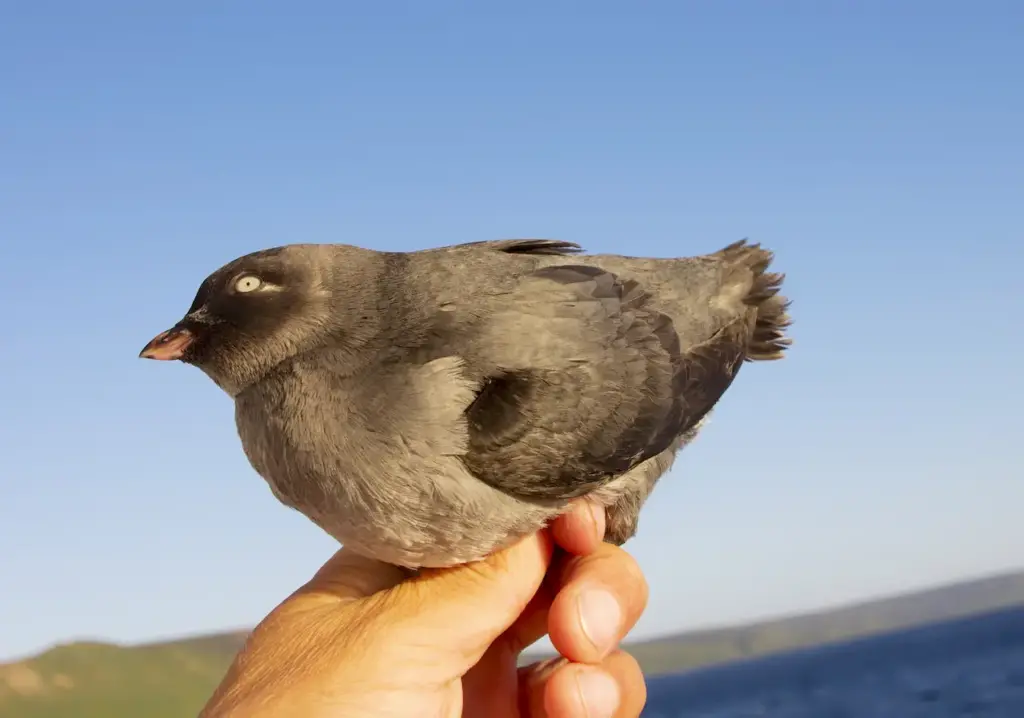
The Whiskered Auklets, Aethia pygmaea, is a small seabird of the auk family.
Description
It is one of the smallest alcids, only the closely related Least Auklet being smaller. Its name is derived from the long white feathers on its face that are part of its breeding plumage.


Habitat and Distribution
The Whiskered Auklet, unlike many seabirds who migrate across oceans and continents to find food, is a creature of habit. The Whiskered Auklet lives in a small area of the North Pacific year-round, mainly around the Aleutian Islands, Alaska, and some adjacent island groups, off the coasts of eastern Russia.
This behavior is very unusual, as many seabirds breed in one place and winter elsewhere. Instead, Whiskered Auklets stay near their breeding islands all year round, feeding, nesting and roosting within a small coastal zone.
The islands are rocky volcanic rocks with many crevices, boulder fields and a variety of other features. Not only are these features essential for nesting, but they also protect predators and harsh conditions. Nesting sites can be found on cliffs or rocky slopes at the base coastal mountains.
Whiskered Auklets live in the ocean within a 16-kilometer range of land. This is a small area for a seabird. The birds prefer areas where the tidal flow creates turbulent zones. These are often called tide rips and passes. These areas are dynamic and concentrate planktonic food, allowing for efficient foraging.
They are extremely vulnerable to changes in the island habitat and nearshore marine conditions due to their year-round attachment. These birds can be affected by a variety of factors, including the introduction of invasive species, oil spills or changes in the distribution and abundances of prey due to climate change.
The Whiskered Auklet was originally classified as two species because of minor differences in its range. However, genetic and morphological research has shown that it exhibits clinal variations, which are gradual changes throughout its range.
Breeding and Nesting
The breeding biology is fascinating, but also understudied. The Whiskered Auklet breeds in small, loose groups hidden between rocks, boulders and cliffs. This is unlike many other alcids which breed in noisy, large colonies. Nesting is usually done in crevices in rocks that are cool, dark and safe for the chicks and eggs.
The small seabirds are known to invest a lot of time and energy into their offspring. The egg is incubated by both parents, who alternately do so. It is laid directly onto the rocky crevice floor without nesting material. The chick is fed and brooded by both parents until it leaves the nest and goes on its own.
In the pitch-black of a crevice or rock fissure, these tactile feathers allow birds to sense the walls around them much like the whiskers of a cat. These feathers are tactile, allowing birds to feel the walls of a rock fissure or crevice in the darkness. They work like cat whiskers. Birds with shorter whiskers bumped into obstacles more often, proving that the feathers serve a sensory function.
Chicks are hatched in the early to middle summer. Breeding occurs in late spring or early summer. Adults begin to molt as the season moves into August. This can sometimes overlap with the raising of chicks. Due to the harsh conditions of northern environments, the timing of molting is very precise.
Nesting colonies are usually not well organized, but they can be shared by other auklets, such as Crested and Least Auklets. The Whiskered Auklet is often distinguished from its more gregarious cousins by its secretive nesting behavior and preference for smaller spaces.
Due to the single egg clutch, dependence on crevices and tight annual cycle, reproductive success is closely linked to habitat quality and predator absence. Nesting sites can be severely affected by any disturbance, such as natural erosion or human interference. According to National Geographic, this species is well documented.
Food and Diet
The Whiskered Auklet has a specialized and localized feeding behavior. This species rarely ventures far from the land, unlike many seabirds who travel vast distances to find food. The foraging activity of this species is concentrated within 16 km of the islands, where it nests and rests. According to WWF, this species is well documented.
Auklets change their diet according to the season, relying on the most plentiful and nutritious prey. Auklets feed primarily on copepods during the summer, when they are breeding and raising their chicks. These small planktonic crabs that swarm in large numbers in nutrient rich waters. Neocalanus plumbchrus is a species that makes up a large part of the auklet’s summer diet.
During the fall and winter, as the seasons change, and copepods become less abundant, the Whiskered Auklet changes its diet from copepods to larger prey, euphausiid Krill in particular. This flexibility ensures a consistent food supply throughout the year. However, the species is still vulnerable to changes in ocean conditions which could disrupt the seasonal abundance.
The Whiskered Auklets hunt by diving under water and “flying” through the water to pursue prey. The dives are usually shallow and short, which is consistent with the preference of these birds for feeding nearshore. They are powerful underwater swimmers due to their high wing loading, but they are less agile than some of the open-ocean species.
Due to this strong fidelity, changes in oceanography, such as changing currents or decreasing prey availability because of overfishing and climate change, can have serious implications for survival.
Vocalization
The Whiskered Auklets are not well-known for their vocalizations, but they do make a variety of sounds. This is especially true during breeding season and when returning to the roost. They usually make soft, simple calls, which are described as meowing or whining sounds.
The majority of vocal activity is at dusk and during the night when birds arrive at or leave their nesting crevices. These calls serve a variety of functions, including helping mates find one another at night, establishing territories, and warning away intruders.
There are few detailed studies on the vocalizations of this species, due to its nocturnal behavior and tendency to hide in crevices. Anecdotal evidence and recordings indicate that these sounds play a role in social cohesion, navigation and cohesion, especially when the environment is dark and cluttered.
As Whiskered Auklets live near their colonies all year round, vocalizations may not be limited to breeding season. They can occur at any time of the year since the birds use the same nesting and roosting sites.
References
- BirdLife International (2008). Aethia pygmaea. In: IUCN 2008. IUCN Red List of Threatened Species. Downloaded on 24 February 2009.
- Seneviratne, Sampath S. and Ian L. Jones (2008) Mechanosensory function for facial ornamentation in the whiskered auklet, a crevice-dwelling seabird. Behavioral Ecology Advance Access. DOI 10.1093/beheco/arn029
- Aethia pygmaea (TSN 177021). Integrated Taxonomic Information System. Retrieved on 24 February 2009.Byrd, G. V. and J. C. Williams. 1993. Whiskered Auklet (Aethia pygmaea). In The Birds of North America, No. 76 (A. Poole and F. Gill, Eds.). Philadelphia: The Academy of Natural Sciences; Washington, D.C.: The American Ornithologists’ Union.
Conservation
The Whiskered Auklet has been classified as a species with Least Concern (LC) by the global conservation authorities. However, this classification hides the fact that it is vulnerable to many threats, some of which are growing in number.
Invasive predators that are introduced to islands where nesting birds live pose a serious threat. Rats, cats and foxes can easily gain access to auklet nests hidden in crevices of rocky terrain and feed on eggs, chicks or adults. The birds depend on predator-free island for breeding and roosting. Even a single introduction can have disastrous consequences.
Oil pollution is another major issue. Due to their foraging and roosting nearshore, Whiskered Auklets can be highly vulnerable to oil spills or marine pollution. Like all seabirds’ feathers, Whiskered Auklets are dependent on them for waterproofing. Even small amounts of oil could cause hypothermia and reduced foraging.
Conclusion
The Whiskered Auklet is a bird full of paradoxes. It’s rare, but not endangered. It’s small, but it has a lot of character. This tiny seabird, with its orange-scented plumage and comical facial whiskers, lives in crevices, refuses to migrate and has a variety of adaptations.
Its uniqueness, however, is also a vulnerability. It is a specialist that is confined to a small strip of rocky island and nearshore waters, which are under increasing threat. To protect this mysterious auklet, you need to have foresight and research. You also need to be committed to protecting the windswept islands, churning tides, and wild waters that it lives in.
By conserving the Whiskered Auklet we are protecting more than just a bird. We are also conserving an ecosystem that is complex and delicate, where the ocean meets the rock and ancient rhythms continue to be played out, far from the gaze of most people.