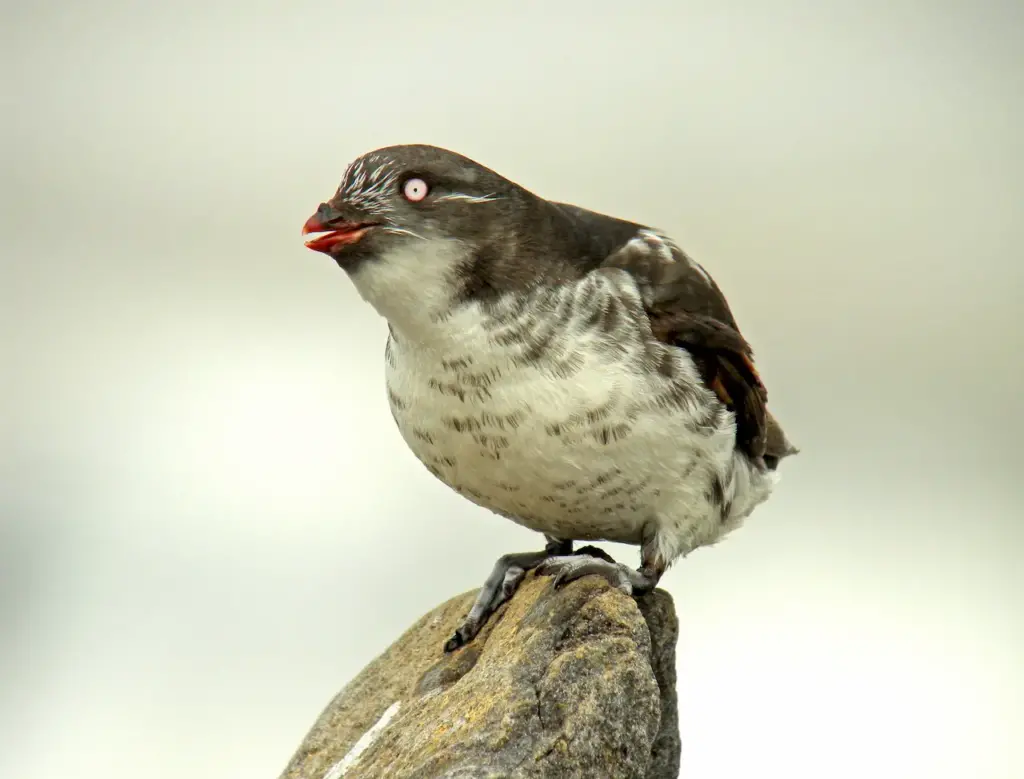
The Least Auklet (Aethiapusilla), a seabird of remarkable power and beauty, is one of the most impressive seabirds. This tiny seabird is a small member of the auks and thrives in harsh marine environments. It has one of the biggest populations of any species of seabird in the world. The Least Auklet is physically small, with an average weight and length of 6 inches. However, its ecological importance and resilience make it a giant within the field of marine ornithology. This post will explore the distribution of this Arctic bird, its feeding habits, nesting techniques, and conservation concerns.
Global Distribution: The Least Auklet’s Home
The Least Auklet’s distribution centres around the northern Pacific Ocean and the Islands of Alaska and eastern Siberia. The most common seabird in North America, it is also one of the most numerous seabirds worldwide, with a population estimated to be close to 9 million individuals. The nesting areas are rocky crevices, coastal cliffs, and isolated islands. The largest breeding colonies of the Aleutian Islands are found on St. Lawrence Island and Little Diomede Island. Least Auklets migrate a short distance after the breeding season. They usually remain near the edge of the sea ice for the entire winte,r where food is plentiful. Their ability to survive extreme Arctic conditions is a testament to their evolutionary success.
Habitat and Environment – Life at the edge of the ice
Least Auklets inhabit the Arctic or sub-Arctic regions, which are marked by cold water, unpredictable weather and shifting ice conditions. The seabirds that make up this species are marine experts and spend most of their time away from the shore. During breeding season, they flock to remote, rocky islands, which are not inhabited by land predators. The birds are protected by these areas, which are often inaccessible by humans. In the off-breeding seasons, they live in the margins around the pack ice where the nutrient-rich water supports a variety of prey species. Scientists can monitor ocean health by observing the presence of these animals along the edge of sea ice.


Hunger in tiny packages: voracious hunters
The Least Auklets, despite their size, are voracious and efficient predators. They feed primarily on calanoid copepods and especially those of the genus Neocalanus, which are found in abundance in stratified Arctic water. Also, they feed on Euphausiids, Pteropods and other types of Zooplankton. These prey items tend to be concentrated in areas of oceans with upwelling and thermoclines that create dense patches. The Least Auklet not only use its wings to fly above water, but also uses them as paddles underwater to propel itself when diving into the ocean in pursuit of prey. The pursuit dive method allows the bird access to prey in three-dimensional space. Few other birds can match this food niche.
Feeding efficiency: High metabolism and high intake
The Least Auklet’s high metabolism rate and daily food consumption are among its most remarkable features. The birds consume as much as 86% their body weight every day. This is the equivalent to a 150-pound person eating more than 120 pounds of food every day! This diet is high in energy to support their active lifestyle, which includes intense periods of diving, flying and raising chicks during breeding season. They are important players in the Arctic Marine Food Web because of their specialised feeding strategies. They help regulate populations and serve as prey to larger predators such as gulls, foxes, and gulls.
Breeding Behaviour in Crowded Colonies
The Least Auklet breeds in colonies. These nesting groups can range from hundreds of thousands to more than a million birds. These colonies are usually located on boulder fields or rocky slopes, where the birds nest in crevices under rocks or between talus. This communal life has many benefits, including protection against predators and an increase in foraging efficiency because of social cues. It also leads to intense competition over nesting spaces. This is especially true for larger auklets such as the crowned auklet, which can displace Least Auklets.
Nesting and parental care: Raising Next Generation
Each breeding pair of Least Auklets will lay one egg in the crevice they choose. The male and female share incubation duties, brooding and feeding. After a period of incubation lasting around a week, a downy black chick is born. The chick is semiprecocial. This means that it is mobile and partially developed, but still dependent on its parents to provide warmth and food. The unique way that Least Auklets and other small auklets feed their chicks is what makes them so special. Least Auklets do not carry fish in their bill like murres or puffins. Instead, they transport copepods in a sublingual bag – a special structure below the tongue. This adaptation allows the birds to feed chicks soft, highly nutritious prey. According to Cornell Lab of Ornithology, this species is well documented.
Prepare for the sea with Fledging and Independence
After the chick is sufficiently developed, typically within 25-30 days, it departs the nest, heading straight to the sea. No further parental care is required. The Least Auklet chicks can dive and feed almost immediately following fledging, unlike some seabirds that are dependent upon adults for several weeks. This rapid transition is important in a breeding window that is so short, particularly during the brief Arctic Summer when food is plentiful and conditions are ideal. According to RSPB, this species is well documented.
The Population Status of One of the Most Numerous Seabirds in the World
The Least Auklet has a large population, and i,s therefore a conservation success, for the time being. The IUCN classifies them as Less Concern due to their millions across the North Pacific. The massive colonies of these swarming ants are often visible at a distance. But abundance doesn’t mean invincibility. They are a vital component of Arctic ecosystems and important bioindicators for ocean health. Researchers study trends in the Least Auklet population to better understand changes in marine productivity, climate variability and pollution impacts.
Predators and Pollution as Conservation Concerns
The Least Auklets are still common, but they face serious threats. The introductions of invasive predators are among the most important. These non-native birds decimated colonies of ground-nesting birds, including the Least Auklet. Introduced rats, known for their nest-raiding behaviour, are also a growing issue on islands where Auklets reproduce. Oil Spills and Marine Pollution are also a threat to Auklets. This is especially true in wintering habitats. Even though large-scale oil spills are uncommon in these remote areas, the impact they can have on dense colonies of auklets is enormous.
Climate Change and Ocean Warming – A Growing Concern
Climate Change and Ocean Warming are also long-term threats to the Least Auklet. The availability of prey species such as Neocalanus Copepods could decrease or move northwards, reducing the food supply near breeding colonies. Changes in ocean currents and the timing of plankton blossoms could impact breeding adult survival rates and chick survival rates. Least Auklets play a key role in monitoring these trends to understand how Arctic ecosystems will react to global climate change.
The role of the Least Auklet within Arctic Ecosystems
The Least Auklet is one of the most common seabirds in the Arctic. It plays an important role in ecosystem function. They act as vectors to transfer marine-derived nutrients into terrestrial habitats by feeding at sea and laying eggs on land. This enriches soils in the vicinity of nesting colonies. The microbial life and the plant life that they produce are supported by their guano. They are therefore a vital species for coastal islands. This goes far beyond their role as prey and predators.

Birdwatching and ecotourism: A rare glimpse into Arctic birdlife
While their location makes it difficult to see them, wildlife tours in Alaska to St. Paul Island and St. Lawrence Island can provide a unique opportunity to observe Least Auklets. Photographers and naturalists are amazed by their aerial displays and dense colonies’ chatter. They also enjoy the synchronised flight. The Least Auklet could become a conservation ambassador as interest in Arctic Ecotourism increases.
Last Thoughts on the Resilient Least Auk
The Least Auklet is a small seabird, but its adaptability and complexity are remarkable. This bird’s life is shaped by its extreme environmental conditions, its precise biological timing and its intricate ecological relationships. Least Auklets, though abundant, are still vulnerable to threats that wildlife around the world faces, including invasive species and pollution. The continued conservation, research, and public awareness are key to ensuring this tiny ocean navigator continues to thrive in the future.