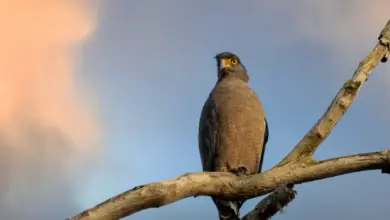
The American Harpy Eagle (Harpia Harpyja) commands attention with its enormous size, regal pose, and mythic past. Carl Linnaeus first described the species in 1758, as Vultur harpyja. Later, it was placed into its own genus Harpia, where it is still the only representative. The Harpy Eagle is the most powerful and largest raptor of the Americas, and one of the largest eagles in the world. It occupies an important place in science and in culture. This impressive bird lives in the dense, towering canopy of Neotropical lowland forests, especially in Central and South America. The name is derived from the winged harpies in ancient Greek mythology, who were said to carry souls into the underworld. Harpy Eagle has a body that resembles an eagle, and a unique expression on its face. It truly looks like a creature from legend.
A Visual Description Of The Harpy Eagle
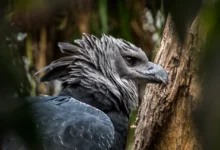
Harpy Eagles have one of the most distinctive appearances among birds. The upper part of its body is covered in slate-black plumage, while the underside has crisp white feathers. The eagle’s chest and neck are adorned with a broad black band that gives it a distinct armoured appearance. The bird’s head is a pale grey colour and is crowned with an elegant, double crest. When the bird becomes alarmed or excited, it can raise this crest into a crown. The male and female Harpy Eagles have identical plumage. However, the female is larger. The talons of the Harpy Eagle are impressive. They can measure up to 5 inches and are similar in size to grizzly-bear claws. Harpy Eagles are apex hunters with muscular legs, fierce eyes and talons that measure up to 13 cm (5 inches).

Dimensions, strength, and other important measurements
Harpy Eagles are among the largest birds of prey. The heavier females weigh an average of 6.5kg to 9kg (14-20lbs). However, rare captives like Jezebel, a well-known female, have reached 12kg (26lbs). The males are much lighter and weigh an average of 3.8 to 5.4 kg (8.5-12 pounds). The species is approximately 200cm (6ft 7in) long and measures 294-105 cm (2.94-3.43ft) wide. The Harpy has relatively small wings compared to eagles that live in open areas. However, this is an important adaptation. The bird can twist, turn and maneuver at high speed through dense foliage while pursuing its prey. The Philippine Eagle and Steller’s Sea Eagle are the only two birds that come close to this size. Both rely on wings with a wider span adapted to more open habitats. Only the extinct Haast’s Eagle from New Zealand was larger than the Harpy.


Prey preferences and Ecology of the Harpy eagle
Harpy Eagles are arboreal mammal specialists. Its main prey is monkeys and sloths. These animals are perfectly adapted for life in the rainforest canopy, but still vulnerable to this predator. The Harpy diet was revealed by research conducted in Parintins, Amazonas, Brazil, from 2003 to 2006. Sloths made up nearly 79% the eagles’ diet, according to remains delivered to nests. 39% was made up of three-toed slots ( Bradypus variegatus), and 40 % two-toed slots ( Choloepus Didactylus). is made up of small to medium-sized primates, such as capuchins or howler monkeys.
The Harpy Eagle hunts macaws, but mammals are its main diet. The Parintins site had a Green-winged Macaw that accounted for approximately 0.4%. All other bird species combined made up 4.6%. Harpy Eagles are equipped with talons that can generate an incredible 42 kgf/cm2 (530 lbf/in2) pressure. They can immobilise and lift prey weighing up to 34 of their own body weight. Its sheer power allows it to take prey that other raptors can’t, reinforcing the status of its ecosystem as a dominant force.
Reproduction Behavior and Parenting Behavior
Harpy Eagles have a long and slow reproductive cycle, which makes them vulnerable to environmental threats. The breeding pair builds a large stick nest in a tall tree. They often choose the towering Kapok tree, which is one of the largest trees of the rainforest. The kapok is revered in many South American cultures and believed to bring bad fortune if it’s cut down. This old belief helps protect the Harpy Eagle nesting habitat.
The female usually lays two white eggs but only raises one chick. The second egg is not developed once the first hatches. This is a natural mechanism to ensure that parental resources aren’t divided. The chick flies after approximately six months, but the parents continue to feed it and teach for an additional 6- 10 months. This makes the Harpy’s Eagle parental care the longest among raptors. A pair only produces one chick every 2 to 3 years. Therefore, a stable environment and minimal human interaction are vital. Harpy eagles can be aggressive when defending their nest. This is especially true if they believe that humans or other animals are threatening their young. According to Audubon Society, this species is well documented.
Habitats, Ranges, and Environmental Importance
Harpy eagles are found in tropical lowland rainforests throughout Central and South America. They can be found from southern Mexico up to northern Argentina. Its stronghold, however, is the Amazon Basin, where the large expanse of undisturbed rainforest provides abundant prey as well as tall nesting trees. It is most closely associated with the higher emergent canopy where it nests and hunts away from disturbances and ground-level predators. It is a top predator that plays an important role in maintaining the ecological balance of a forest by controlling sloths and monkeys. It is a good indicator of forest health and can be used to plan environmental conservation. According to Cornell Lab of Ornithology, this species is well documented.
Conservation Status and Threats
The Harpy Eagle is under increasing threat throughout its range, despite its majestic size and ecological importance. Deforestation due to cattle ranching and logging for agriculture, mining, and farming has destroyed large areas of habitat. Harpy Eagles are losing both their hunting and nesting territories as forests fragment. This makes it more difficult for them to survive. Humans also kill the species because they mistakenly believe it to be a danger to livestock, or are afraid of its size. According to BirdLife International, this species is well documented.
Harpy Eagles have disappeared from the Atlantic Forest in Brazil and are now found only in the Amazon. In the 1990s, southern Brazil was already rare, and research later confirmed steep declines. In 2009, the species was listed as critically endangered by states like Espirito-Santo, Sao Paulo and Parana. endangered by the Rio de Janeiro. And likely extinct by Minas Gerais, Rio Grande do Sul and Minas Gerais.
The Harpy Eagle has been classified globally as Near-threatened and listed on CITES Appendix I. This highlights the high risk of its extinction without strong conservation. Conservation groups, including The Peregrine Fund, categorise it as a “conservation-dependent species,” meaning its future hinges on active habitat preservation, research, and reintroduction efforts.
Current Conservation Efforts & Scientific Research
Diverse organisations and government agencies work tirelessly to preserve the Harpy Falcon. The National Institute of Amazonian Research monitors over 62 nesting locations. Most of these are located within the Amazon Basin. Satellite telemetry provides new insights into species dispersal patterns. One chick has been fitted with a transmitter, which will allow researchers to track its movement for over three years.
Also, captive-breeding programs and releases offer hope. A Harpy Eagle chick, from the almost extinct Parana population, hatched in 2009 at the Itaipu Binacional reserve near the Itaipu Dam. In the same year, a female adult held in captivity in Bahia for 12 years was released in the wild after being rehabilitated and fitted with a radio transmitter. While challenging, these efforts are essential steps towards restoring populations where the species is extinct.

Harpy Eagles in Popular Culture and Media
Harpy Eagles are a symbol of modern culture and media. They have a great deal more than just ecological significance. The national animal of Panama appears on the coat of arms of the country. The Harpy Eagle is featured on the cover of O’Reilly Media’s R in a Nutshell, a book that combines literature and technology. The Harpy Eagle’s iconic design also influenced the Harry Potter series of films, which showcases its influence. In Garry Kilworth’s novel Frost Dancers, a Harpy Eagle called Bubba is a powerful antagonist for the heroes. These examples show the Harpy’s long-lasting role as a symbol for power, mystery and the wild.
Conclusion
American Harpy Eagle represents more than just a bird. It is a living example of the strength, diversity, and irreplaceable biodiversity that is found in rainforests. The strong>American Harpy Eagle/strong> is more than just an extraordinary bird. It’s a living symbol of the rainforest’s strength, complexity, and irreplaceable biodiversity. Its survival is directly tied to the health and survival of the rapidly disappearing tropical forest. The Harpy Eagle is a symbol of protecting ecosystems and indigenous cultures, as well as one of the most iconic and beautiful species on the planet. There is hope for this majestic bird to continue to soar over the forests of America in the future with continued research, conservation and public awareness.