Dickinson’s Kestrels (Falco dickinsoni) is a bird of prey from southern and eastern Africa belonging to the falcon family Falconidae.
It is named after John Dickinson, an English physician and missionary who collected the type specimen.
It is also known as the White-rumped Kestrel. Its closest relatives are the Grey Kestrel and Banded Kestrel, and the three are sometimes placed in the subgenus Dissodectes.



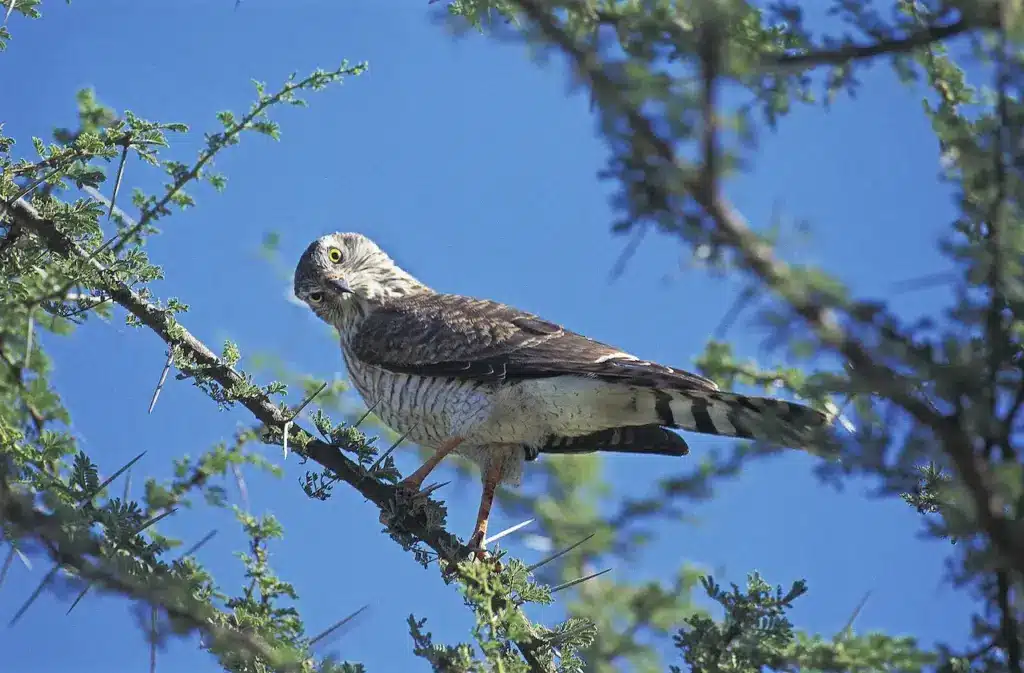
Description
It is a fairly small, stocky kestrel with a large, square head. It is 27-30 cm long with a wingspan of 61-68 cm and a weight of 167-246 grams. The female is about 4% larger and 10-20% heavier than the male.
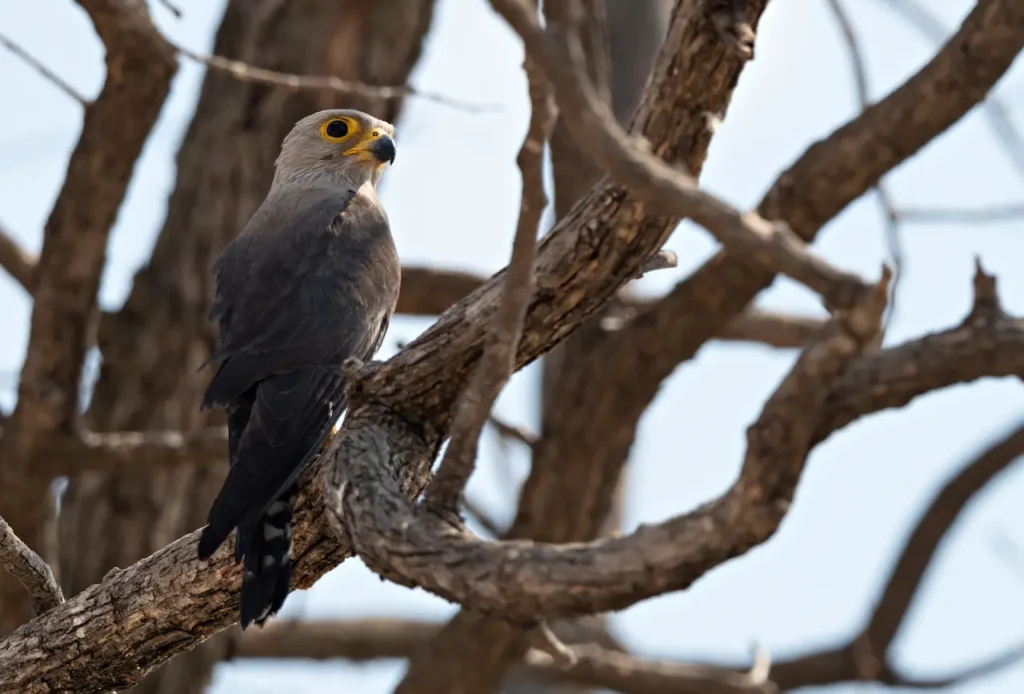
The plumage is mostly dark grey with a pale head and rump. The tail is grey with narrow black bars and a broad subterminal band. The underside of the flight feathers is also barred.
The cere (soft skin surrounding the nostrils) and feet are yellow, and there is bare yellow skin around the eye. The bill is dark grey, and the eyes are brown.
Juvenile birds are grey-brown with barred flanks and without the paler head and rump. They have a greenish cere and eye-ring.
Vocalizations
Dickinson’s Kestrels are relatively quiet for a predatory bird. It uses fewer vocalizations and fewer elaborate calls, relying instead on subtler communication. The alarm and contact call is high-pitched, but not loud or long-range. These calls are usually used in territorial disputes or to alert the nest when it is disturbed.
Both adults and chicks are more vocal during the breeding season. Adults can use mewing sounds to communicate and attract their young birds, particularly when they are delivering food. The calls are gentle and short, more functional than musical. This quieter behavior could offer some protection, as it reduces predator attention.
Its vocalizations are modest in general, reflecting the fact that it is a bird more commonly seen than heard.
Distribution and Habitat
Dickinson’s Kestrel range is extensive but patchy. It extends across southern and eastern Africa. The Dickinson’s Kestrel can be seen in the majority of Mozambique and Zimbabwe, Zambia, and Malawi. It is also found in northeastern South Africa, especially in and around Kruger National Park, northern Botswana and northeast Namibia, eastern Angola, a the southern parts of the Democratic Republic of the Congo. Kenya is also occasionally visited by this species, though less frequently.
The bird’s range is over 3.4 million square kilometers. Despite its size, it is still considered rare and localized. It is rare in some areas, but more common in others, like Zanzibar or the Pemba Islands. This variation is not only linked to geography but also to habitat quality and accessibility. According to BirdLife International, this species is well documented.
Dickinson’s Kestrels are closely linked to specific types of environments: open woodlands and savannas, which are often near water. It is attracted to swampy areas and floodplains, and it has a strong association with palm trees. These tall palms offer ideal nesting and resting areas, with elevated views of the surrounding terrain. They also provide protective hollows. Baobabs are important for nesting, in particular. In some places, the kestrel is adapted to altered landscapes such as coconut plantations, where tall trees are still available. According to eBird, this species is well documented.
Dickinson’s Kestrel, unlike many other raptors that can adapt to urban and mountainous environments with ease, avoids dense forest cover and high altitudes. It prefers to stay below 1,200m above sea level, and hunts in areas with trees interspersed amongst open ground. Its behavior is influenced by the presence of perches, since it prefers to hunt from perches rather than flying.
Behavior
It usually hunts from a perch and only occasionally hovers. Large insects such as grasshoppers form the bulk of the diet. It also feeds on lizards and amphibians and sometimes birds, bats, rodents, and snakes. It is often attracted to grass fires where it preys on fleeing insects and other prey.
Breeding and Nesting
Dickinson’s Kestrel’s breeding habits are closely aligned with seasonal cycles, but they can vary depending on where you live. In Tanzania, the breeding season typically lasts from July until October. In the south, such as in Zimbabwe and Mozambique (and elsewhere), the breeding season usually runs from September to December.
The nesting behavior of many birds is simple. Nests are not elaborate structures, but a simple scrape or shallow depression in the hollow of a baobab or dead palm. The kestrel can repurpose an older nest that was made by Hamerkops or other species. This shows an adaptability and ability to save money.
Nests are usually placed between 2 and 18 meters above ground level, providing both protection from predators as well as a commanding perspective of the surrounding area. The clutch is usually one to four cream-colored eggs with brown blotches or speckles. The male will provide food for the female during incubation. This lasts about 30 to 32 days.
The chicks will remain in the nest between 33 and 35 days after hatching before they leave. After leaving the nest, young birds may stay in the area for several weeks to learn how to hunt and improve their survival skills.
Conservation Status
Currently, Dickinson’s Kestrel has been classified as a species with Low Concern. This status reflects the species’ wide range and absence of dramatic population decreases throughout its distribution. This designation does not, however, mean that the species is safe from all threats.
The loss of habitat is a major conservation concern, especially the removal of palm trees that are essential for nesting and hunting. Palm trees are often cut down for firewood or agriculture in many places, which leaves kestrels with no tall trees to nest and hunt on.
Changes in fire regimes and overgrazing can also degrade the open wooded environments on which the kestrel relies. As woodlands and wetlands are fragmented and drained, the kestrel’s nesting and prey base decreases. Climate change is a longer-term threat that could alter the availability of nesting opportunities.
Conclusion
Dickinson’s Kestrel is not as well-known as Africa’s other raptors, such as the majestic Martial Eagle and the charismatic Secrecybird. But it has a significant role in the ecosystems that it lives in. It is a key predator of small mammals and reptiles in the savanna. Because it is dependent on floodplains, palm trees, and natural disturbances such as fire, the zebra serves as a barometer for habitat health. It also represents Africa’s diverse, but increasingly fragile, landscapes.
The kestrels’ understated beauty with their steel-grey feathers and white rumps reflects the discreet nature of their life. It does not need dramatic aerial displays or loud calls to survive. It relies on patience, keen eyesight, and a strong bond with its environment. The presence of this bird in a particular area indicates a healthy ecosystem, with intact forests, abundant insect life, and functioning ecological webs.
With that dependence comes vulnerability. Dickinson’s Kestrel is threatened by habitat destruction, climate change, and unsustainable land use practices. Even a small loss of palms, nesting trees, or wetlands can be enough to tip the balance in its favor.