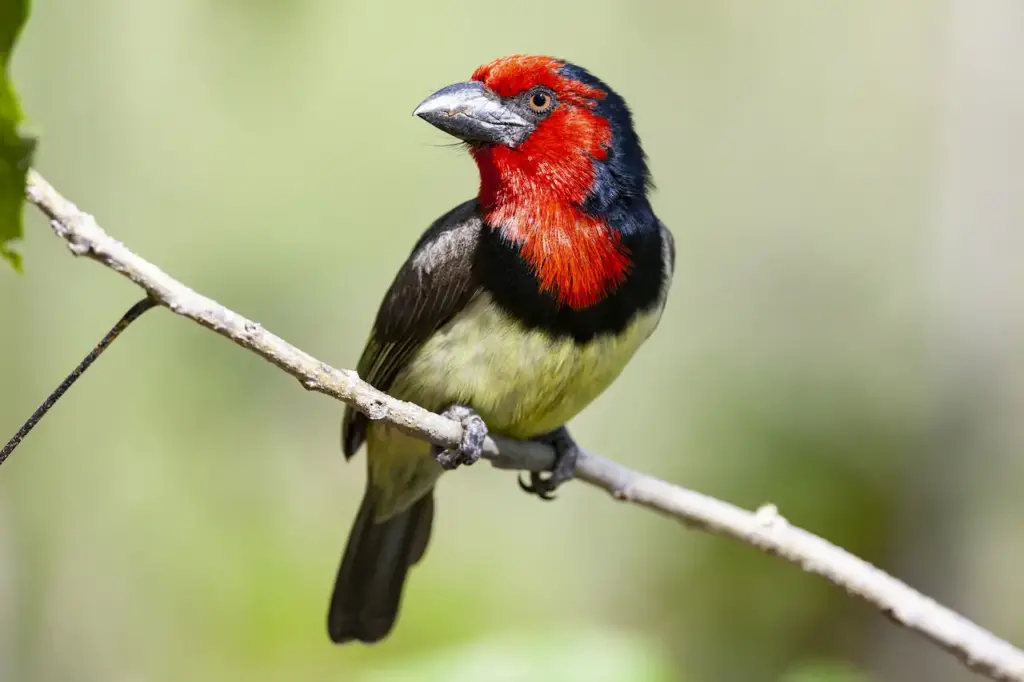
The Red-faced Barbets (Lybius rubrifacies) is an African Barbet that is found in Burundi, Rwanda, Tanzania, and Uganda. It inhabits dry savanna, moist savanna, and arable land.


This species is threatened by habitat loss.
Description
Red-faced Barbets are compact, plump birds that measure between 20 and 25 cm. The Red-faced Barbet has a large, proportionate head to its body. It also has a heavy bill with bristles. These bristles can help it to manage insects and fruit, or protect its facial skin when feeding in foliage.
As its name suggests, the most distinctive feature of this bird is the red colouration on the face, especially around the eye and mouth area. The red of the face stands out in contrast to the darker feathers that cover the rest of the head. The body plumage, including the back, wings and tail, is largely dark with some mottled or streaked patterning. The wings often have yellow streaks. The underparts may be paler, or even more muted in colour. However, they still have patches of dark colours mixed with the darker tones. Both sexes look similar: Sexual dimorphism, or differences between males and females, is minimal. The plumage does not tell you whether a bird is male or female.
The plumage of juveniles is usually less vibrant: it’s less clear, less clean and mottled. The maturation of adult colouration is a process that takes time and may involve several moults.
The Red-faced Barbet is a solid bird with a large chest, a rounded belly and strong legs. It’s not adapted to long flights, but it’s perfect for climbing and perching on branches. The large bill is distinctive: it can be used to tear and open fruit, catch insects with hard bodies, or even handle small vertebrates.
Habitat and Distribution
Red-faced Barbets are native to East Africa. The known range of the Red-faced Barbet includes Burundi. Rwanda, Tanzania and Uganda. It is found in a variety of landscapes, including fruiting trees and insect-rich foliage.
It is found in dry Savanna and moist Savanna. Agricultural land is also a habitat where it is present. This is farmland. It will tolerate some changes to landscapes as long as there are enough trees and fruit sources. Arable land with scattered hedgerows or trees, agroforestry zones or villages with gardens may serve as habitats for at least feeding and movement.
The species is distributed across many countries and may have different habitats. In some places, it’s a moist savanna, with dense tree cover, while in others, it’s a drier savanna, with more open grasses and thorny shrubs. When available, the species uses riverine strips or gallery forests to move around or feed.
Its elevation preferences have not been well documented. However, this species is found in lowland and low-mid altitudes. It does not prefer high alpine zones nor extremely wet montane forests. The presence of this species on arable land indicates that it is tolerant of human modification of habitat. However, its survival is heavily dependent on the preservation of fruit trees and tree cover in savanna/forest edges.
Breeding and Nesting
Red-faced Barbet breeding and nesting are well-documented, but many aspects are still understudied. Partially documented are the modes of nesting and egg numbers, as well as incubation periods, parental roles, and nesting modes. Less common are nest site fidelity, success rates, and fledging durations.
The nests of these birds are usually found in a ree cavity. It may be a natural cavity (hollow branches, dead limbs, or old trees) or it could have been excavated previously by birds or other animals. The cavity, once selected, provides shelter for the eggs and young and protects them from predators and weather. It is not known the depth, height and internal lining of cavities, nor their orientation. These details can vary depending on the local tree species.
In a single clutch, the female will lay between 2 and 4 eggs. The incubation period lasts between 13 and 15 days. During this time, both parents are involved in the care of the chicks. Both parents feed the chicks once they hatch. Early nestling is crucial for growth. The exact length of time until the young leave the nest or remain dependent is unknown.
The timing of breeding is often coordinated with the abundance of insects and fruits during or after the rains. It ensures parents and nestlings have enough food. Breeding timing may vary depending on the region. In areas with more consistent climates, seasons are less defined and may allow for some flexibility.
Nesting opportunities can be limited because cavity nests, by nature, are restricted by the availability and quality of trees. Trees are also often cut down for firewood or other purposes, such as farming. According to Audubon Society, this species is well documented.
Diet / Feeding Behaviour
Red-faced Barbets have a varied diet. Fruit is a major part of the diet. Figs are particularly important, although other wild fruits and vegetables are sometimes consumed. Fruit is eaten whole. Indigestible parts, like seed pits, can be regurgitated later or passed. Because barbets swallow fruit whole, they act as seed dispersers, carrying seeds away from parent plants and later depositing them through excretion or regurgitation–helping the regeneration of plants. According to eBird, this species is well documented.
These barbets also eat insects, and sometimes other animals. The range of insects is wide: locusts and beetles to ants, cicadas and dragonflies. The insects are not limited to trailing insects, but can also catch flying insects. Other non-insects include scorpions and centipedes. On occasion, geckos, lizards or frogs are also taken. The variety of food they eat allows them to be flexible, especially when fruit is scarce.
Birds tend to feed alone. Birds can forage in pairs or alone. Birds forage in trees and shrubs. They may fly out to catch insects that are moving, or hop through the foliage searching for prey. Fruit eating may lead them to gardens, plantations or the edges of forests. They do not fish nor are they water dependent. Instead, they feed on foliage and branches instead of in or over water.
When insects are at their peak or when fruits are in season, they may be more active. Seasonal changes affect the relative balance of animal prey and fruit. Fruit consumption is higher in many fruit-eating bird species when the fruit is ripe. In lean times, they rely more on insects and other prey. They can use cultivated fruits when wild fruit is scarce, but this may expose them to human threats (such as pesticides, disturbance, persecution).
They are more than just consumers; they help shape the environment by spreading fruit trees and other plant species.
Vocalizations
The Red-faced Barbet is known for its vocal behaviour. These barbets, unlike some quiet forest birds, use their calls to communicate with each other in a variety of social contexts, including territorial defence, pair communication and mate attraction. They may also coordinate during breeding.
The species has been known to sing duets. Duet singing is when male and female birds call in an antiphonal, or coordinated manner. This can be done to establish or defend territory. Each bird has its own role in the duet. Timing can also be crucial. These duets can also strengthen pair bonds.
The calls are loud enough or noticeable enough to be heard across the savanna or forest edges, or patches of trees. These calls may be harsh or sharp, consist of trills or repeated sequences. The literature is less specific about the frequency, pitch or structure of duets, but it does suggest a complex social structure.
During the breeding season, vocalisation can increase, as calls for courtship, alarm and nest defence are more frequent. Calls may be less frequent or intense outside of breeding season. However, pair communication, territorial maintenance, and roost calls will likely continue.
Conservation
IUCN has classified the Red-faced Barbet as Near-Threatened. This designation is a reflection of the concern over its declining population, small range and habitat loss. Because the bird is dependent on fruit-bearing trees, tree cavities and sufficient insect prey, as well as intact savannas or edge forests, anything that threatens these elements can be dangerous.
The greatest threat is the loss of habitat. The conversion of dry and moist savanna landscapes for farming, grazing and firewood is a major threat. Trees are cut, forest edges are reduced, fruit-trees and wild figs are removed, and old trees and branches are lost (important for cavity formation). Contributing factors include agricultural expansion (particularly converting savannas or bushlands into crop fields), the collection of charcoal or wood, and possible bushfires. In some areas, pesticides may reduce insect prey. The fragmentation of habitat, such as the division of a savanna by roads or settlements or agricultural areas, makes it difficult for birds to migrate between feeding and nesting sites. It also reduces genetic transfer and limits the availability of good territory.
Conclusion
Red-faced Barbets are a stunning example of beauty and ecological significance. It combines fruit-eating and insect-hunting; it nests inside cavities, defends its territory using song and duets; and it navigates landscapes that are both wild and farmed. Its red bill, large face, fruiting trees and duet call make it stand out. However, its habitat requirements and threats make it vulnerable.
Despite its classification as Near Threatened, the Red-faced Barbet survives in areas with favourable habitatparticularly those that have effective protection for woodland patches, savannas, and fruit trees. The fact that it is found in multiple countries provides hope for cooperative conservation. Although it is not a bird that is abundant globally, its ecological role and rich diet make it a key player in the ecosystems. Its loss would be a major blow to the biodiversity of the East African savanna.
The barbet is a reminder that the trees, fruits, insects and birds at the edge of fields are important. People often alter the land cover by removing the fruit trees, dead branches, insects and hollows. By protecting birds such as the Red-faced Barbet, we are also protecting ecosystems’ ability to regenerate and support life.
Species Research by Sibylle Johnson
Please Note: The articles or images on this page are the sole property of the authors or photographers. Please contact them directly with respect to any copyright or licensing questions. Thank you.