The Great Thick-knees (Esacus recurvirostris) is a very large wader that is a resident breeder in tropical southern Asia from India and Sri Lanka into Southeast Asia.


This is a species of gravel banks along rivers or near lakes, and also on beaches. A single egg is laid in a bare scrape on the open shingle.
It is mainly nocturnal or crepuscular (active during the twilight) like other stone curlews, but can frequently be seen foraging by daylight, moving slowly and deliberately, with occasional short runs.
It tends to be wary and fly off into the distance ahead of the observer, employing powerful, rather stiff wingbeats.
Physical Description
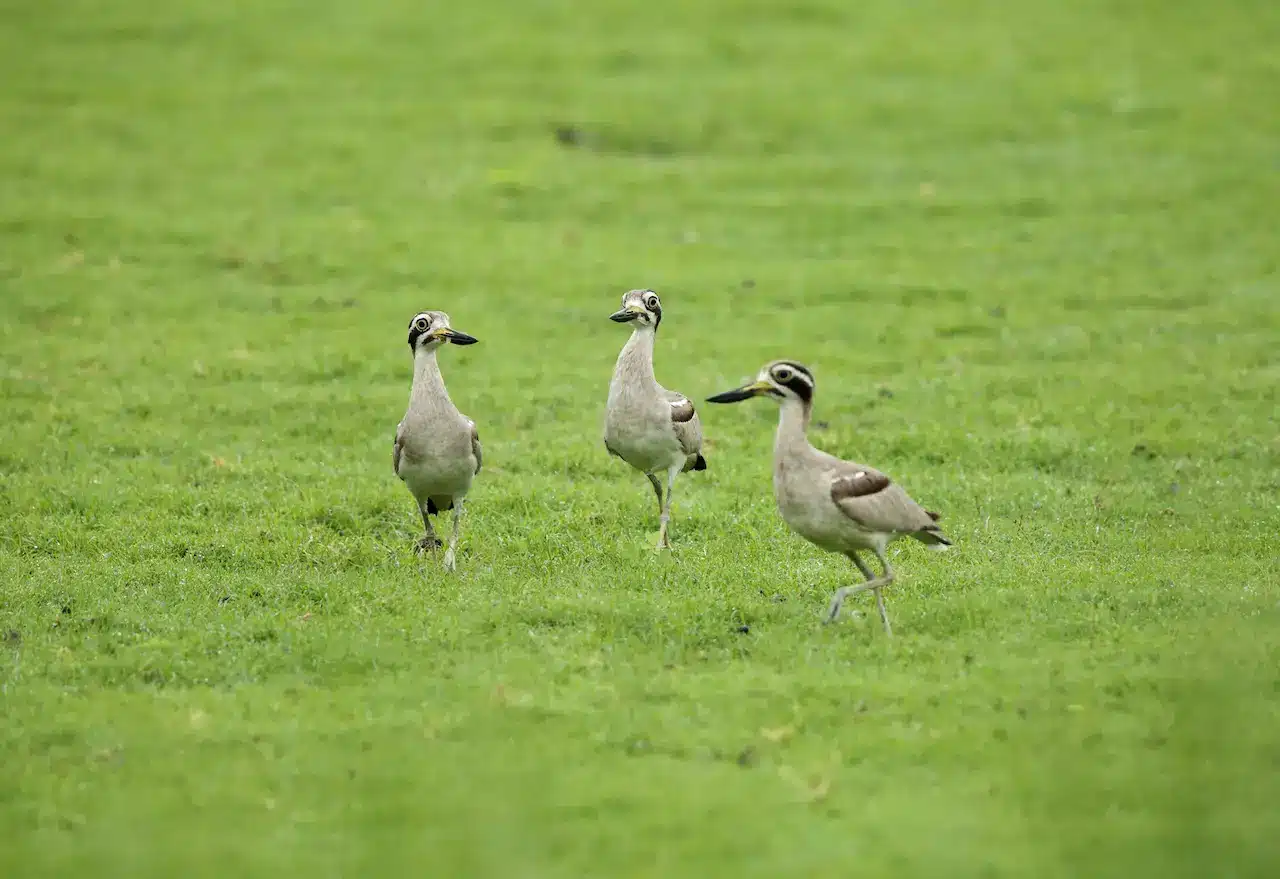
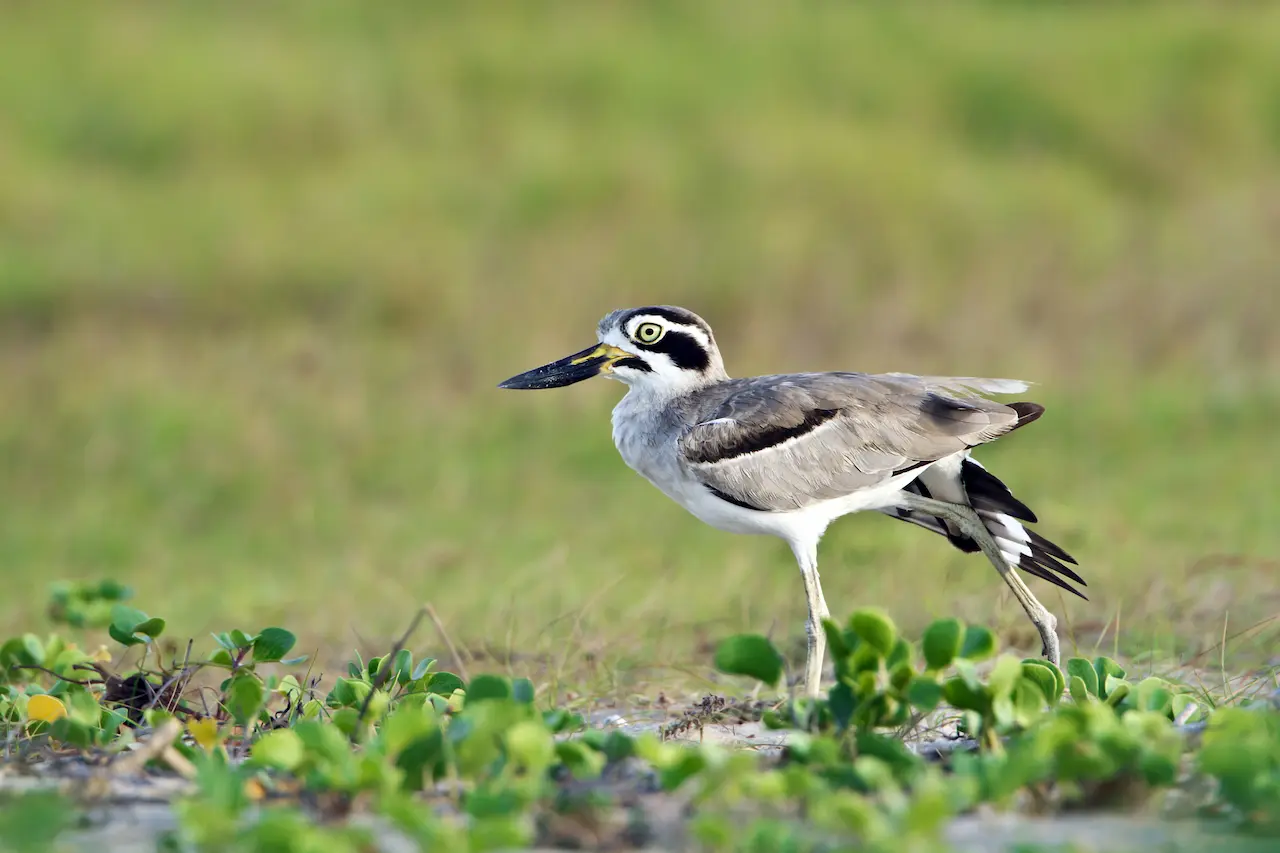
The Great Thick-knees is a very large wader at 49–55 cm, and has a massive 7 cm upturned bill.
It has unstreaked grey-brown upperparts and breast, with the rest of the underparts whitish. The face has a striking black and white pattern, and the bill is black with a yellow base. The eyes are bright yellow, and the legs are duller greenish-yellow.
In flight, the Great Thick-knees show black and white flight feathers on the upper wing, and a mainly white underwing. Males and females look alike, but young birds are slightly paler than adults.
Habitat and Distribution
The Great Thick Knee breeds in southern Asia. Its range includes India, Pakistan, Sri Lanka, Bangladesh, Myanmar, Thailand and Southeast Asia. It is closely associated with water-associated habitats in this range, though not necessarily vegetated marshes. Instead, it prefers open, rocky or sandy banks along rivers, lakes and beaches, as well as sometimes even beaches.
The habitats that it prefers include gravel or pebbles (riverine shales), sandy or pebbly beaches of lakes, slow-flowing river shores, and sometimes open beaches. These substrates offer both camouflage as well as feeding opportunities. These sites should also have enough open space and minimal vegetation to allow the bird to see approaching threats and provide shade or cover during the day.
Although it makes local movements, the Great Thick Knee is mostly resident and not migratory. These birds may be forced to move e higher banks during seasonal changes in river and lake levels, particularly when there is flooding or monsoon. Young birds can establish themselves in new areas within their general range. However, there is no evidence of long-distance broad migration.
In India, breeding occurs between February and July. In Pakistan, it is from March to June. And in Sri Lanka, it’s primarily from April to July. These dates correspond to seasonal variations in the availability of water and substrate. This species is rare throughout its range. In many places, its population is patchy and depends on the availability of gravel-bank nesting areas and relatively unaltered riverine edges.
Breeding and Nesting
The Great Thick Knee’s breeding behaviour is simple, but it has been adapted to the environment. When nesting time comes, the bird will seek out shingle or sand banks near rivers or lakes. Nests are not elaborate structures in the sense that they use elaborate materials. Instead, the nest is just a scrape on the ground, a depression between stones, gravel or shingle.
The clutch size is small. Typically, only 1 egg will be laid in a scrape of this size. To reduce predator detection, the egg is camouflaged to blend in with the texture and colour of the shingle. Many stone-curlew/thick-knees species share the incubation duty. For this species, there is evidence of both parents being involved. According to Audubon Society, this species is well documented.
Breeding occurs during the dry season, which is usually in spring or summer. This allows for more stable nesting material and lower water levels. The chicks become precocial after hatching. This means that they are mobile and relatively mature soon after birth. After hatching, they leave the nest scrapes but remain under parental care for a few weeks while they gain strength and learn how to forage. According to RSPB, this species is well documented.
Each breeding attempt is highly responsible due to the low number of eggs (one). Nest failures caused by predation or flooding can have a large impact on local populations. Because of the rarity, successful reproduction is required over several years to maintain a stable population.
Food and Diet
The diet of the Great Thick Knee is a reflection of its habitat specialisation. It feeds on animal prey such as large insects and crabs. Other small prey are also taken near the water’s edge. Its long, powerful bill allows it to dig or probe among substrate, such as stones, mud or debris, to uncover prey. Insects include beetles and other hard-bodied forms, or flightless ones. Crabs are also important along riverbanks or in coastal areas when they are accessible or exposed.
The feeding activity is highest during the twilight hours (dawn or dusk) and at night. This reduces predators as well as competition. The Great Thick Knee is primarily nocturnal, but can also be observed foraging during daylight hours, particularly in areas of the riverbank that are quiet and free from human disturbance. It moves slowly and deliberately, making frequent pauses. Sometimes it makes short runs. It picks prey by sight, using its bill occasionally to probe gravel or mud. It is cautious; if disturbed, it will fly off with strong, rigid wingbeats, rather than ducking close.
The health of the ecosystem in which the bird feeds directly correlates with its success.
Vocalization
The Great Thick Knees do not remain silent. Their haunting calls, which are often described as whistles or wailing, are mostly heard at night and during twilight. The vocalisations are likely used in several ways, including to maintain territory, communicate between mates, alert young, or signal distress. During the breeding season, the nights are quieter, except for the sounds of the thick-knees. These sound waves travel along riverbanks and give the impression of the bird’s presence, even if it is hidden.
They are more active at low light levels, so their calls can be heard more than other birds. The tone of the call is often evocative and has a plaintive quality. It’s also loud for a bird its size.
Conservation
On the IUCN Red List, it is classified as Near Endangered. Globally, its population is believed to be decreasing. Surveys in India indicate that the species is rare and declining. A global population estimate ranges from 1,000 birds to 25,000 individuals. However, there is substantial uncertainty. The trend is down. The most significant threat is habitat loss, particularly degradation of riverine or lakeshore habitats.
The Great Thick-knee is threatened by human activities such as dam and barrage construction that alter river flows, destroy gravel banks, and pollute rivers and lakes. Other threats include disturbances (people walking or boating), unsustainable sand and gravel extraction, and conversion of lakeshores and riverbanks to agriculture or other land use. High water levels or flooding during the season can cause eggs and chicks to be destroyed.
Due to its dependence on certain substrates (gravels, pebbles, and open banks), any change in the availability of those surfaces can reduce breeding chances. In certain parts of the range, this species could face local extinction – for example, in Southeast Asia, where rapid river cutting and development are occurring.
Conclusion
The Great Thick Knee is an amazing species. It’s large, mysterious, powerful and haunting. It lives at the junction of land and water, on gravel, shingle and riverbanks, and along lakeshores. These are places that are often overlooked in conservation discussions, but are vital for many species. It is active between dawn and dusk, moving from the shade to the sun by day and then becoming more vocal and alive as night approaches.
The life history of this species is a combination of specialisation and fragility. Its prospects are uncertain because it only lays one egg in many populations. The species is found in many places, including some that are surprisingly inhospitable or remote. This is a testament to the species’ adaptability and resilience.
Conservationists consider the Great Thick-knee an indicator species. Its presence or absence can tell us about river health, floods and flows. It is important to protect the shores, the water quality, the river ecology and the traditional ways that people interact with rivers.
Copyright: Wikipedia. This article is licensed under the GNU Free Documentation License. It uses material from Wikipedia.org … Additional information and photos added by Avianweb.
Please note: The articles or images on this page are the sole property of the authors or photographers. Please contact them directly with respect to any copyright or licensing questions. Thank you.