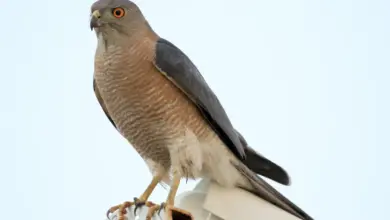
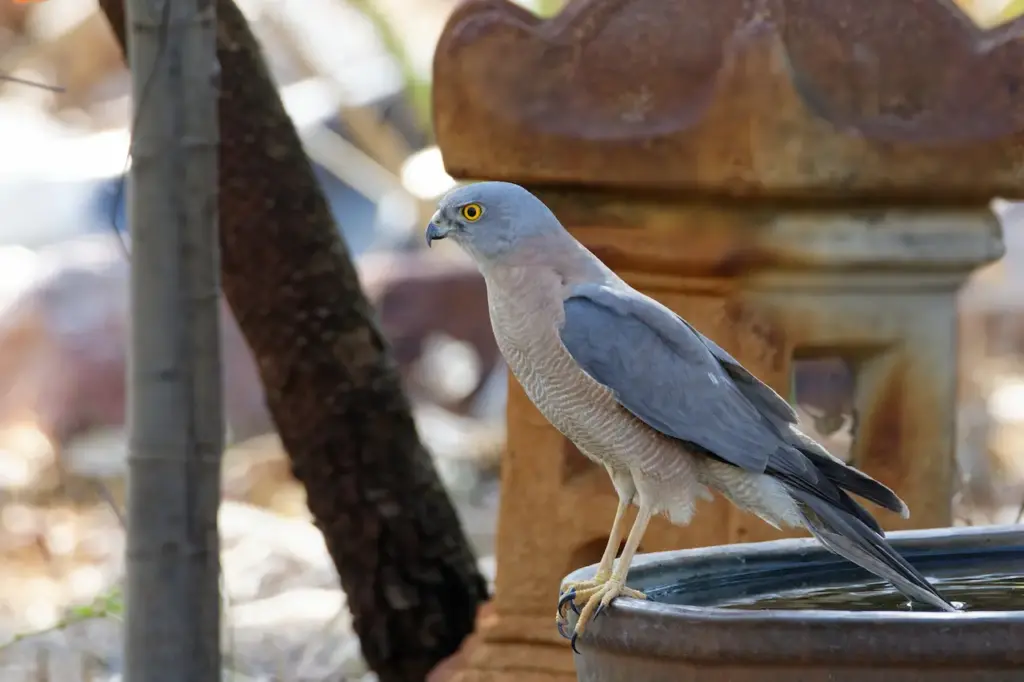
The Collared Sparrowhawks (Accipiter microcephalus) is a small and slender bird of prey that is widespread throughout Australia and New Guinea except for sandy deserts. It inhabits forests and woodlands.
Description
The body length is 30–40 cm (11.8–15.7 in) and the wingspan is 55–80 cm (21.7–31.5 in).
Females, which weigh 240 g (8 oz) as adults, are noticeably larger than males, which weigh 125 g (4 oz).


The upper plumage is grey with a chestnut collar; the underparts are mainly rufous, finely barred with white.
It is similar to the Brown Goshawk but smaller.
Habitat and Distribution
Collared Sparrowhawks are widespread in Australia, New Guinea and many smaller islands. The Collared Sparrowhawk is a resident species throughout its range. However, some areas can show local or partial movements, such as juveniles dispersing or individuals moving to respond to changes in food or habitat. Large-scale migration, however, is unknown. It is absent in very arid areas, such as sand deserts that lack enough cover or prey.
Its habitats vary, but they always contain woods or forest components. It can be found in dense forests, woodland edges, urban areas, suburban areas, and even places where there is still good tree cover. The species is also found in disturbed open forests, shrubs and tall trees, as well as plantations most important habitat characteristics include cover for hunting (perches in foliage), nesting sites (trees large enough to accommodate the nesting birds), and availability of prey – small birds.
It is found in Australia’s temperate and tropical zones. This includes coastal forests, inland woodlands, and upland areas. It inhabits the same forest types in New Guinea. The elevation ranges are different, but they tend to be lower-mid-elevation forests. Habitat loss is a major factor in local presence because it avoids deserts, open treeless areas, and habitats that are completely devoid of trees.
It is widespread and not uncommon in general, but its density is not uniform. In tropical or forested areas, the species is more prevalent. However, in landscapes that have been heavily cleared or altered, they may only be found at low densities or near large trees or remnant vegetation. The species’ secretive nature, which often involves hunting and resting from hidden perches, as it is a solitary bird, may also mean that some areas are under-recorded.
Breeding and Nesting
In Australia and New Guinea, there are a few places where the breeding behaviour of the Collared Sparrowhawk is documented, but not everywhere.
Nests are made in trees. Nests are usually made of twigs and sticks, placed on a branch or fork high in the foliage. They’re well hidden by leaves or the anopy. Nests are often lined with green or fresh leaves to add insulation or moisture. During this period, the female is responsible for most of the incubation while the male provides food.
Usually, clutches are between three and four eggs in size. However, occasionally it has been reported that clutches can be as large as five eggs. The eggs are usually white, but may have brownish spots or blotches. The incubation period is approximately 35 days. After hatching, chicks stay in the nest between 24-33 days. After fledging, young birds are dependent on their parents to feed them and teach them how to hunt for another period of time, often up to six weeks. During this time, parents protect their young; the female is responsible for brooding the young, especially in adverse weather conditions (heat or cold) during the first week.
In Australia, the timing of breeding depends on the region. For example, in many areas of Australia, breeding occurs during spring and summer (roughly between September and February), when conditions are more favourable. In New Guinea, the timing of breeding may change to coincide with the rainy season or when there are more small birds.
The Sparrowhawk’s size makes it difficult to raise chicks. Weather, feeding losses, and predation can all reduce the success of reproduction. Nest failure can be caused by disturbances, such as trees being felled, humans intruding, or predation. In many areas, the availability of nesting sites with good cover (large trees) is a major factor.
Food and Feeding Behaviour
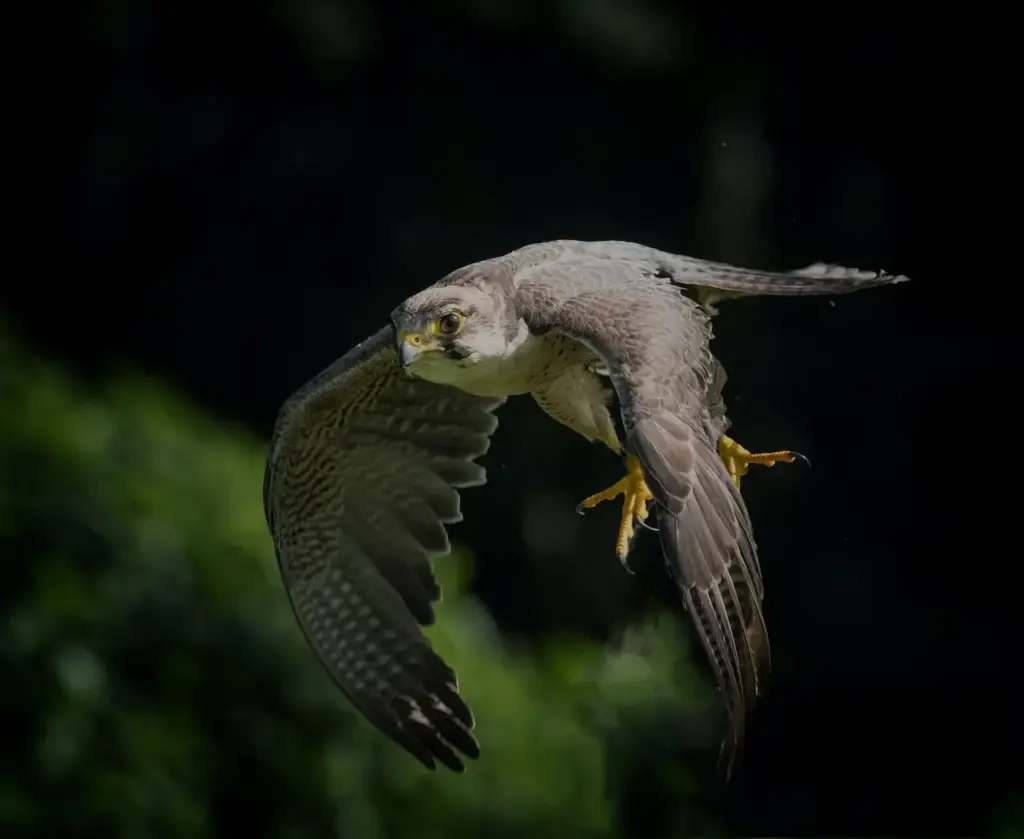
Collared Sparrowhawks are experts at hunting small birds. They make up the majority of their diet. It captures prey using stealth, surprise and agility. Its hunting strategy is to rest or hide in dense foliage and watch for passing small birds. It will often fly quickly, darting between the trees or gliding down to catch birds as they are flying. Its structural adaptations, such as its long middle toe and strong talons, allow it to grasp prey securely. According to BirdLife International, this species is well documented.
Sparrowhawks will also eat insects, especially larger ones, lizards and sometimes even small mammals, depending on the availability of prey. Birds are the main prey of this species, particularly passerines and smaller arboreal species. According to Audubon Society, this species is well documented.
The hawk hunts mainly during daylight hours, peaking at dawn and dusk, when prey is more visible or small birds are most active. It may also take advantage of bird roosts, approaching at low light to catch prey unaware.
Sparrowhawks will often use edge habitats and fragmented woods in suburban areas, where prey is plentiful. They can hunt without being noticed until they hear the startled sound of small birds or see the flash of their wings.
Sparrowhawks’ ability to feed depends on three factors: the density of prey, their cover (which provides hiding and surprise), and minimal disturbance by humans. The loss of undergrowth and foliage can reduce cover, reducing hunting opportunities.
Vocalizations
The Collared Sparrowhawk does not make as much noise as other songbirds, but it still uses vocal signals, particularly during times of breeding, territorial interaction, and disturbance.
Reports include a rapid “keek,keekkeek”, almost trilled sound. This is often used to indicate contact on oran alaran m. A softer “wit-wit”, which is used for less urgent communication, can also be heard. Sparrowhawks are usually silent when hunting or ambushed and rely on stealth. During other times, such as during nest defence or display, or when the adults are bringing food to the nestlings, they become louder and more aggressive.
The calls of young birds at the nest are often loud, but their specific description is less clear. Body posture, display or chase flights, combined with calls, help pair bonding and territorial defence.
Hearing its call is the most reliable way to find it in densely vegetated or forest areas.
Conservation Status and Threats
IUCN has classified the Collared Sparrowhawk as Less Concern due to its widespread distribution, ability to survive in semi-modified habitats and a wide range of forested and wooded habitats. But that doesn’t mean the bird isn’t at risk.
One major threat is habitat destruction–clearance of forest and woodland for agriculture, urban expansion, logging, or other land uses reduces both hunting zones and nesting sites. The fragmentation of habitats (breaking up continuous woods into patches) can make movement, prey capture, and genetic exchange more difficult.
Pesticides and other environmental contaminants can also be harmful. Birds of prey are prone to accumulating toxins that travel up the food chain, reducing reproductive success or causing direct death. Although not as extensively studied as some raptors, such as the eagle owl (e.g. Sparrowhawks, which feed heavily on insects and fish, are at risk of contamination if they live near agricultural land.
Conclusion
The Collared Sparrowhawk shows how adaptability and specialisation are balanced. It is most successful in woodlands or forests where it can hunt stealthily. However, the Collared Sparrowhawk has proven that it can survive near human settlements as long as there are suitable perches and nesting areas. Although it is small in comparison to other raptors, its agility, speed and hunting skills make it a formidable predator.
The life of this small but persistent animal, which is silent in ambush and loud in alarm when threatened, speaks to an ecological niche that hunters fill. It is not endangered globally, but local populations may decline; chemical threats, disturbances, and habitat changes could reduce its resilience.
The Collared Sparrowhawk, a bird that is popular with birdwatchers, can be rewarding both when it’s present and absent: its absence signals a change in forest cover, prey base, or human impact. It is an indicator of the quality of the habitat and ecological balance where it persists.
Beauty Of Birds strives to maintain accurate and up-to-date information; however, mistakes do happen. If you would like to correct or update any of the information, please contact us. THANK YOU!!!