The Cocos Buff-banded Rails, Gallirallus philippensis andrewsi, is an endangered subspecies of the Buff-banded Rail endemic to the Cocos (Keeling) Islands, an Australian Offshore Territory in the central-eastern Indian Ocean. The local Cocos Malay name of the bird is Ayam Hutan (“Chicken of the Forest”).
Description
The Cocos Buff Banded Rail is a subspecies of Buff-banded Rail, which belongs to the rail family Rallidae. It retains a lot of the rail’s general form, including a compact, somewhat robust body, short, wingless wings that are adapted to limited flight and strong legs for walking through undergrowth, vegetation and leaf litter.

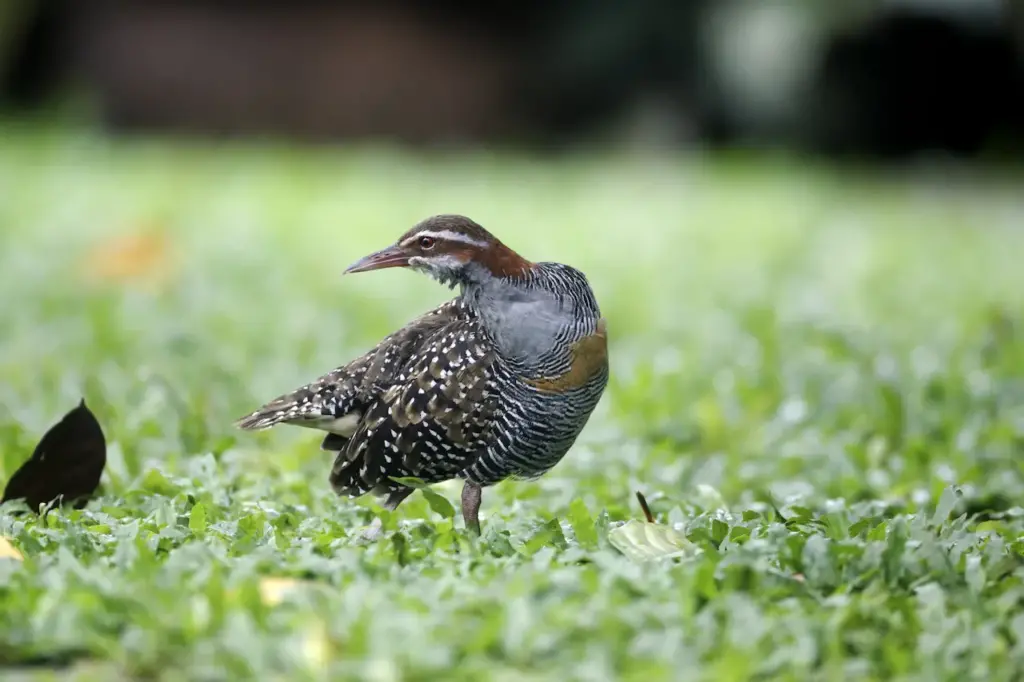
The plumage of this bird is highly patterned and cryptic, making it ideal for hiding in dense vegetation. The upper parts of the bird are usually dark brown to medium brown with subtle shading and variations that blur out outlines in shadows and undergrowth. Underparts are patterned with a combination of chestnut, buff and dark shades, giving it a mottled appearance. This patterning makes it difficult to see the rail, even when close, unless you move.
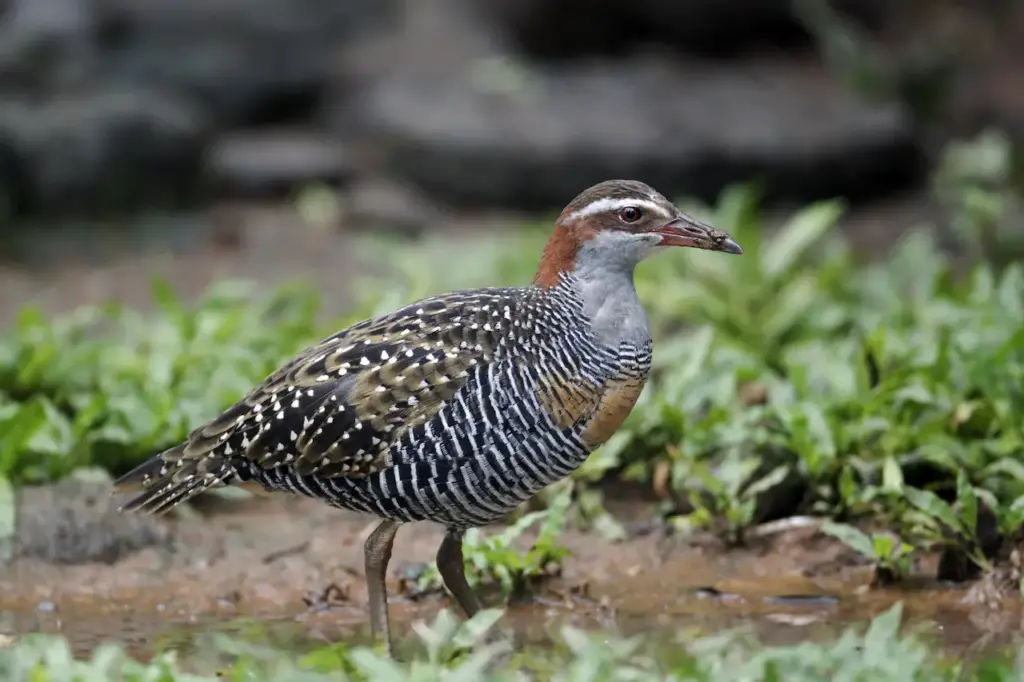
The beak of a rail is a moderately long, thick, and suited for probing soil, leaf litter and substrates that are shallow along the lagoon edges. Legs and feet are strong and well-suited to walking on uneven vegetation and near shallow water. The eyes are usually dark and alert. This is indicative of a bird that is constantly watching for danger or opportunities. The juveniles are duller with less contrast between patterns, softer plumage and less distinct bars until they reach maturity.
Distribution and Habitat
This bird is now effectively limited to the 1.2 km² North Keeling Island. It is still occasionally reported from the 26 islands comprising the Southern Atoll of the Cocos (Keeling) Islands, where it was once common, but recent surveys have failed to find it. It is extinct throughout the Southern Atoll apart from occasional visits by birds dispersing from North Keeling, which are unable to establish viable populations.
On North Keeling the Rails occupy all the limited ground habitats on the island, including the shore of the lagoon and the understorey vegetation of Pisonia forest and Coconut palms. Population size is estimated as 850-1000 birds, with a population density of 7-8 birds/ha
Food and Diet
The Cocos Buff Banded Rail is an omnivorous generalist with a diet that reflects the opportunistic eating habits necessary for survival on a tropical island. It mainly forages on the ground. It moves through the forest and along the lagoon edges to find food.
Invertebrates, such as insects and worms, crustaceans, and molluscs, are a large part of its diet, particularly along the intertidal zone of the central laguna. Rails are often seen digging in the soil or turning over debris and leaves to find hidden prey. The rail also eats fruits, seeds, fallen berries and seabird scraps.
Rails have been seen scavenging the waste of seabird colonies. They are known to take advantage of any protein source, including eggs, carrion and organic debris. Its methodical foraging is deliberate and slow, moving quietly and slowly as it searches forest floors or lagoon edges. According to Audubon Society, this species is well documented.
The rail’s diet flexibility is an important advantage for the environment. Rails can adapt to seasonal and environmental changes by shifting their focus on food. According to eBird, this species is well documented.
Vocal Behavior
The Cocos Buff Banded Rail, despite being shy and elusive, is known to use a variety of sounds. The majority of vocalisations are subtle and low-pitched, which is why they often go unnoticed. Rails use calls to communicate with their mates and young, especially in dense undergrowth.
During the breeding season, vocal behaviour is likely to increase, with calls being used for territorial or mating reasons. Alarm calls can also be used when the bird becomes startled. These are usually a sharp, short squeak or a rasping note to warn others or scare off intruders. The rail may adapt its calls to be louder than the squawking noddies and terns that are often heard in the vicinity of seabird colonies.
Conservation
The probable causes of extinction on the islands of the Southern Atoll are habitat clearance and predation by introduced mammals, including feral cats, Black Rats, and humans, as well as competition with feral junglefowl. Threats to the only remaining breeding population on North Keeling are the introduced Yellow Crazy Ant, the possibility of accidental introduction of terrestrial predators, and the impact of cyclones and tsunamis. North Keeling is entirely contained within the Pulu Keeling National Park, but the island is so small that reintroduction of the Rail to one or more of the southern islands, after habitat preparation, is envisaged as a precautionary measure. The Cocos Buff-banded Rail is classified as Endangered under Australia’s Environment Protection and Biodiversity Conservation Act 1999.
As the only bird taxon endemic to the Territory, the Cocos Buff-banded Rail has featured frequently on postage stamps issued by the Australian Government for the Cocos (Keeling) Islands.
Conclusion
The Cocos Buff Banded Rail’s story is one of hope, resilience and isolation. This rail is a shining light in a world of island species that are threatened with extinction by human activity and environmental disturbance. It is confined to a small island in the Indian Ocean. It has adapted to the environment, coexisted with seabird colonies and survived threats that would have wiped its counterparts out elsewhere.
Survival is not assured. The delicate balance of North Keeling can easily be tipped in the wrong direction without constant vigilance. For this subspecies to have a long-term chance of survival, it is essential that conservation efforts continue, prey exclusion continues, habitat preservation and island introductions continue.
The Cocos Buff Banded Rail, more than an endangered bird, i a symbol of Australia’s offshore biodiversity. It is important to protect it because not only will you ensure the survival of this unique lineage, but also the health of the entire island ecosystem. The rail’s quiet calls and rapid movements under the trees remind us of the fragility and beauty of life on the edge.
Copyright: Wikipedia. This article is licensed under the GNU Free Documentation License. It uses material from Wikipedia.org)
Please Note: The articles or images on this page are the sole property of the authors or photographers. Please contact them directly concerning any copyright or licensing questions. Thank you