
Black-and-yellow Silky-flycatchers
Black-and-yellow Silky-flycatchers (Phainoptila melanoxantha)

The Black-and-yellow Silky-flycatchers (Phainoptila melanoxantha) occur naturally in Central America.
Like the other members of its Phainopeplas family, these birds can imitate the calls of twelve other species, including the calls of the Red-tailed Hawk (Buteo lineatus) and the Northern Flicker (Colaptes auratus).
Description
Black-and Yellow Silky Flycatchers are small to medium-sized silky flycatchers. They have a plump body with round wings and a tail with a moderately long, squared or slightly rounded tip. Their legs are good for perching, but not great for long jumps. The overall size of the Black-and-Yellow Silky Flycatcher is between 20 to 21.9 centimeters. The average adult weighs between 55-60 grams. The juveniles are similar to adults but have a more muted coloration.


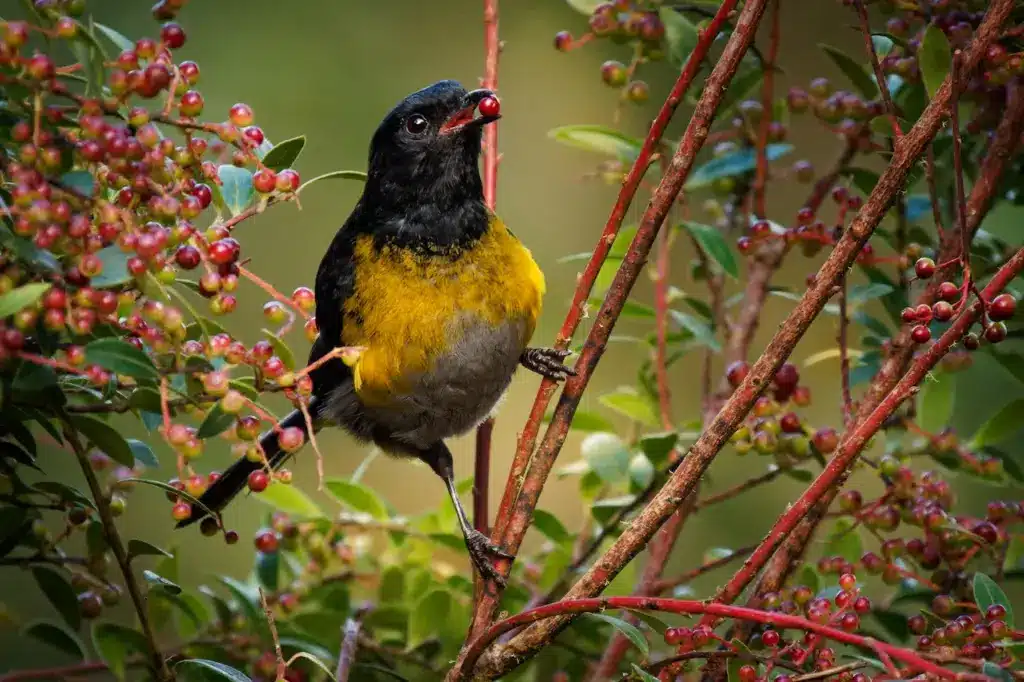
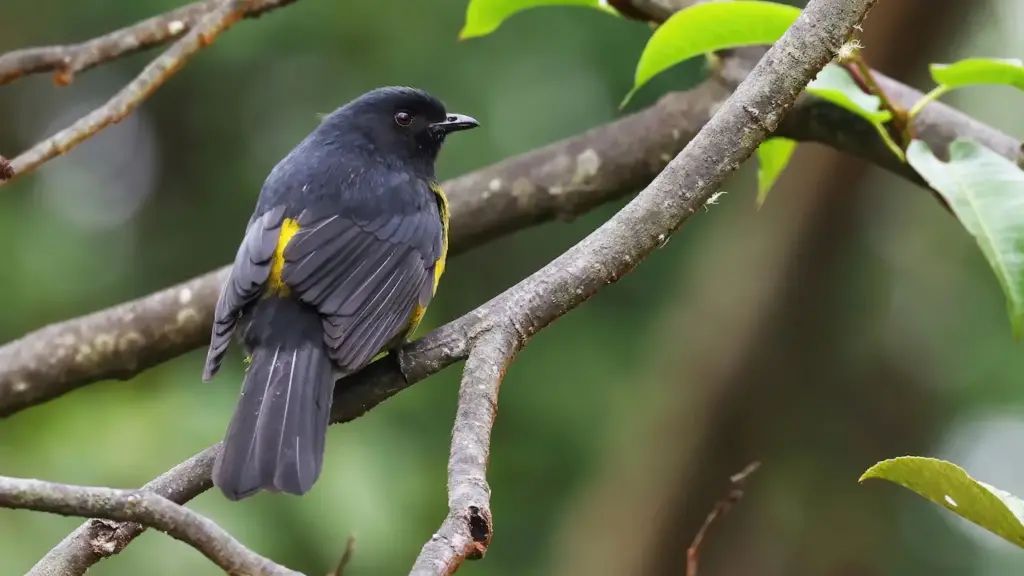
The sexual dimorphism is moderate but still evident. The male is a striking contrast. Its back, head, and wings are all mostly black. This creates a velvety, deep, dark background against which its brighter plumage stands out. The flanks and rump are a vibrant yellow. The breast has an olive tint, which transitions to a gray belly. The females are softer in tone: olive green on the upper parts and yellow flanks. However, the head cap and neck are more subdued, with greys mixed throughout. The juveniles have duller colors. They are similar to females, but the greys and yellows tend to be less prominent.
Habitat and Distribution
The Black-and Yellow Silky Flycatcher is a mountainous bird. The Black-and-Yellow Silky Flycatcher is a mountain bird. It can be found in the mountains of Costa Rica and in western Panama. The elevation range of this species is usually between 1,800 m and the timberline, which is often around 3,000 m. In Costa Rica, the species is often found in humid, forested mountainous areas with dense undergrowth, epiphytes, ferns, and thick shrub layers. It also uses second-growth forest, forest edges, and garden habitats adjacent to these high forests–particularly after the breeding season when birds may descend to slightly lower elevations in search of food.
Populations are patchy within their range due to the patchy habitat. Cloud forests are fragmented naturally by terrain (mountains, ridges, and valleys), but they’re also threatened by human conversion. In areas with intact forests and little disturbance, the Black-and Yellow Silky Flycatcher is more common. It may not be present in areas where the forest has been fragmented or cleared.
The distribution of the bird is affected by elevation because climate and microclimates (humidity, ty temperature rainfall) are crucial for cloud forest structure. In certain mountain ranges, the bird is rarer below 2,400 meters. Some wandering may occur during the non-breeding season.
The species has a resident (non-migratory), non-migratory behavior in its range. It does not migrate long distances. However, it may make local altitudinal shifts (seasonal changes up or down the slopes in response to climate or food conditions).
Diet
They mostly feed on berries, small insects, fruits, and vegetables.
Like the other members of its family, they have a specialized mechanism in their gizzard that shucks berry skins off the fruit and packs the skins separately from the rest of the fruit into the intestines for more efficient digestion. No other bird family is known to be able to do that.
Breeding
The breeding behavior of the Black-and Yellow Silky Flycatcher has been observed, but is still incompletely documented. Costa Rica’s main breeding season occurs around May and April. Timing may vary depending on local climate and elevation.
The pair builds the nest (male and female working together). The nest is usually a compact, bulky cup made of fern fronds and thin stems. Sometimes, it’s lined with soft materials. Nests are usually placed in a shrub or sapling, between 1.5 and 4 meters high. They provide cover and protection by being placed in dense vegetation.
The clutch size is small. Usually, only two eggs are laid. The eggs are a pale or greyish white with spots or streaks, which help them blend into the nest environment. Both parents share incubation. Incubation lasts about 15 days. According to BirdLife International, this species is well documented.
Both parents care for the nestlings once they are hatched. The young are raised in the nest for around 19 days before they leave. The young are still dependent on their parents for a while after they have fledged. They need to learn how to navigate and find insects and fruit. According to RSPB, this species is well documented.
The dense foliage surrounding the nest is a good way to hide the nest from predators. Nest material and location are affected by high humidity, moss, and forest structure.
Vocal Behavior
The Black-and Yellow Silky Flycatcher is a relatively quiet bird compared to other songbirds. The Black-and-Yellow Silky Flycatcher is not well known for its long and elaborate songs. Its calls are usually short, thin, high notes. Observers have reported calls such as “tsit” and “tseep”, which are small, delicate sounds. This belies its robust appearance when perched.
The bird’s voice is heard much more often than it is seen. This is because the bird forages in a quiet manner and is usually still when feeding on fruiting trees. You can often hear it calling in the mid-story or lower canopy foliage.
Birds can also make soft chattering calls or whispers in pairs or small groups, especially outside of breeding season. While some literature on the Silky-Flycatcher family mentions that mimicry occurs in related species, there is no evidence to support this claim. There is no evidence that this species imitates the calls of other bird species. While some literature on the silky-flycatcher family mentions mimicry in related species, there are no references to Phainoptila melanoxantha performing mimicry (e.g). This is not supported by authoritative field guides or peer-reviewed observations.
The vocal activity of birds is usually greater at dawn and dusk, when they are active during feeding times and moving between feeding sites and roosting areas. Calls are often simple and repetitive. They do not consist of long, complex song sequences.
Conservation
IUCN has classified the Black-and Yellow Silky Flycatcher as Less Concern. This means that, despite its limited range, it is not believed to be declining at a rate high enough to warrant higher concern. The species is found in high-elevation forests in Costa Rica and western Panama. These forests are well preserved, especially in national parks and protected reserves.
The species is sensitive to environmental change because it lives in a mountainous area and relies on cloud forest habitat. Habitat loss and fragmentation are threats: deforestation, both legal and illegal, expansion of human settlements, infrastructure (roads and tourism), and deforestation to support agriculture threaten forest cover, degrade epiphyte loads, and reduce understory microhabitat. Fruiting trees and epiphytic plants are important to the diet of this species.
Climate change is another concern. Cloud forest ecosystems rely on stable temperatures and humidity regimes. Cloud base changes, increased drying, or shifts to rainfall patterns can reduce habitat quality and epiphyte coverage, as well as reduce fruit production. The birds may be forced to move higher in the habitat or have a smaller area.
Conclusion
The Black-and Yellow Silky-Flycatcher is an enigmatic songbird that lives in the mist and solitude of the mountains. The striking colors of the male, black, yellow, and olive, as well as a female with a more gentle palette, along with its modest voice, fruit-rich diet, et and careful breeding, all define a species that is adapted to living in delicate, specialized, and often endangered forests.
The cloud forest is its home, not the wide plains, nor the dense lowlands. It’s a place where epiphytes thrive, moisture dominates, and changes are slow but steady. It is vulnerable because of its specialization. Cloud forests in Central America are threatened by habitat loss, climate change, a nd forest fragmentation. The Black-and-Yellow Silky Flycatcher is dependent on these cloud forests.
Although there is no imminent threat to the species, it is important to remain vigilant. It is important to protect its habitats and forest reserves. We can restore degraded areas. And we need to understand its life cycle better. Birders may need to climb trails to find it, or peer into mossy branches to listen for “tsit’ notes at dawn. But if its habitat is preserved, this mountain jewel will continue to grace Costa Rican and Panamanian forests.


