The American Wigeon, also known as the Baldpate and commonly called American Widgeon (Anas Americana), is one of North America’s most widely recognised and common dabbling ducks. The males of this species are best known for their distinctive cream-colored heads and their sociable, but sometimes mischievous, feeding habits. American Wigeons can be seen swimming peacefully through wetlands, marshes and lakes. They play an important role in the ecosystem as they graze aquatic vegetation.
The origin of the name “Baldpate
The name “Baldpate”, which is derived from the creamy-white cap, runs down from the crown to the bill of male American Wigeons. The word “pate”, which is an ancient term for the head, gives the appearance of baldness. This feature makes the species easily recognisable and has been a part of North American bird lore for centuries.
Social Behaviour and Group Dynamics
American Wigeons can be very social outside of the breeding season. They can be found in small mixed groups with other ducks, coots, and geese. These flocks can grow to thousands of birds during migration or at feeding sites. The gregariousness of these birds protects them from predators and also increases their feeding efficiency. This is especially true in wetland habitats with many eyes to detect danger.


“Robber Duck” Feeding Reputation
American Wigeons have a reputation for opportunistic eating habits. They often steal vegetation from other waterbirds while foraging with them. They are known as “poacher” ducks or “robber ducks” because they steal vegetation brought to the surface by diving ducks, coots, and swans.
Activity Patterns and Daily Behaviour
The ducks spend most of their time on the water. They swim, feed, and rest. American Wigeons can swim well but do not dive. They rely on surface feeding, and they graze. Their behaviour, however, changes drastically during the breeding season. The pairs become territorial and aggressively defend their chosen ponds, wetlands or bodies of water.
Breeding Season Territoriality
American Wigeons, unlike their winter behaviour, are less tolerant of other ducks in the breeding season. The breeding territories can be widely separated, and the competition for nesting sites is fierce. The males defend their nesting sites and mates from other waterfowl and rival males, thus ensuring that the females and eggs have access to food.
Breeding Ranges in North America
The American Wigeon breeds mainly in the northwestern and central parts of North America. Their breeding range extends southward from Alaska and the Northwest Territories, in northern Canada, to northeastern California and north Colorado. The species prefers shallow freshwater marshes, ponds and wetlands surrounded by grasslands. These habitats provide nesting cover as well as abundant food resources.
Migration and seasonal movements
American Wigeons are migratory birds that travel long distances to reach their breeding and wintering grounds. In the autumn, they migrate south along the major flyways, including the Pacific and Atlantic routes as well as the central interior. Their remarkable migrations demonstrate their adaptability and endurance in diverse climates and terrains.
Winter Range and Habitat Use
In winter, American Wigeons can be found in all 48 states of the United States. Winter range includes both coasts of the United States, Mexico, Central America and the Caribbean. It also extends into northern South America. Also, they spend the winter in Bermuda and Hawaii. Winter habitats for these birds include freshwater rivers, lakes, estuaries and bays with abundant aquatic vegetation.
Rare Vagrancy Outside of the Americas
The American Wigeon is a New World bird, but it regularly vagrants into Western Europe and Britain. Also, they have been seen as far away as Japan and northeastern Siberia. Birdwatchers are often able to observe these sightings due to strong winds, navigational errors or other factors.
The overall size and physical build
The American Wigeon is a medium-sized bird, weighing between 1.13 and 2.9 pounds and measuring 18 to 23 inches. The wingspan of American Wigeons ranges between 30 and 36 inches. The teals are bigger than the pintails. They have a smaller bill and a shorter neck.
General Characteristics of Plumage
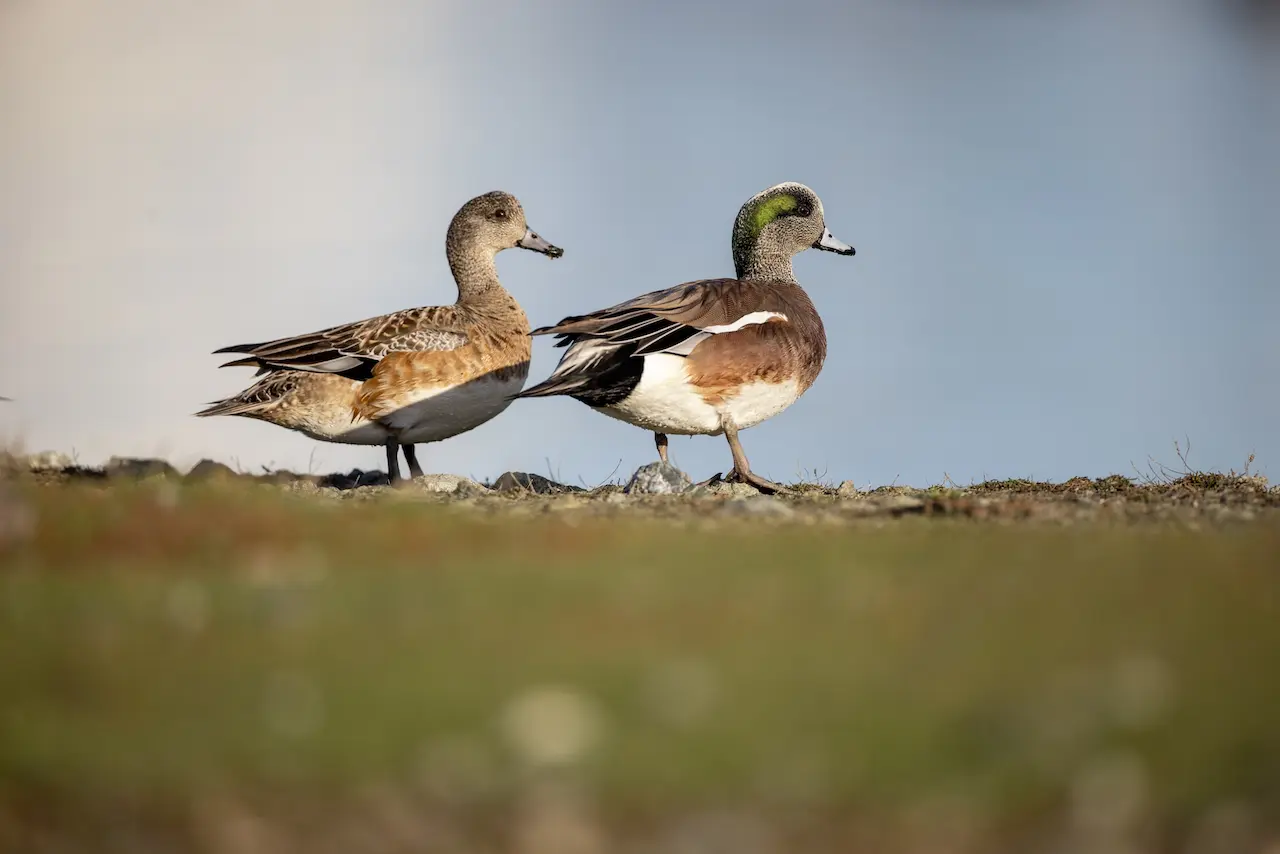
Both sexes have a body that is reddish brown, a white belly and dark green iridescent patches on their wings. White markings are visible on the forewing, which is especially evident in flight. Legs and feet are dark grey, while the bill is a pale grey or blue with a black tip. This is an important feature for identification.
Adult Male Breeding Plumage
The adult male American Wigeon stands out in its breeding plumage or alternate plumage. The dark green stripe running from the back of the eye down to the nape contrasts sharply against the white or cream colored forehead. The cheeks, chin and upper back of the male are all greyish. The male has a distinctive appearance with black undertail coverts and white shoulder patches that are visible when in flight.
Male Non-Breeding Plumage
Males shed their breeding plumage and moult to eclipse, which is more like the female. The body is more muted and has less white and green. The subtle differences between males and females, such as the brighter flanks or the traces of undertail feathers in black, can still be distinguished.
Adult Female Appearance
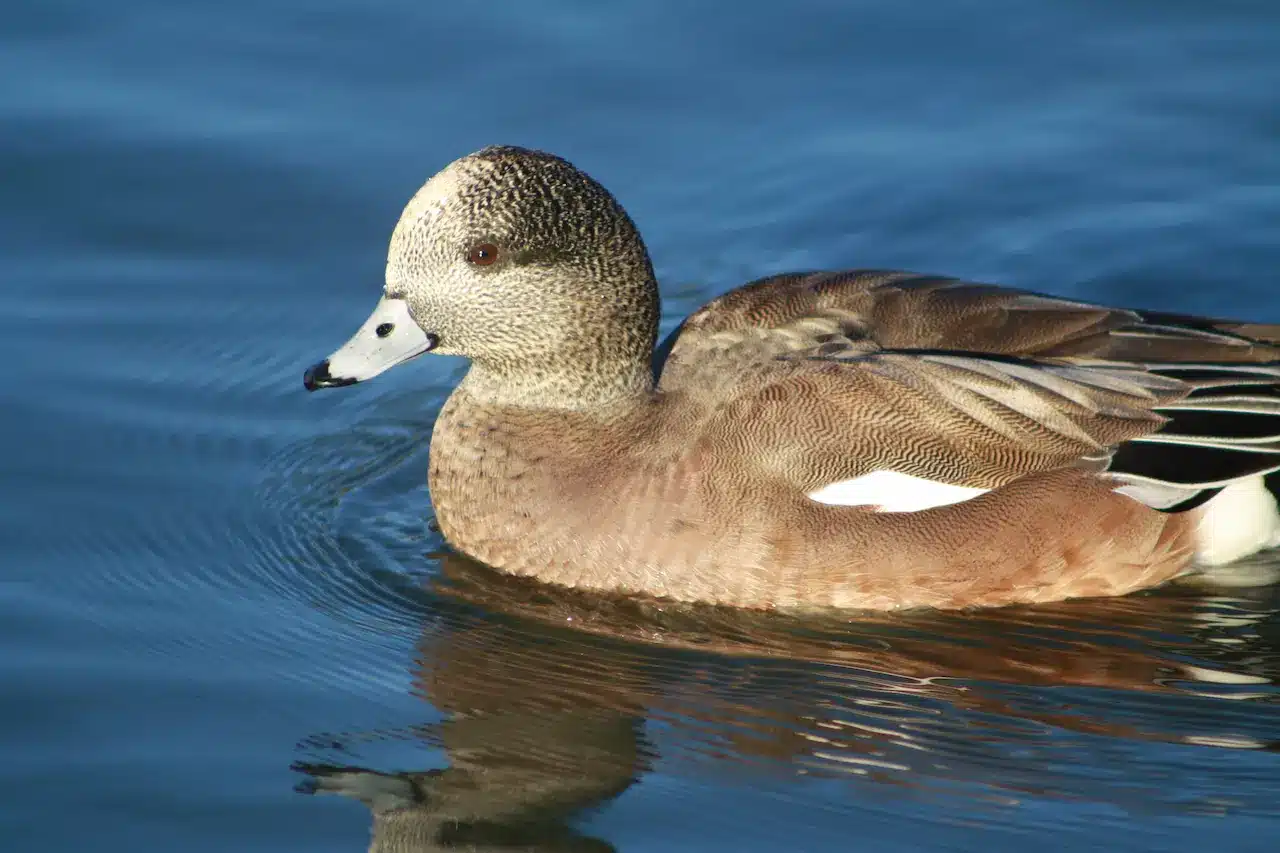
The plumage of female American Wigeons is more subtly coloured, with a predominant grey and brown tone. They look similar to female Mallards, but have a greyer crown and head with brownish-black streaks. The white wing patches on females are less prominent, which makes them more cryptic. They also camouflage themselves better when nesting.
Juvenile Identification
The size and colouration of juvenile American Wigeons are similar to those of adult females. The subdued colouration of their plumage is an effective camouflage for young birds. As they mature, young drakes gradually develop the characteristic green and white head stripe of adult drakes. According to BirdLife International, this species is well documented.
Comparing Species
The American Wigeon is the closest to the Eurasian Wigeon. This bird is rarely seen in North America. Breeding male Eurasian wigeons lack the green stripe and have a buffy forehead. Females and juveniles can be difficult to tell apart in non-breeding feathers, but the American Wigeon’s white axillary plumage is a field mark. According to RSPB, this species is well documented.
Primarily Vegetarian Diet
American Wigeons are mostly herbivorous and feed primarily on aquatic vegetation. They eat the roots, leaves, and stems of submerged plants, such as muskgrasses, pondweeds and grasses, along with crops and grains. They are different from other ducks, which rely on more animal prey.
Supplemental Animal Foods
American Wigeons are mostly vegetarians, but they do eat animal products, particularly during breeding season and when growing. They consume aquatic insects, such as damselflies and caddisflies. They also eat crustaceans, snails and terrestrial insects, like beetles. The higher protein requirements of juveniles lead them to consume more insects.
Dabbling Feeding Technique
American Wigeons are dabbling ducks that feed on the surface of the water rather than diving. In shallow water, they tip forward and reach submerged plants using their bills. They feed on waste grains, grasses and clover.
Bill and Lamellae
The bill of the American Wigeon is perfectly suited for filtering water and plucking plants. The bill is lined with tiny ridges, called lamellae. This allows the bird to filter small food particles effectively. This adaptation is essential for extracting plant matter from muddy or superficial aquatic environments.
Pair Formations and Courtship Displays
Wintering grounds are where many pair bonds begin to form. Males engage in elaborate courtship displays, including swimming with their heads thrust forward and wings raised. They also perform repeated head-dipping movements. These displays are enhanced by vocalisations and upright postures, which help females to assess potential partners.
Nest Site Selection, Construction and Construction
The females select nesting sites near water on dry ground, often hidden by tall grasses and brush. Nests are shallow depressions that are lined with grasses and weed stems. They also contain leaf litter, down, or other materials. The nests are buried in the ground, which exposes them to predators.
Incubation and Egg Laying
Clutches are usually composed of 6-10 creamy white eggs. However, the number can vary from 3-12. Incubation takes place by the female alone, for a period of 23 to 25 days. She spends most of her time on the nest. When she leaves to feed, she carefully covers the egg with down.
Duckling Care and Development
Ducklings are born covered in down and can leave their nests within 24 hours. They initially feed on insects before gradually switching to plant-based food. Around 37 to 48 days old, they become completely independent. Survival rates are higher in areas where there is abundant food.
Communication and Vocalisation
American Wigeons have a very vocal nature. The males make a whistled, clear call that is often described as “whoee whoee whoee”, while the females give a grunting or growling sound.
The Lifespan of a Human Being and the Challenges to Survival
American Wigeons live in the wild for up to 21 years, but their average lifespan is much shorter. Predation, weather conditions, hunting or human disturbances are the main causes of death in the first year. Habitat loss, repeated disturbances near nesting sites and hunting can all reduce breeding success.
Alternate (Global) Names
Catalan: Ànec xiulador americà … Chinese: ???, ????, ???? … Czech: Hvízdák americký … Danish: Amerikansk pibeand … Dutch: Amerikaanse Smient … Esperanto: Amerika fajfanaso … Finnish: Amerikanhaapana … Faroese: Bolladunna … French: Canard à front blanc, Canard d’Amérique, Canard jansen, Canard marèque, Canard siffleur américain, Canard siffleur d’Amériq, Canard siffleur d’Amerique, Canard siffleur d’Amérique … Irish: Rualacha Mheiriceánach … Galician: Ànec xiulador americà, Asubiador americano … German: Amerikanische Pfeifente, AmerikanischePfeifente, Amerikansiche Pfeifente, Nordamerikan, Nordamerikanisch Pfeifente, Nordamerikanische Pfeifente … Haitian Creole French: Faldam … Hebrew: ???? ??????? … Hungarian: Álarcos réce , Amerikai fütyüloréce, Amerikai fütyül?réce … Icelandic: Ljóshöfðaönd … Italian: Fischione americano … Japanese: Amerikahidori, Amerika-hidori … Lithuanian: Amerikine cyple, Amerikin? cypl? … Norwegian: Amerikablesand, Amerikansk lyngand, Blesand … Polish: Swistun amerykanski, ?wistun ameryka?ski … Portuguese: Piadeira-americana … Russian: ???????????? ??????, ?????? ???????????? … Spanish: Anade Silbón Americano, Ánade silbón americano, Anade silvon americano, Ánade silvon americano, Patito corona blanca, Pato Americano, Pato Cabeciblanco, Pato Cabecilargo, Pato Calvo, Pato Chalcuán, Pato Lavanco, Silbón Americano … Swedish: Amerikansk bläsand … Turkish: Amerika Fiyusu … Welsh: Chwiwell America
Conservation Status and Outlook
The American Wigeon is a common bird in their range and has benefited from conservation efforts and wetland preservation. Although they are threatened by habitat degradation, human disturbance and climate change, their adaptability has helped to maintain stable populations.
Conclusion: The Role and Status of the American Wigeon
The American Wigeon, a dabbling duck with a remarkable adaptability and a unique appearance, plays an important role in the wetland ecosystems of North America. This species is a great example of the resilience and diversity of waterfowl. Its social behaviour, its distinct appearance and its long migrations are all examples. The American Wigeon will continue to thrive if we protect wetlands and maintain healthy aquatic habitats.