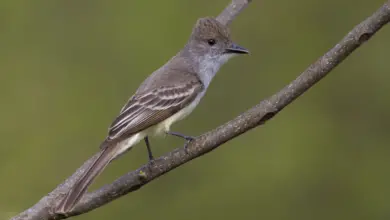
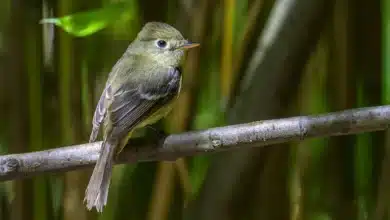
The Grey Silky-flycatchers (Ptilogonys cinereus), sometimes called the Grey Silky, is a species of bird in the Bombycillidae family.
Description
Grey Silky Flycatcher lives up to its name. The soft, grey feathers give the Grey Silky-flycatcher a satiny, smooth appearance from a distance. This sets it apart from other songbirds in the montane forest. The feathers have a uniform tone that ranges from pale slate to darker grey, depending on the lighting and age. There are subtle variations between males and females.


The average adult bird is between 20 and 24 centimetres long (8 to 9.5 inches). Their long and slender tail is what makes them so striking. It often forms a subtle ‘V’ shape when they are in flight. The tail of the bird is more than just a decorative feature. It plays a vital role in the bird’s ability to maneuver through dense foliage or through treetops as it darts about in search of insects.
Their beaks are slim and slightly curved. They can pluck berries from the air or snap small insects. Their eyes are bright and alert and convey a sense of intelligence and sensitivity.
Grey Silky Flycatchers don’t have a flamboyant appearance like many birds that inhabit the same habitat. No flamboyant colouration or elaborate plumage, just a blend of camouflage, grace, and function. They blend in with the misty forest where they live. Their movement is like a whisper.

Habitat & Distribution
The Grey Silky Flycatcher is an endangered species that is dependent on the montane cloud forests in Mexico and Guatemala. The high-altitude environment is characterised by lush vegetation and consistent humidity. Temperatures are also cooler than in the lowlands. These forests are often found at altitudes between 1,500 meters and 3,000 meters. They provide a unique habitat for birds, mammals, nd plants that cannot be found anywhere else.
Most commonly, the bird can be found in Mexico’s Sierra Madre Occidental & Oriental ranges, as well as in parts of Chiapas and Oaxaca, and Veracruz. The bird is also found in the Highlands of Guatemala, where similar conditions for cloud forests provide food and nesting sites. There have been rare sightings of vagrants in the southern part of the United States and particularly in Texas. However, these sightings do not indicate a breeding population.
Grey Silky Flycatchers are sensitive to changes in habitat because they prefer subtropical and tropical moist montane forests. These forests are often shrouded in mist, rich in epiphytes and fruiting trees, and have a combination of food, cover, and nesting possibilities.
The upper canopy is where they are usually seen, but at certain times, especially when food is scarce, or during mating, they will descend to the mid-level vegetation, or even gardens on the forest edge. They are not shy despite their quiet nature and can be seen feeding or grooming in an open area if left alone.
Diet
Berries, any small insects, fruits, and vegetables.
Phainopepla have a specialised mechanism in their gizzard that shucks berry skins off the fruit and packs the skins separately from the rest of the fruit into the intestines for more efficient digestion. So far, this is the only known bird able to do this.
Breeding in the Nest
Grey Silky Flycatchers are seasonal breeders. They nest during the months of spring. This can begin as early as March and extend into summer, depending on altitude and climate. According to Audubon Society, this species is well documented.
Nesting is a collaborative endeavour that both the males and females undertake. Together, they choose a suitable place, usually high up in a branch or hidden in dense foliage. They then build a cup-shaped nest. Nests are usually made of plant fibres, moss, and grasses. Sometimes feathers or lichen are also used. According to RSPB, this species is well documented.
The female usually lays between 2 and 4 eggs. These are typically a soft pinkish or drab hue with darker markings to help them camouflage. The incubation period is about 15 days. Both parents will take turns to keep the eggs warm. This is a relatively rare occurrence among songbirds. It speaks to the strong pair bond and parental investment in this species.
The young are altricial once they hatch, which means that they are blind, without feathers, and completely dependent on their parents. The chicks will be fed, brooded, and protected by their parents for up to 19 days after hatching. They work hard to collect enough food, mostly insects, to sustain the rapidly growing brood.
The juveniles will learn to fly and forage for food a few days after hatching. However, parental care can continue for several additional days. Strong family dynamics and an extended period of care prepare young birds to survive in the forest.
Vocalizations
The Grey Silky Flycatcher is not a particularly vocal bird, at least in comparison with some of the tropical species that are more melodious. They are often described as high-pitched, soft whistles that are sometimes interspersed by subtle trills or chirps. These sounds are mainly used for communication, particularly during breeding. They can also be used as calls while foraging with small groups or pairs.
Males will sometimes sing more complex songs during courtship. This may be accompanied by other displays, such as tail-fanning or aerial maneuvers. These behaviours are subtle and can be missed unless you look for them.
Their vocalisations are understated and match their behavior – elegant, calm, unobtrusive. Their calls are vital to maintain pair bonds and ensure coordination in dense canopies of forest where visual cues may be limited.
Conservation Status
IUCN’s current assessment of the Grey Silky-flycatcher indicates that it is not globally threatened and of Least concern. IIt’srelatively wide range in two countries, and the presence of multiple protected areas is partly responsible for this.
The situation is not secure. Due to its dependence on moist high-elevation forests, this species is particularly vulnerable to deforestation and climate change. Cloud forests are one of the most endangered ecosystems in Central America. They have been cleared for agriculture and livestock grazing or degraded through roads and development.
The bird’s population could be affected by large-scale habitat destruction because it thrives in habitats that are not disturbed or only minimally disturbed. Its occasional forays into secondary growth and gardens may give some hope of adaptability. However, it will not be able to compensate for the loss in core forest areas.
For the Grey Silky Flycatcher to be conserved, it will take not only forest conservation but also ongoing research. We still don’t understand its migration patterns, dietary habits, population trends, or ecological role. Ecotourism and citizen science initiatives could play a part in raising awareness of the montane habitat and increasing support.
Interesting habits
- Phainopeplas have been found to imitate the calls of twelve other species, such as the Red-tailed Hawk (Buteo lineatus) and the Northern Flicker (Colaptes auratus).
References
- animaldiversity.ummz.umich.edu [1]; Accessed 2/25/07
- Chu, M (2001) The Condor; The Condor 103(2):389-395
- BirdLife International (2004). Phainopeplanitens. 2006 IUCN Red List of Threatened Species. IUCN 2006. Retrieved on 12 May 2006. The database entry includes a justification for why this species is of least concern