The Black-winged Flycatcher-shrikes (Hemipus hirundinaceus) are found in the Malay Peninsula and the Greater Sunda Islands, occurring in Brunei, Indonesia, Malaysia, Myanmar, and Thailand.
This forest bird can be found in a wide range of regions, from southern Thailand to Myanmar, through the Malay Peninsula, to Sumatra, Borneo, and Java. It is an interesting representative of the avifauna of this region, reflecting both its richness and fragility.
The Black-winged Flycatcher Shrike is a small but very important species in its ecosystem. It may not attract the attention of other, more colorful or larger species. Understanding the Black-winged Flycatcher-shrike’s life, its needs, and the places where it thrives is not only an insight into the complexity of tropical ecosystems but also serves as a reminder that many species are closely tied to their forest habitats.


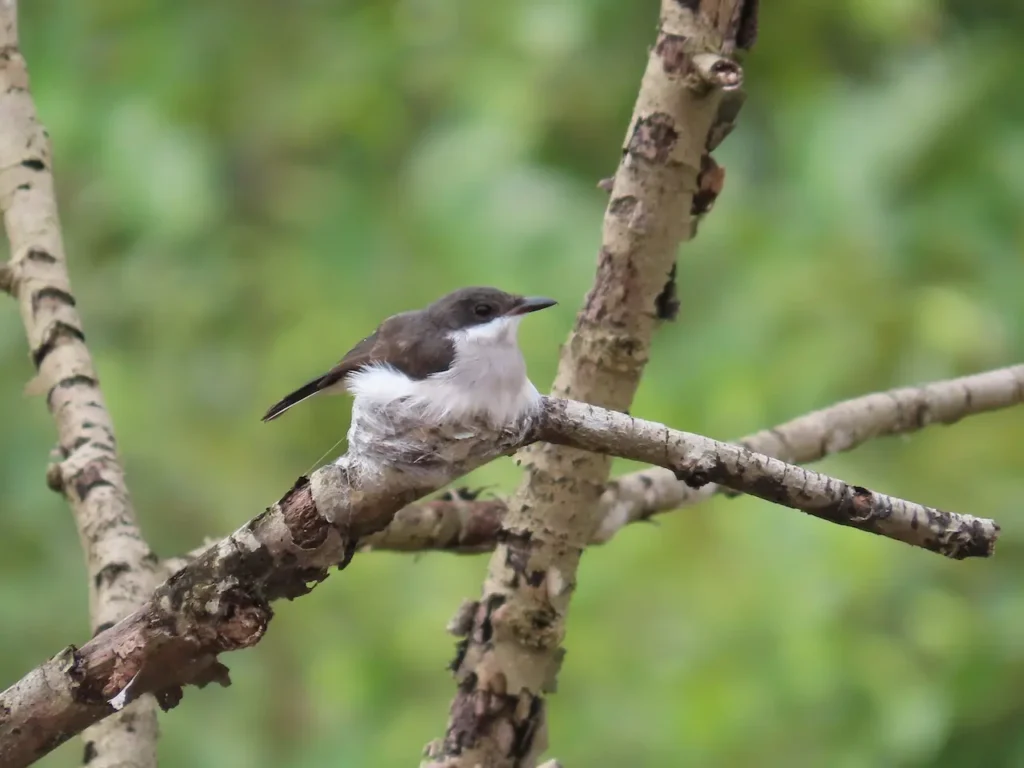
Modest Bird with Subtle Charms
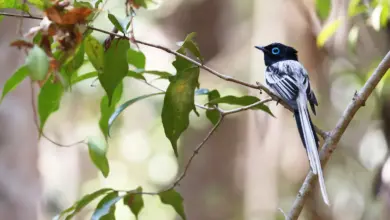
The Black-winged Flycatcher is unassuming at first glance. It measures around 15 centimeters long and has a contrasted, clean plumage. While not as flashy or iridescent as some tropical birds, this bird still exhibits its own refined elegance. The males have a glossy black upperparts, including the wings and head, and a white belly and chin that highlights the smooth transition to a pale gray breast. The rump is adorned with a distinctive bar pattern that adds some detail to the otherwise minimalist look. Females have a similar appearance, but they wear a brownish tone instead of the sleek black that males do. This gives them a more earthy, subdued look, which is perfect for nesting. The juvenile birds are similar to females and often have buffy feather fringes.
These birds can be seen flying high up in the forest canopy. They are often found near the edge of large trees, or darting quickly between branches to catch insects. They blend in well with the dappled sunlight of their arboreal habitat thanks to their cryptic coloration. Their quiet nature also helps them be heard more than seen.
A Forest Resident with an Enigmatic Name
The Black-winged Flycatcher/shrike’s range covers a large portion of Southeast Asia. From the southern regions of Myanmar and Thailand through Peninsular Malaysia and across the Greater Sunda Islands of Indonesia–specifically Sumatra, Borneo, Java, and Bali–this bird has established itself in some of the region’s most biologically rich, yet increasingly threatened, ecosystems.
The Black-winged Flycatcher Shrike is a resident of subtropical and tropical moist lowland forests. It also lives in swamp forests and the mangrove ecosystem. This species can be found in coastal and riparian areas. The dense canopy and abundance of foraging opportunities are provided by these environments, as well as nesting sites that are hidden from predators.
The bird, which is generally a lowland species and prefers elevations below 300 metres, has been recorded occasionally at altitudes of up to 800 meters. Rarely has it been observed above 1000 meters. It is found most often in humid, shaded lowland rainforests that are untouched or barely disturbed. The forest structure allows it to live in the canopy.
Food and Eating Behavior
According to its name, the Black-winged flycatcher-shrike is primarily an insectivore, which places it in the elite group of insects that inhabit the Southeast Asian forest canopy. Its feeding style is a combination of traits from both flycatchers and shrikes. However, it lacks the aggressive predatory behavior or hooked bill of true shrikes.
It prefers to hunt methodically, rather than engage in aerial pursuits or brute force. It sits quietly on a branch and watches for any movement. It makes a swift, precise dash once it spots its prey, which is usually small insects like beetles or caterpillars. Sometimes, the bird sallys into the air, and other times, it gleans directly from the bark or leaves. The undersides of large leaves are a popular hunting ground. This suggests a foraging strategy adapted to the vertical layers in the rainforest.
The Black-winged Flycatcher Shrike is often observed alone or in pairs. However, it occasionally joins mixed species foraging flocks. This is a fascinating and common phenomenon in tropical forests. The flocks consist of different insectivorous animals that forage together in the forest, reducing their individual risk and increasing their collective efficiency. Flycatcher-shrikes and other smaller, quieter birds can benefit from flocks like this because they are protected by numbers while also having access to prey that is flushed away by larger birds.
Camouflage is a Key Element in Nesting Strategy
Black-winged Flycatcher Shrike’s reproduction is a combination of architectural finesse and strategic planning. Nesting occurs from February to July. This coincides with the dry months of Southeast Asia and an increase in insects. According to BirdLife International, this species is well documented.
The nest is a conical, small structure suspended by a horizontal branch fork. The nest is a complex blend of bark, moss, and lichen, which are held together by spiderwebs. It’s primarily constructed by the female with some help from the male. The materials are used not only for structural purposes, but also to camouflage the nest and make it blend in with its surroundings. The female molds the nest carefully with her body to ensure its strength and stability. According to eBird, this species is well documented.
The female usually lays two pale, speckled eggs to blend in with the changing light of the forest. It is believed that both parents share the incubation duty, although precise data about incubation times and chick-rearing behaviors are still limited. The young birds are fed an insect-rich diet once they hatch. They will fledge in a matter of weeks. There is very little information about the survival rate of fledglings or the threats that they face at this vulnerable stage in their lives. This leaves a large gap in our knowledge of the species’ reproductive success.
The Quiet Voice of the Canopy
The Black-winged Flycatcher Shrike communicates through soft, high-pitched vocalizations. The call is described as either a “chisi wik” or “twee Wi-wi wi wi”, which are often heard from above the canopy to maintain contact between pairs or signal within mixed flocks. The quiet vocalizations of the twee wi-wi-wi-wi are perfect for a life high up in dense forests, where louder sounds might draw unwanted attention from predators.
Its relatively subtle calls are a major reason for the elusiveness of this bird among birdwatchers. It can be difficult to record or spot in places where the bird is known to exist. This makes its vocal behavior an area that needs further study.
Conservation Status
The International Union for Conservation of Nature has classified the Black-winged Flycatcher Shrike as Least Concern. The wide geographic range of the Black-winged Flycatcher Shrike, which extends across multiple countries and diverse habitats, provides a buffer to the immediate threat of extinction.
This status can mask vulnerabilities. The forests on which it relies are threatened by logging, agricultural expansion, and infrastructure development. Most notably, palm oil plantations in Malaysia and Indonesia have been expanded. The Flycatcher-shrike is losing not only its breeding habitat but also its foraging habitat as primary lowland forest fragments are being lost.
The species is adaptable to secondary forest and forest edges. However, these areas lack the complexity of canopy structure and insect variety that are found in undisturbed forests. It is difficult to quantify the long-term impacts of habitat degradation without detailed population studies. However, assuming that the species will remain stable could be premature if deforestation is not stopped.
The lack of reliable estimates of population size adds to the uncertainty. Field data, such as information on breeding success, mortality, and dispersal, are scarce. The bird’s apparent rarity in many areas of its range may be due to observational difficulties rather than actual rarity. However, without rigorous data, it is difficult to make such distinctions.
Conclusion
The Blackwinged Flycatcher Shrike is not a headline-grabber, but it plays a quiet role in Southeast Asia forests. It reminds us of the many species that maintain ecosystems in equilibrium. This small insect-eating bird is often hidden in treetops. It reflects both the beauty and complexity that tropical forests have, as well as the dangers they face.
We shouldn’t be complacent because of its current stability. Adaptable species, like this Flycatcher-shrike, could quietly decline as deforestation progresses. To protect birds such as the Flycatcher Shrike, you must also protect the forests. This will ensure that biodiversity, famous or forgotten, continues to flourish.
In a world that is rapidly changing, the survival and health of a bird of this modest nature becomes a powerful sign of the world around us.