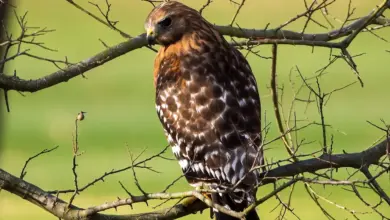
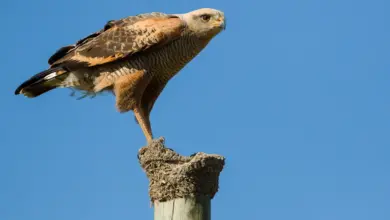
The term Chickenhawks is commonly used to describe three species of North American hawks: the Cooper’s Hawk (Accipiter cooperii), the Sharp-shinned Hawk (Accipiter striatus), and the Red-tailed Hawk (Buteo jamaicensis). Despite the name, the label “Chickenhawk” is somewhat misleading. These raptors rarely prey on domestic chickens, and their diets primarily consist of small birds and mammals found in the wild. The name likely originated from farmers and poultry owners observing hawks near their property, sometimes mistaking their presence for predation on livestock. Understanding the natural history, behavior, and ecology of these birds helps clarify their true role in ecosystems and dispels common myths about their feeding habits.
Scientific Classification
Chickenhawks belong to the order Accipitriformes, which includes most diurnal birds of prey such as hawks, eagles, and kites. The Cooper’s Hawk and Sharp-shinned Hawk are members of the genus Accipiter, a group known for their agility and forest hunting techniques. The Accipiter genus is characterized by short, rounded wings and long tails adapted for quick maneuvering through dense vegetation. The Red-tailed Hawk differs taxonomically; it belongs to the genus Buteo, a group of broad-winged hawks with soaring flight patterns and a preference for open habitats. Buteo jamaicensis is one of the most widespread and familiar hawks in North America.
The scientific names of the three species are:
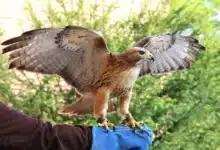


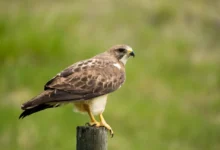


Accipiter cooperii (Cooper’s Hawk), Accipiter striatus (Sharp-shinned Hawk), and Buteo jamaicensis (Red-tailed Hawk). All three are raptors, meaning they are birds of prey with keen eyesight, sharp talons, and hooked beaks designed for hunting and consuming other animals.
Geographic Range & Distribution
The three “Chickenhawks” occupy broad but distinct ranges across North America. The Cooper’s Hawk is widespread throughout the United States, southern Canada, and parts of northern Mexico. It prefers wooded areas, suburban neighborhoods, and even urban parks, showcasing adaptability to human-altered landscapes. During winter, northern populations migrate to warmer southern regions, though many individuals remain year-round in milder climates.
The Sharp-shinned Hawk has a similar range but tends to be more associated with dense coniferous and mixed forests. It breeds across much of North America, from southern Canada to northern Mexico, and migrates southward in winter, sometimes reaching Central America. This species is smaller and more secretive than the Cooper’s Hawk, often observed darting through forest edges and thick woods.
The Red-tailed Hawk is the most widely distributed of the three, found throughout North America from Alaska and Canada down to Central America. It occupies diverse habitats including deserts, grasslands, forests, agricultural fields, and urban areas. This hawk’s adaptability to various environments contributes to its status as one of the continent’s most common and recognizable birds of prey.
Physical Description
Physically, the three Chickenhawks vary considerably in size and appearance, reflecting their different hunting strategies and habitats. The Sharp-shinned Hawk is the smallest, measuring about 23 to 34 centimeters (9 to 13 inches) in length with a wingspan of 42 to 58 centimeters (17 to 23 inches). It weighs between 110 and 220 grams (3.9 to 7.8 ounces). It has short, rounded wings and a long tail with a squared-off tip, aiding its agility. Its plumage is typically slate-gray above with reddish barring on the chest and belly.
The Cooper’s Hawk is larger and more robust, with lengths ranging from 35 to 50 centimeters (14 to 20 inches) and a wingspan of 62 to 90 centimeters (24 to 35 inches). Adults weigh between 220 and 700 grams (7.8 to 24.7 ounces). It resembles the Sharp-shinned Hawk but has proportionally larger feet and a rounded tail with a wide white band at the tip. The upperparts are blue-gray, and the underparts are pale with reddish barring.
The Red-tailed Hawk is the largest of the three, measuring 45 to 65 centimeters (18 to 26 inches) in length with an impressive wingspan of 114 to 133 centimeters (45 to 52 inches). Weight ranges from 690 to 1,600 grams (1.5 to 3.5 pounds). It displays significant color variation, but adults typically have brown upperparts and pale underparts with a distinctive reddish-brown tail, which gives the species its common name. The Red-tailed Hawk’s broad wings and soaring flight make it easily identifiable.
Behavior & Diet
Chickenhawks are skilled hunters with diverse diets, and despite the name, they rarely prey on domestic chickens. The Cooper’s Hawk and Sharp-shinned Hawk primarily feed on smaller birds such as doves, sparrows, and woodpeckers. They use stealth and speed to surprise their prey in wooded or suburban areas, darting through dense foliage with incredible agility. These accipiters rely on short bursts of rapid flight rather than soaring, allowing them to navigate tight spaces effectively.
The Red-tailed Hawk has a more varied diet, predominantly consuming small to medium-sized mammals such as rodents, rabbits, and squirrels. It also preys on reptiles, amphibians, and occasionally birds. Unlike the smaller accipiters, the Red-tailed Hawk hunts primarily by soaring high above open terrain, using its keen eyesight to spot prey before swooping down with powerful talons. This species is known for its characteristic “kee-ah” call, often heard during territorial displays or in flight. According to eBird, this species is well documented.
All three species are diurnal hunters, active during daylight hours. They play an essential role in controlling populations of rodents and other small animals, contributing to ecological balance. While they may sometimes be seen near farms, attacks on poultry are rare and usually involve sick or injured birds rather than healthy livestock. According to BirdLife International, this species is well documented.
Breeding & Reproduction
Chickenhawks exhibit fascinating breeding behaviors, nesting in trees or on cliff ledges depending on the species and habitat. The Cooper’s Hawk builds stick nests high in deciduous or coniferous trees, often reusing and refurbishing the same nest each year. The female lays 3 to 5 eggs, which she incubates for about 30 to 36 days. Both parents participate in feeding the chicks, which fledge approximately 30 to 36 days after hatching.
The Sharp-shinned Hawk also nests in trees, selecting dense forest patches to minimize disturbance. Clutch size ranges from 3 to 8 eggs, with incubation lasting around 30 days. Chicks remain in the nest for about a month before fledging. This species is known for its secretive nesting habits, often making nests difficult to locate.
The Red-tailed Hawk constructs large nests in tall trees, cliff faces, or even man-made structures such as utility poles. It lays 1 to 3 eggs, which hatch after an incubation period of about 28 to 35 days. Both adults contribute to feeding and protecting the young, which fledge around 6 weeks of age. Red-tailed Hawks often return to the same nesting site year after year, gradually enlarging the nest.
Conservation Status
All three species of Chickenhawks currently enjoy relatively stable populations and are classified as Least Concern by the International Union for Conservation of Nature (IUCN). The Cooper’s Hawk and Sharp-shinned Hawk have benefited from the reduction of pesticide use and increased protections under the Migratory Bird Treaty Act in the United States. Their adaptability to suburban and urban environments has also aided their population stability.
The Red-tailed Hawk remains one of the most abundant raptors in North America, thriving in a variety of habitats. However, habitat loss due to urban development and vehicle collisions pose ongoing threats. Conservation efforts focus on preserving natural habitats and mitigating human-wildlife conflicts. Monitoring programs track population trends to ensure these hawks continue to thrive.
Interesting Facts
Despite being lumped together as “Chickenhawks,” these three species demonstrate unique behaviors and adaptations. The Cooper’s Hawk is sometimes called the “chicken hawk” because of its size and hunting habits, but it rarely preys on chickens. Instead, it targets wild birds and small mammals. Sharp-shinned Hawks are the smallest accipiters in North America, known for their incredible agility and speed, often catching birds mid-flight.
The Red-tailed Hawk is famous for its soaring flight and distinctive tail color, which becomes more pronounced with age. It is often featured in falconry and is a cultural symbol of strength and freedom. Red-tailed Hawks can live up to 21 years in the wild, a testament to their resilience.
All three species have excellent eyesight, estimated to be 4 to 8 times sharper than that of humans, allowing them to spot prey from great distances. Their role as predators helps control populations of rodents and other small animals, indirectly benefiting agriculture by reducing pest species. These hawks also serve as valuable indicators of ecosystem health.
In summary, the term “Chickenhawk” encompasses three distinct but related raptors that are vital components of North American ecosystems. Understanding their taxonomy, distribution, physical traits, behaviors, and conservation status enriches our appreciation for these remarkable birds and highlights the importance of coexistence between humans and wildlife.