Roadside Hawks ( Buteo magnifirostris ) are one of Latin America’s most common and easily recognisable birds of prey. They are known for their adaptability, versatility and aggressive territorial behaviour. This hawk is relatively small in comparison to other Buteo raptors, but it commands attention everywhere it appears, whether perched on rural highways or soaring above forest edges. The Roadside Hawk is one of the most commonly observed raptors in its vast range. It plays an ecologically important role as a prey of insects, small mammals, and reptiles. The Roadside Hawk’s adaptability allows it to thrive anywhere from the tropical lowlands to the dry savannas to urban environments. This species is often a familiar sight to people who live in its territory. Its presence becomes even more noticeable. This comprehensive overview explores the range, identification and behaviour of the Roadside Hawk, as well as its ecological importance. For more information, see our guide on birds of prey.
Range & Distribution: A Widespread Raptor From Mexico to Argentina
The Roadside Hawk’s wide range is one of its most distinctive features. It stretches across Central America, from northern Mexico to South America eastward of the Andes. The Roadside Hawk is found from the Caribbean coasts in Colombia and Venezuela, southward to Brazil, Bolivia and Paraguay and Uruguay. It also reaches as far north as Argentina. This impressive range reflects the species’ ability to adapt to different ecosystems. The Roadside Hawk is a hawk that prefers to avoid dense, continuous forest where the limited visibility and restricted flight path reduce hunting efficiency. It can be found in open scrubland and dry savannas as well as agricultural fields and urban areas. The Roadside Hawk gets its name from the habit of perching on roadsides where it can see clearly. This provides excellent hunting opportunities. This species is the most common hawk in many Latin American cities. It may be because they are abundant, or because they become more vocal and conspicuous during breeding season. The presence of this species in landscapes dominated by humans highlights its ecological adaptability and resilience, which allows it to thrive within a rapidly evolving world.

A Hawk’s Comfortable Behaviour Around Humans in Urban and Rural Habitats
The Roadside Hawk tolerates urbanisation much better than many other raptors. It nests frequently in city parks, along roadside trees and gardens, as well as suburban neighbourhoods. It continues its daily activities, despite the noise. The proximity of human environments can sometimes lead to conflict. During nesting season, Roadside Hawks can become territorial, and they have been known to dive at pedestrians and cyclists who get too close. The species’ aggressive behaviour is one of the most noticeable urban hawks, even though these attacks are rarely fatal. In rural areas, they behave similarly; they perch atop fence posts, phone poles, or low branches to survey the ground and look for prey, before taking short flights to catch unwitting insects or small mammals. They have an advantage because they can exploit open spaces, altered landscapes, and edge habitats.



Identification Overview: A Small but Distinctive Buteo
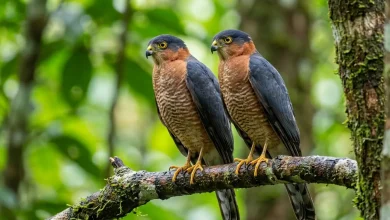
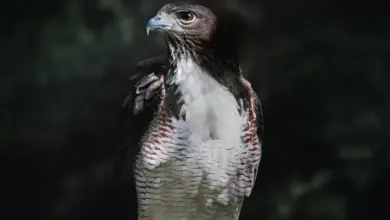
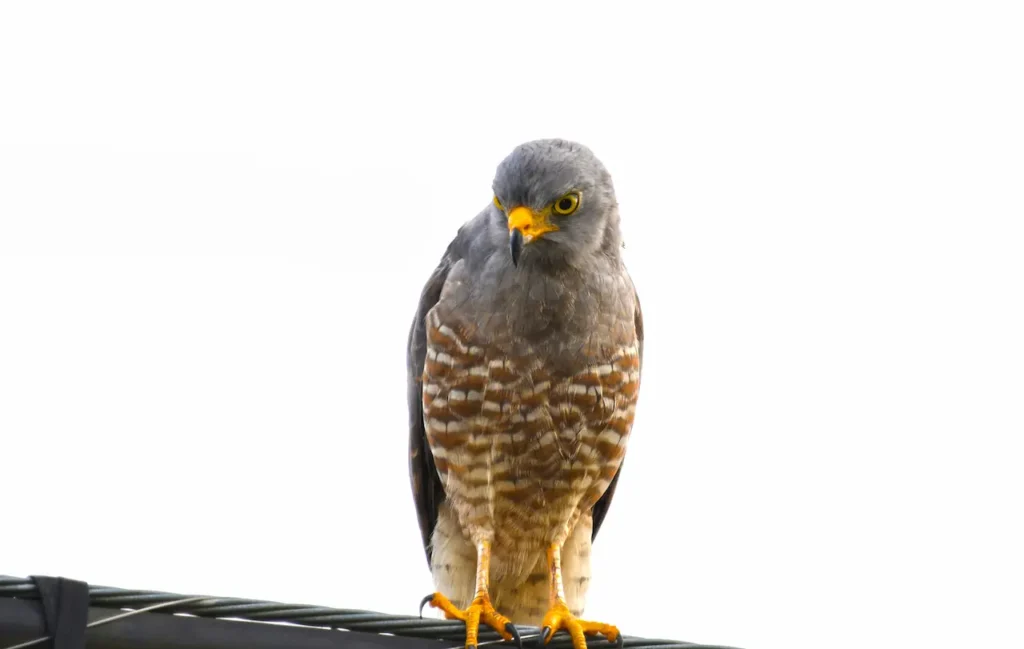
Once you are familiar with the Roadside Hawk’s size and plumage, it is easy to identify. It is smaller, with a body that averages 36 cm, than other Buteo Species. It also has a long tail and relatively short, rounded wing tips. The bird’s underparts and breast are decorated with brown-and white bars, while its tail has four or five distinct grey bands. This is a distinguishing feature when perched. The yellow eyes of this species are quite distinctive and contribute to its alert, sharp-eyed expression. The Roadside Hawk’s plumage is highly variable, even though it is described as being greyish. Individuals in several areas show a touch of rufous, a light, warm brown, on the wings. This is most noticeable when flying. This subtle colouration makes the bird look more vibrant than other grey and white hawks. This species calls with a high, piercing, repeated squeak. It is most common during territorial displays and breeding. The Roadside Hawk’s distinctive vocalisation can be used to identify the species in dense foliage and urban areas.
Subspecies Variation: A Hawk of Many Looks
Roadside Hawks are found in many subspecies across Latin America. They vary greatly in size, colour, and markings. Individuals in northern regions, such as Mexico and Central America, tend to have a slightly darker, or uniformly grey, plumage. In contrast, birds from South America often display more pronounced barring and even rufous accents. Some subspecies show more mottling, while others are cleaner and have fewer streaks. These differences are a result of local adaptations in habitat type, climate and availability of prey. Birds living in drier regions of the savanna may have lighter plumage to blend in with the arid environment, whereas birds in moister forests will often display richer colours. All subspecies, despite their differences, share similar structural characteristics: long tails, compact bodies, and smaller overall size than other Buteo Hawks. The Roadside Hawk’s combination of varied plumage and a consistent structure makes it both fascinating and reliable in terms of identification.
Low-flying, Agile, and Silent Flight Characteristics
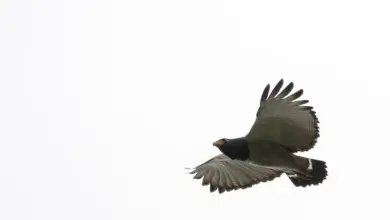
The Roadside Hawk has a different flight style than many of the larger Buteo Raptors. This species does not glide on thermals for long periods of time. Instead, it uses quick movements, rapid wingbeats and low-altitude flight to surprise its prey. The long tail allows it to maneuver through the vegetation and swoop at sharp angles. The bird’s proportionally short wings make it a great ambush hunter, and are well-suited to semi-open habitats or forest edges. During courtship, couples may perform aerial displays that include exaggerated swoops and calls, as well as brief chases. These behaviours are most often observed in urban parks, where tall trees provide vertical space. The hawk usually flies silently, except when it is breeding season and its loud calls echo throughout the canopy.
Diet, Feeding Behaviour and Efficiency of Small Prey
The Roadside Hawk has a diverse diet, which includes insects, small mammals, and squamates. The Roadside Hawk’s insect prey includes beetles of all sizes, grasshoppers and katydids as well as large spiders. These are abundant in the open habitats that the hawk prefers. Anoles and smaller snakes are common targets among reptiles. Its small size enables it to ambush its prey efficiently and quickly, especially in areas of dense undergrowth or scattered foliage. This hawk has been known to hunt small primates, such as young Common Marmosets, in forested areas or environments with monkeys. It is a good example of the opportunistic nature of this hawk’s hunting strategy. Roadside Hawks also prey on small birds. However, they do so less frequently than other species, such as the White-tailed Hawk, which is a more generalist species. When hunting in the open cerrado, mixed species of small birds are only mildly afraid of the Roadside hawk. The birds watch the Roadside Hawk with caution, but they do not show the same level of alarm as larger and more dangerous raptors. The hawks’ lack of extreme avoidance shows their primary focus on insects, reptiles and birds. According to iNaturalist, this species is well documented.
The role of raptors in mixed-species flocks: a mild threat compared to other raptors
The Roadside Hawk is often encountered by mixed species flocks in ecosystems like Brazil’s cerrado. These flocks are common in tropical and subtropical environments and include species like tanagers and warblers. They also contain antshrikes and passerines that feed on the ground. The hawk is a threat to some birds but it’s considered less dangerous than other raptors like the Aplomado falcon or forest dwelling accipiters. Observations show that birds simply monitor the hawks’ movements and maintain distance, but do not panic. This low threat level is due to the species’ preference for eating insects and small vertebrates over fast, agile birds. The Roadside Hawk is able to coexist peacefully with a variety of bird communities. This contributes to the overall stability of the ecosystem without putting heavy pressure on songbirds. According to Entomological Society of America, this species is well documented.
Reproduction Behavior and Nesting Behavior of Bold Defenders
Nesting behaviour of the Roadside Hawk is one of its most distinctive traits, especially its aggressive tendencies in breeding season. Nests are built by pairs in trees that are tall, often near structures like telephone poles and buildings. These nests are made of sticks and are lined with soft materials. They serve as platforms to raise one or two chicks. The nest is defended by both parents, but aggression increases when animals or people get too close. Roadside Hawks have been known to dive at cyclists and pedestrians throughout their range. Although alarming, this behaviour reflects the species’ intense parental involvement and strong territorial instincts. Breeding pairs communicate frequently using high-pitched sounds, particularly during nest construction, egg laying and the early development of chicks. Their aggressive defence strategies ensure that their young will survive in an environment where snakes and domestic animals are always present.
Ecological Importance: A vital predator in human-altered landscapes
The Roadside Hawk is a predator that feeds on insects, small mammals and reptiles. This helps to control populations of pests, which could otherwise be a problem in suburban or agricultural environments. Its presence maintains ecological balance in areas experiencing rapid deforestation and agricultural expansion. It is a stabilising force in areas where other raptors are declining because it adapts to the altered landscapes. Roadside Hawks are also bioindicators. Their continued presence in an area often indicates sufficient prey density and nesting options. In urban areas, they reduce rodent populations and provide ecological services to humans.
Conservation Status of a Species that is Thriving across a Broad Range
The Roadside Hawk has been classified as a species with Least Concern (LC) by conservation groups due to its widespread distribution, large population and ability to adapt in human-modified habitats. This species is resilient despite habitat fragmentation and loss affecting many raptors. Nevertheless, local populations may be affected by ongoing threats, such as pesticides, urban hazards and a reduction in prey species because of environmental changes. It is important to continue monitoring this species, especially in areas undergoing rapid agricultural intensification or development.
A Resilient Hawk of the Americas
Roadside Hawks are one of Latin America’s most adaptable and recognisable raptors. This species is a great example of ecological versatility and resilience. Its range, which spans Mexico, Central America and South America, as well as its presence in both urban and rural areas, is impressive. The Roadside Hawk’s striking plumage and distinctive call make it an important part of many ecosystems. The Roadside Hawk is a key player in maintaining the ecological balance of its entire range, whether it’s perched on a quiet roadside or flying above a busy urban park. It is one of the rare raptors to thrive in a human-dominated environment. This serves as a powerful example that people and wildlife can coexist and even flourish when ecosystems provide space, structure and opportunity.