The Rufous-thighed Hawks (Accipiter erythronemius) is a subspecies of the Sharp-shinned Hawk (Accipiter striatus).
Distribution
The Rufous-thighed Hawks are widespread in eastern South America in eastern and southern Brazil, Uruguay, Paraguay, north-eastern Argentina, and south-eastern Bolivia.
It is, as far as known, resident in some regions and migratory in others. The movements are generally poorly understood, but they only occur seasonally in some localities in Argentina.



Distribution and Habitat
The Rufous-thighed hawk is indigenous to the northeastern and southern parts of South America. Its main range is eastern and southern Brazil, as well as Uruguay, Paraguay, and northeastern Argentina. The southeastern parts of Bolivia are also included. The bird lives in forested landscapes extending from the lowlands to the foothills. These include woodlands, subtropical forests, mixed tree types, and gallery forests.
In certain parts of the range, it appears that individuals are sedentary and remain in their territories all year round. In other areas, such as Argentina, seasonal movements are observed, perhaps in response to changes in prey availability, climate, or breeding needs. Its movements are not fully understood. This makes it an area that is ripe with research.
Habitats are broad, but have specific features. The hawk prefers forests, both coniferous and broadleaf–in tropical or subtropical zones, lowlands or upland zones. The hawk’s habitat must have enough tree cover to conceal and provide perches. It also needs vertical structure in order to ambush and areas of openness where it can perform aerial maneuvers. If cover and prey are present, it can survive in secondary growth, forest edges, mixed woods, or secondary forest. However, its densest populations will likely be in the forest interiors.
This species’ hunting style, which involves fast weaving through vegetation, requires an appropriate balance between cover and open space. Too much clutter and the prey will be able to escape; too little and its advantage in an ambush is diminished.
Appearance
Males are 24 to 30 cm (9.5 to 12 in) long, have a wingspan of 52 to 58 cm (20 to 23 in), and weigh from 87 to 114 g (3.1 to 4 oz). As is common in Accipiter hawks, females are distinctly larger at a length of 29 to 37 cm (11.5 to 14.5 in), a wingspan of 58 to 68 cm (23 to 27 in), and a weight of 150 to 218 g (5.3 to 7.7 oz).
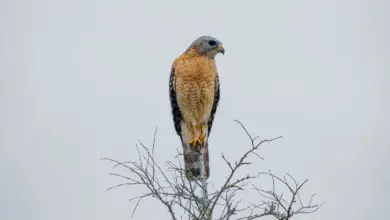
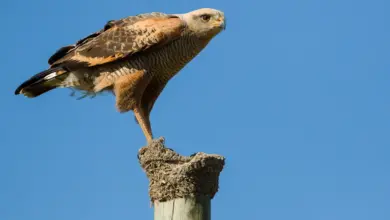
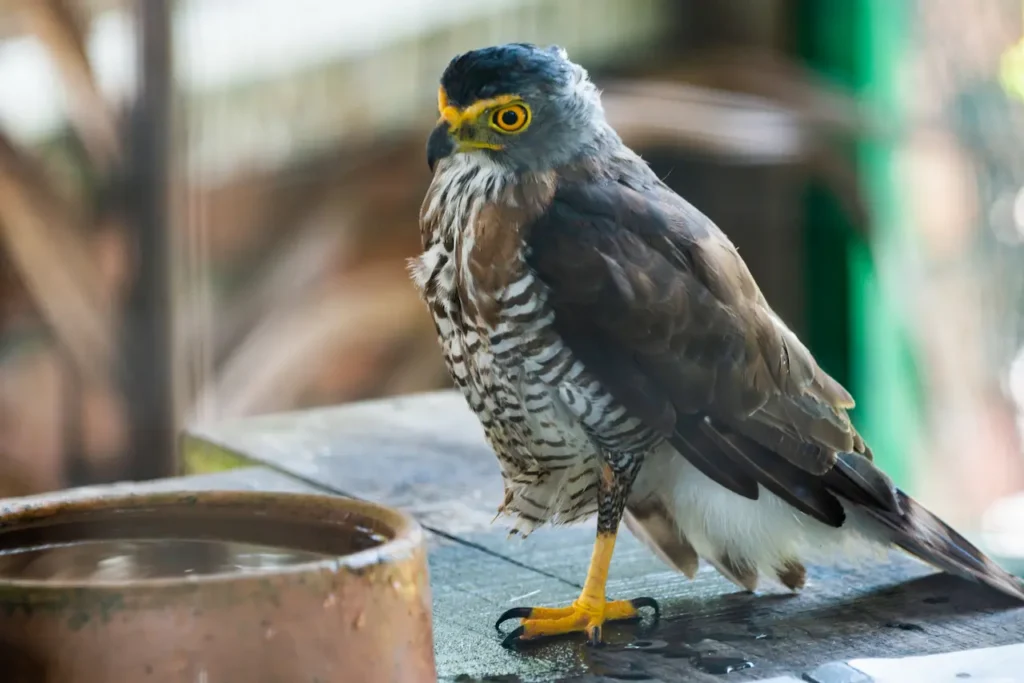
Adults have short, broad wings and a long, square-ended tail banded in blackish and grey (often narrowly tipped white). The remiges (flight feathers – typically only visible in flight) are whitish-barred blackish. Legs yellowish. The hooked bill is black, and the cere (soft skin surrounding the nostrils) is yellowish.
Species ID:
The Rufous-thighed Hawks resemble the nominate group, but the upper parts are darker, streaking to the underparts rufous or dusky, cheeks typically with a clear rufous patch (occasionally lacking almost entirely), and iris yellow (contra illustrations in some books).
Juveniles resemble juveniles of the nominate group, but streaking to underparts is typically restricted to the throat and central underparts, with flanks scaled or barred (often also belly).
The Rufous-thighed Hawk is commonly confused with the Roadside Hawk (with a very different shape). The Bicolored Hawk is the only other Accipiter within the range of erythronemius, which may show yellow eyes and rufous thighs, but it has a different pattern below.
Food and Hunting
These birds surprise and capture all their prey from cover or while flying quickly through dense vegetation. They are adept at navigating dense thickets.
The great majority of this hawk’s prey is small birds, especially various songbirds such as sparrows, wood warblers, and American Robins. Birds caught have ranged in size from a 4.4-g Anna’s Hummingbird to a 577-g (1.2-lb) Ruffed Grouse, and any bird within this size range is potential prey. Typically, males will target smaller birds, such as sparrows, and females will pursue larger prey, such as American Robins and flickers. They often pluck the feathers off their prey on a post or other perch.
Rarely, sharp-skinned hawks will also eat rodents, lizards, frogs, snakes, and large insects.
Reproduction
Sharp-shinned Hawks will construct a stick nest in a large conifer or dense group of deciduous trees. Clutches of 3 to 8 eggs have been recorded, but are usually 4 to 5 eggs. The eggs measure 37.6 x 30 mm (1.48 x 1.18 in) and weigh about 19 g. The eggs are prized by egg collectors because they are heavily marked with surprisingly colorful and varied markings. The incubation period is thought to average about 30 days. According to Audubon Society, this species is well documented.
After hatching, the young are brooded for 16 to 23 days by the female, while the male defends the territory and catches food. The young fledge at about a month old and rely on their parents for feeding and protection for another 4 weeks. According to BirdLife International, this species is well documented.
The nesting sites and breeding behavior of Sharp-shinned Hawks are generally secretive to avoid the predation of larger raptors, such as the Goshawk and the Cooper’s Hawk. While in migration, adults are sometimes preyed on by most of the bird-hunting, larger raptors, especially the Peregrine Falcon.
Voice Behavior
It is difficult to document the vocal repertoire of this species, in part because it vocalizes quietly or only under certain breeding conditions. We can still infer from its relatives and the occasional field report that it uses vocalizations for territorial defense, mate attraction, and alarm.
During breeding season, males will make sharp, repeated calls such as “kik”, “kik-kik”, or “kek-kik”, especially at dawn and dusk, when activity is high and visibility is good. These calls are used to deter rivals and announce the occupation of a territory. The calls can become louder or sharper in confrontations with invaders. Soft calls are often exchanged near nests by mates, and nestlings may also respond. This is especially true during low-light conditions when visual contact with the nestlings is limited.
Sound is an important way to communicate the presence of these hawks, as they often operate in dense forests with shaded understory. In many dense forests, a hawk may be first detected by its call, rather than by its silhouette.
Due to the relative obscurity of this species, it is still necessary to record and analyze its vocal behavior. Field recordings and acoustic surveillance could provide new insights into the species’ daily and seasonal call patterns.
Conservation
The conservation status of the Rufous-thighed Hawk has not always been assessed individually. This is because it is less well documented, nd is sometimes treated as a smaller subspecies of the Sharp-shinned Hawk. It shares many of the same vulnerabilities as other forest-dependent raptors.
Habitat loss is the biggest threat. The forests are fragmented by deforestation, logging, urban development, and cattle ranching. The loss of vertical structure and understory cover, as well as perching habitat, affects the ability to hunt, breed, and reproduce. Nest site availability is affected by the removal of mature trees. Prey bird numbers decline in heavily deforested regions, removing the food source that hawks depend on.
Forest fragmentation confines hawks to smaller patches and reduces their ability for genetic exchange. If prey levels fall below critical thresholds, some populations could be locally exterminated.
Hunting and trapping, even though less documented, can also reduce the reproductive success. Due to their secretive nature, population declines can go unnoticed for a long time.
A second challenge is taxonomic limbo. Because some authorities still consider the Rufous-thighed hawk a subspecies within Accipiter striata, they may overlook it in conservation planning, which focuses on “species”, rather than distinct populations or subspecies.
There is still hope. In some parts of the range, forests are relatively intact or well-protected. Populations may recover or stabilize if conservation efforts and habitat protection are increased. Citizen science, targeted surveys, nest monitoring, and forestry policy that safeguard mature forest patches and corridors will increase its chances of survival.
Conclusion
The Rufous-thighed hawk is a forest-dwelling predator that is less visible, more heard, and less understood than other hawks in open terrains. The rufous markings on its body, the stealthy nature of its hunting, and its forest-specific adaptations all point to a lineage that has been finely tuned for woodland life.
This hawk is a good reminder that not every raptor is grand and gaudy. Some thrive in the silence, camouflage, or ambush. Its protection is part of a larger effort to protect South America’s forest interiors, maintain habitat continuity, and honor lesser-known creatures who play critical roles in ecosystem life.
Birders and naturalists may find that catching the swift silhouette weaving between trees or hearing a sharp “kek kik” will become a memorable experience. Conservationists can consider spotting stable populations in well-protected forest patches as a sign of success. The Rufous-thighed Hawk inspires us to respect the forests and raptors that support them.
Keep your eyes and ears open at dawn and dusk if you are in forested areas of southern Brazil, Paraguay, or northeastern Argentina. You might see a flashing rufous or hear a sharp cry, as well as one of the silent predators lurking in the understory, among the foliage and bird song.