The Ranongga White Eye is an important species, despite its size. It helps disperse seed, pollinates flowers, eats insects and contributes to forest health. It is also vulnerable because of its limited range, habitat pressures and sensitivity to the forest structure. We will explore the following: what we know about its appearance, its habitat, its movements, its diet, its calls, threats to its survival, and possible solutions.

Description
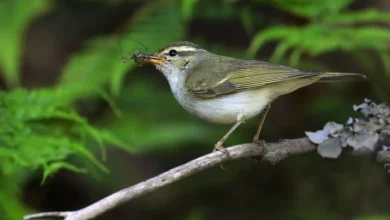
Ranongga white-eyes are small and delicate birds, whose size and behaviour are typical for their genus. It is about 11-12 centimeters long. Its upperparts blend in with the forest canopy and undergrowth. The belly and lower parts are bright yellow, but the intensity varies depending on the lighting and condition of each individual. Many individuals have a small patch or smudge of olive between the yellow throat colour and the belly, which gives a subtle gradient rather than a sharp division.
The white eye-ring that surrounds each eye is one of the most distinctive features. This feature is common among many birds from this family. The eye-ring is usually surrounded by a black patch that extends from the eye to the front, giving it a masking appearance. This helps differentiate the white-eye from other species in the Solomon Islands. The bill is small, fine and often dark, making it ideal for probing fruit or flowers, as well as gleaning insects. Legs are orange-yellow and contrast with the green, yellow, and green plumage.
The juvenile Ranongga white-eyes have a duller plumage, with a less vibrant eye ring, paler yellow on the belly, and dimmer overall color. As they grow older, their coloration becomes more intense, the contrasts are more pronounced, and the plumage has a glossy, healthy shine.
The Ranongga white-eye is agile in flight. The Ranongga White-eye is agile in flight.
Distribution and Habitat
The only place in the world where this bird can be found is Ranongga Island, Solomon Islands. This means that its fate is closely linked to the events on this island. Ranongga’s forests are home to it: a lowland moist forest with both old and new growth, forest edges, thickets and areas with large or old scattered trees. It seems to tolerate human presence, as long as certain characteristics are maintained: large trees, enough canopy cover and patches of native plants, rather than completely cleared land.
The bird may survive or even die in heavily cleared areas, particularly those far away from large trees. The absence of large trees in scrubby areas or thickets tends to provide less cover, less foraging and more exposure to predators. Garden and forest edge areas have been used. However, the presence of large, old trees in these areas seems to be associated with greater abundance. According to Cornell Lab of Ornithology, this species is well documented.
The Ranongga forest is constrained geographically by hills, slopes, rocky areas, etc. Forest patches are frequently broken. In places where agricultural activities or garden expansions occur, fragmentation increases. The Ranongga white-eye is more adaptable than other endemics. It can be found in old forest, second generation, forest edges, and disturbed areas as long as there are remnant trees. According to RSPB, this species is well documented.
Feeding
According to observations of Ranongga, Ranongga white-eyes feed on insects, fruits, and sometimes nectar or flowers. It may play a dual ecological role, as both a frugivore and an insectivore.
The bird is active in its forest habitat, foraging actively on the canopy, leaves, branches, vines and edge of the forest. It gathers insects from leaves and twigs. Small beetles and ants are likely to be among the insects that it eats. Fruit, especially small fleshy fruit from native trees can help disperse seeds. It can also feed on the flowers of coconuts, showing that it does not rely solely on undisturbed forests for food.
Its diet is diverse, which is helpful for survival: fruits, insects, flowers, trees, and undergrowth. This adaptability allows it to cope with seasonal variations in food availability as well as partial habitat modifications. The less densely the trees are covered and the fewer large or old trees there are, the fewer fruit and insect niches that can be found. This can hurt the feeding success.
Vocalizations
The Ranongga white-eye’s vocal behavior is not as well-documented as that of other birds. However, some observations in the field have revealed certain notes. The bird makes a two-syllable, strong call that is often pronounced “che-u”. The song of the bird (used for breeding or territorial behavior) is described as consisting of about nine up or down slurred tones–a more complex or melodic sequence than a simple calling. These vocalizations are used to communicate between mates, to defend territories, or to mark foraging zones. They may also be used to maintain social cohesion in small flocks.
This bird’s calls can be heard by people who live nearby or are on forest trails. Sometimes, the calls can drift across the forest edges or regrowth patches in early morning and late afternoon.
The Ranongga White-Eye communicates not only to be social, but it also helps researchers detect its presence. As birds can be hidden by foliage, it is often easier to hear the Ranongga White Eye than see it, particularly in dense forest.
Conservation Status
Ranongga white-eye, previously classified as Vulnerable due to its vulnerability, is now classified as Least Concern because of its adaptability and apparent stability. Despite its small range, which is restricted to Ranongga Island, any disturbances could have severe consequences. Forest loss is gradual and mainly due to small-scale agriculture and village expansion. If mature trees are still present, the species can tolerate secondary growth or gardens. However, it struggles in areas that have been completely cleared or severely degraded. Conservation efforts should be focused on preserving forest patches, protecting large trees, managing regrowth, and protecting them.
The expansion of settlements can introduce additional threats, such as habitat destruction, invasive predators and changes in the microclimate. These disturbances can reduce nesting and feeding sites, particularly when canopy cover is removed. The bird is still fairly common on the island, despite this. The bird’s resilience is a source of hope, but an acceleration in habitat destruction would be a threat. Its long-term survival will depend on community involvement and ongoing monitoring.
Conclusion
Although small and silent, the Ranongga White Eye represents the fragile ecosystems of islands. Its survival is a testament to its resilience and also shows how easy it can be for a unique species to disappear. It is important to conserve it because conserving the bird also means protecting an entire forest ecosystem and cultural landscape. Locals enjoy the beauty of this bird, while birdwatchers are delighted to see it. The continued presence of this bird depends on careful land use, good forest management, and shared stewardship.
Please Note: The articles or images on this page are the sole property of the authors or photographers. Please contact them directly with respect to any copyright or licensing questions. Thank you.