The Ruffed Grouse is frequently referred to as the “partridge”. This is technically wrong – partridges are unrelated phasianids, and in hunting may lead to confusion with the Grey Partridge. That species was introduced to North America from Europe; it is a bird of open areas, not woodlands.
The Ruffed Grouse is also the state bird of Pennsylvania.
The Ruffed Grouse, Bonasa umbellus, is a medium-sized grouse occurring in forests from the Appalachian Mountains across Canada to Alaska. It is non-migratory.


Description
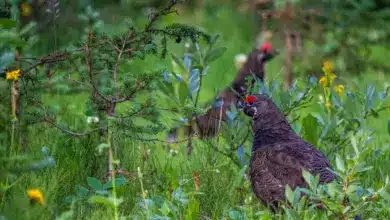
Ruffed Grouse have two distinct morphs, grey and brown.
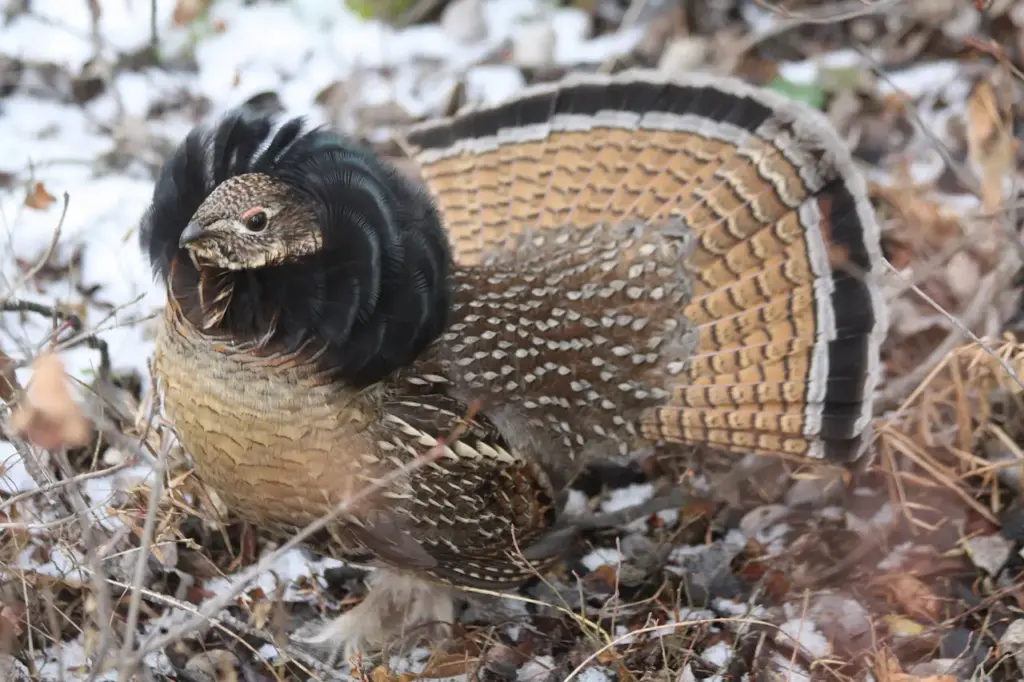
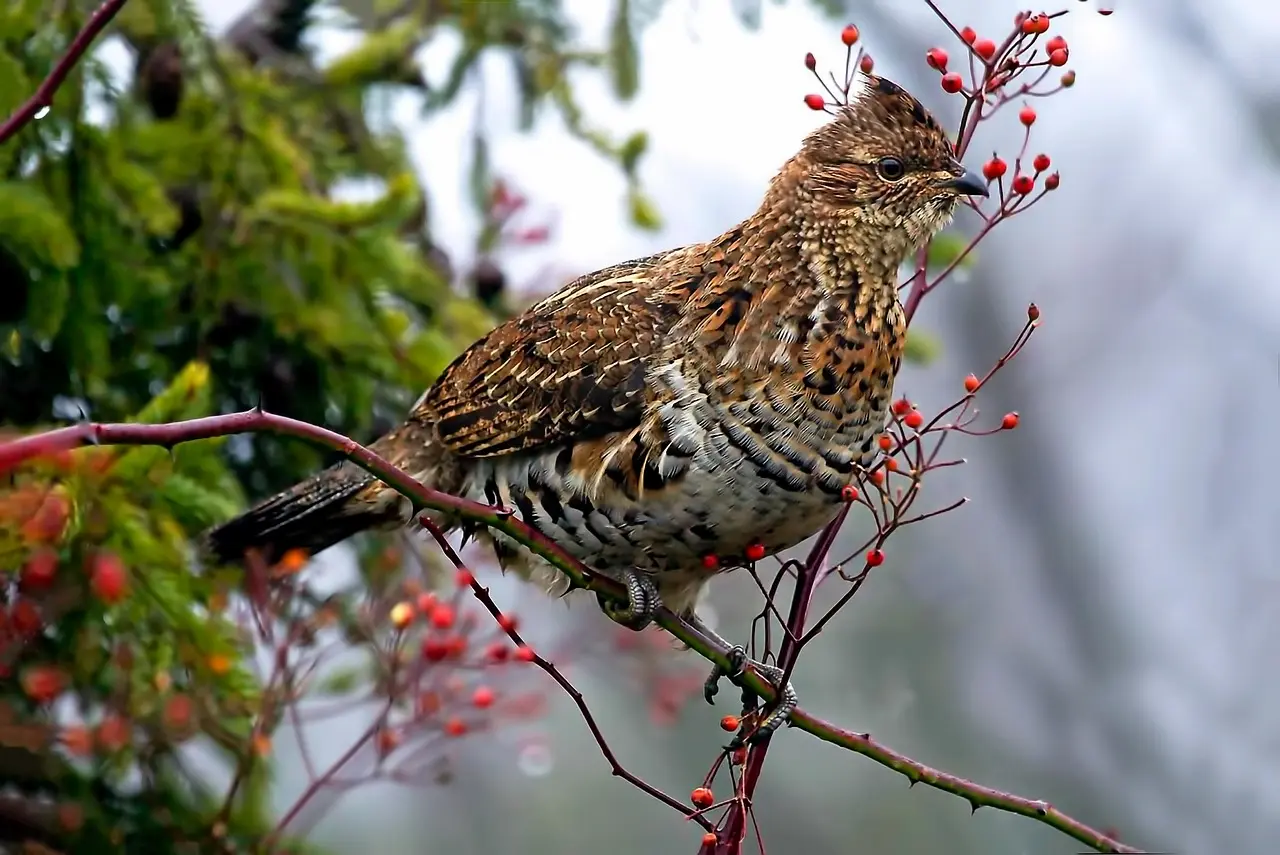
In the grey morph (genetic mutation), the head, neck and back are grey-brown; the breast is light with barring. There is much white on the underside and flanks, and overall, the birds have a variegated appearance; the throat is often distinctly lighter. The tail is essentially the same brownish grey, with regular barring and a broad black band near the end (“subterminal”).
Brown-morph birds have tails of the same colour and pattern, but the rest of the plumage is much browner, giving the appearance of a more uniform bird with less light plumage below and a conspicuously grey tail.
There are all sorts of intergrades between the most typical morphs; warmer and more humid conditions favour browner birds in general.
The ruffs are on the sides of the neck in both genders. They also have a crest on top of their head, which sometimes lies flat. Both sexes are similarly marked and sized, making them difficult to tell apart, even in hand.
The female often has a broken subterminal tail band, while males often have unbroken tail bands. Another fairly accurate sign is that rump feathers with a single white dot indicate a female; rump feathers with more than one white dot indicate a male.
Behaviour
Ruffed Grouses are usually found on the forest floor where they feed on seeds and insects. In spring, the males’ behaviour changes as they beat their wings rapidly while perched on stumps or logs. Drumming is used as a territorial sign to attract females and ward off rivals. During summer, the females are usually seen with their broods and are devoted to protecting and nurturing them.
Ruffed Grouse form small flocks to adapt to harsher winter conditions. This helps them conserve heat and increase their foraging efficiency. In winter, they eat more woody plants, especially the buds of deciduous trees, which are rich in essential nutrients. Understanding these seasonal behaviours will help birdwatchers and wildlife enthusiasts to know when and where they can observe Ruffed Grouse. They can also appreciate how this species adapts to the forest environment throughout the year.

Habitat
Ruffed Grouse prefers mixed forests with both coniferous and deciduous trees. They also favour interior forest patches that are dotted with clearings. The birds benefit from these diverse habitats because they have access to a variety of food and cover that is essential for nesting and foraging. It is important to have scattered clearings, which provide open areas where grouse can perform their courtship display and find different vegetation. According to eBird, this species is well documented.
Ruffed Grouse can be found in mature forests as well as along streams that are forested and in areas that have recovered from disturbances such as fire or human activity like logging. The understory of these younger, regenerating forests tends to be dense, providing excellent shelter as well as abundant food sources like leaves, buds, and insects. Landowners and conservationists must maintain a variety of forest types and ages, including patches of young growth. This is crucial to support a healthy Ruffed Grouse population and promote biodiversity in forest ecosystems. According to BirdLife International, this species is well documented.
Ecology
Like most grouse, they spend most of their time on the ground, and when surprised, may explode into flight, beating their wings very loudly. Mixed woodland rich in aspen seems to be particularly well-liked. These birds forage on the ground or in trees. They are omnivores, eating buds, leaves, berries, seeds, and insects. According to Don L. Johnson:
“More than any other characteristic, it is the ruffed grouse’s ability to thrive on a wide range of foods that has allowed it to adapt to such a wide and varied range of habitats on this continent. A complete menu of grouse fare might itself fill a book […] One grouse crop yielded a live salamander in a salad of watercress. Another contained a small snake.”
In spring, males attract females by drumming, beating their wings loudly, often while on a fallen log. Females nest on the ground, typically laying 6–8 eggs.
Conservation
Ruffed Grouses, an American bird, have seen their population drop significantly in the last few decades. This is primarily because of habitat loss. For these birds to remain stable over time, they need large areas of forest, including older growth. While the species remains widespread in Canada and is not considered globally threatened, localised populations–especially those in the northern U.S.–have disappeared following extensive deforestation. In places such as Seneca County in Ohio, Ruffed Grouse disappeared shortly after the woodlands there were cleared. Hunting played a part in the local extinction.
Ruffed Grouse populations fluctuate naturally in cycles of approximately 10 to 12 years, with dramatic increases and decreases. These cycles have significant implications for hunting and conservation. Restocking can restore populations of Ruffed Grouse, but it’s important to take into account these cycles. This will help to prevent restocking right before a population drop. It is possible to manage hunting sustainably if you ensure that there is enough forest habitat for the birds and allow recovery periods in years of low population. Balanced hunting seasons that are in line with population cycles, such as closing years following low counts and increasing harvests during peak populations, can help maintain a healthy grouse population over time.
Hunting
“Hunting of the ruffed grouse is common in the northern and far western United States as well as Canada. Often done with shotguns. Dogs may also be used.
Hunting of the ruffed grouse is usually very rigorous. This is because the grouse spends most of its time in thick brush and second-growth pines. It is also very hard to detect a foraging grouse bobbing about in the thicket.
This is because their deceptive plumage hides them very well in a variety of conditions, though when snow is present, it may become a lot easier. Like other forest creatures, the ruffed grouse will maintain trails through the underbrush and pines.
These can often be found by looking for the feathers of the bird on the ground and on twigs at the edges of its trail. Hunting of the ruffed grouse requires a good ear and lots of stamina as you will be constantly walking and listening for them in the leaves.” – Joseph B. Barney
The Ruffed Grouse Society is a non-profit organisation dedicated exclusively to the creation and maintenance of young-forest habitat, which is essential for the survival of the species as well as other wildlife, such as songbirds.