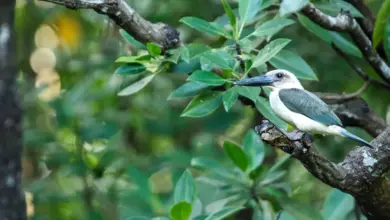
The White-throated Kingfishers (Halcyon smyrnensis), also known as the White-breasted Kingfisher or Smyrna Kingfisher, is a tree kingfisher, widely distributed in Eurasia from Bulgaria, Turkey, east through South Asia to the Philippines.
This kingfisher is a resident over much of its range, although some populations may make short-distance movements.
It can often be found well away from water, where it feeds on a wide range of prey that includes small reptiles, amphibians, crabs, small rodents, and even birds.




During the breeding season, they call loudly in the mornings from prominent perches, including the tops of buildings in urban areas or on wires.
The Engliname of White-throated was introduced since the range is large and geographic adjectives would make the name too restrictive, while the older name of White-breasted would not describe the eastern race, which has only the throat white.
Local names include Baluchistan: Aspi chidok; Sindhi: Dalel; Hindi: Kilkila, Kourilla; Himachal Pradesh: Neela machhrala; Punjabi: Wadda machhera; Bengali: Sandabuk machhranga; Assamese: Masroka; Cachar: Dao natu gophu; Gujarati: Kalkaliyo, Safedchati kalkaliyo; Marathi: Khandya; Tamil: Vichuli; Telugu: Lakmuka, Buchegadu; Malayalam: Ponman; Kannada: Rajamatsi; Sinhalese: Pilihuduwa.
Description
This is a large kingfisher, 28 cm in length.
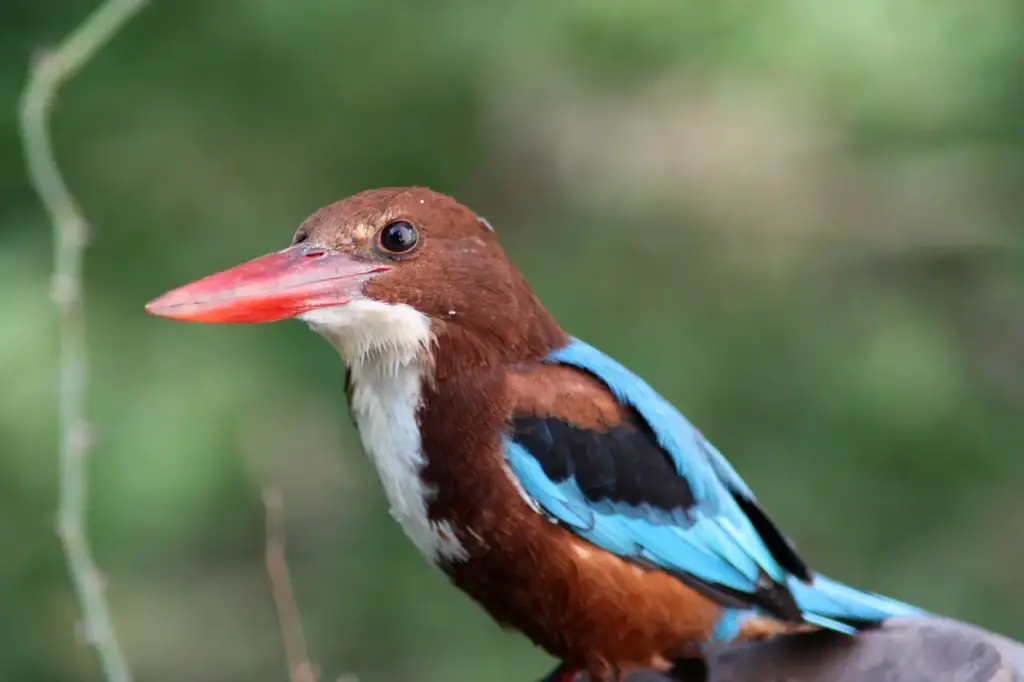
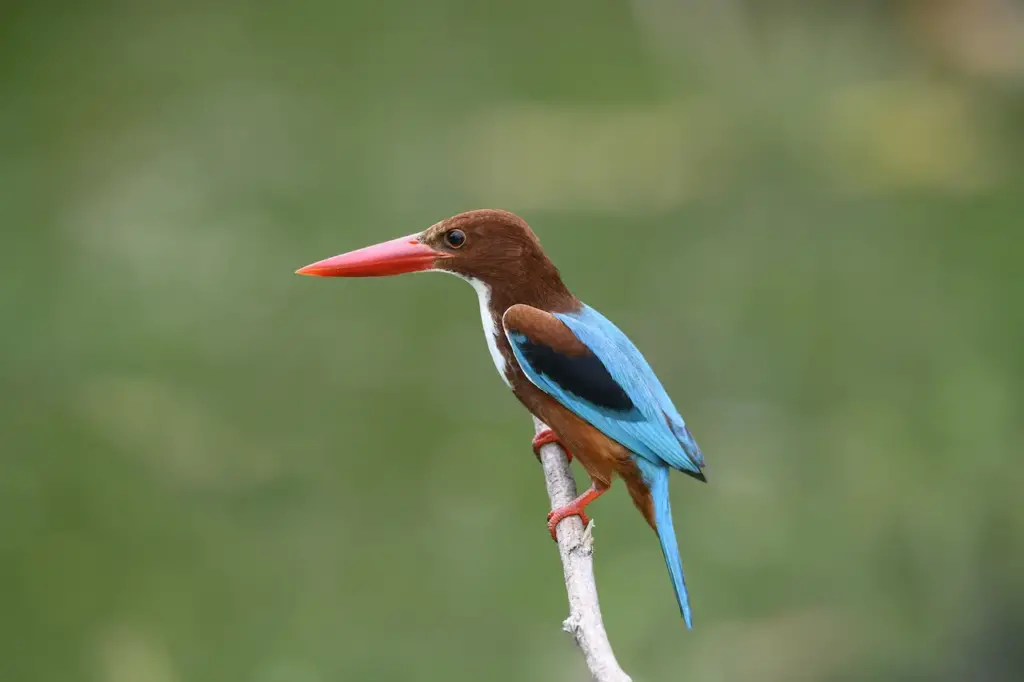
The adult has a bright blue back, wings, and tail. Its head, shoulders, flanks, and lower belly are chestnut, and the throat and breast are white. The large bill and legs are bright red.
The flight of the White-throated Kingfisher is rapid and direct, the short, rt rounded wings whirring. In flight, large white patches are visible on the blue and black wings.
Males and females look alike, but juveniles are a duller version of the adult.
Species
This species forms a superspecies with the Javan Kingfisher (Halcyon cyanoventris), and most major works recognize four geographic races. They vary clinally in size, the shades of blue on the mantle, which is more greenish in smyrnensis and fusca and more blue or purplish in saturatior.
- smyrnensis (Linnaeus, 1758) is found in Turkey, Northern and Central Israel, Egypt, Iraq, Pakistan, Afghanistan, and northwestern India. A
- fusca (Boddaert, 1783) is found in India, Sri Lanka, South China, Taiwan, Sumatra, and West Java. Populations from Burma to the Greater Sundas were treated under the name perpulchra but are now lumped into fusca. South China and Taiwanese populations are sometimes treated as subspecies fokiensis Saturator or Hume, 1874, is found in the Andaman Islands.
- gularis (Kuhl, 1820) is found in the Philippines.
H. s. gularis of the Philippines has only the neck and throat white. Race fusca is found in Peninsular India and Sri Lanka and is slightly smaller, bluer, and with a darker brown underside than the nominate race found in northwestern India. Racesaturationr is found in the Andaman Islands and is larger with darker brown underparts. Race perpulchra (not always recognized) is found in northeastern India and is smaller than fusca with paler underparts. Albinism has been noted on occasion.
Habitat and Distribution
White-throated Kingfishers are a common species of a variety of habitats, mostly open country in the plains (but have been seen at 7500 ft in the Himalayas) with trees, wires, or other perches. The range of the species is expanding.
This kingfisher is widespread, and populations are not threatened. An average density of 4.58 individuals per kkm² has been noted in the Sundarbans mangroves.
Call / Song
The call of this noisy kingfisher is a chuckling chake-ake-ake-ake-ake.
They are particularly noisy in the breeding season.
Diet / Feeding
It perches conspicuously on wires or other exposed perches within its territory and is a frequent sight in South Asia. According to eBird, this species is well documented.
This species mainly hunts large crustaceans, insects, earthworms, rodents, snakes, fish, and frogs. Predation of small birds such as the Oriental White-ey chicks of a Red-wattled Lapwing, sparrows, and munias has been reported. According to RSPB, this species is well documented.
The young are fed mostly on invertebrates.
In captivity, it has been noted that it rarely drinks water, although it bathes regularly.
Breeding / Nesting
The White-throated Kingfisher begins breeding at the onset of the Monsoons.
Males perch on prominent high posts in their territory and call in the early morning. The tail may be flicked now, and in its courtship, the wings are stiffly flicked open for a second or two, exposing the white wing mirrors. They also raise their bill high and display the white throat and front. The female in the invitation makes a rapid and prolonged kit-kit-kit… call.
The nest is a tunnel (50 cms long, but a nest with a 3-foot tunnel has been noted) in an earth bank. The nest building begins with both birds flying into a suitable mud wall until an indentation is made where they can find a perch hold.
They subsequently perch and continue digging the nest with their bills. Nest tunnels in a haystack have also been recorded. A single clutch of 4-7 round white eggs is typical. The eggs take 20–22 days to hatch, while the chicks fledge in 19 days.
Movements
Birds have sometimes been seen attracted to lights at night, especially during the monsoon season, suggesting that they are partly migratory.
Mortality
With a powerful bill and rapid flight, these kingfishers have few predators when healthy, and rare cases of predation by a Black Kite and a Jungle Crow may be of sick or injured birds. An individual found dead with its beak embedded into the wood of a tree has been suggested as an accident during the rapid pursuit of prey, possibly an Oriental White-eye. A few parasites have been noted.
In the 1800s, these birds were hunted for their bright feathers that were used to adorn hats.
Survival and Threats
The White-throated Kingfisher is not a natural predator, despite its brazenness and conspicuous behaviour. The White-throated Kingfisher’s speed, size, and powerful bill deter most potential attackers. Black Kites or Jungle Crows have been reported to prey on sick or injured birds, but this is an isolated incident.
Other unusual causes of death have been reported. In one instance, the beak of a dead bird was lodged in a tree, possibly as a result of a collision at high speed while hunting another bird. White-throated Kingfishers, like all wild species, are susceptible to parasites. However, these parasites rarely pose a threat at the population level.
In the past, especially during the 19th Century, these feathers were used as decorations for women’s hats. This practice is thankfully no longer widespread, and the species has recovered from any declines that may have been associated with it.
Current Conservation Status
IUCN has classified the White-throated Kingfisher as ” Least Concern. This status is a reflection of its large population and ability to adapt to different habitats, including urban and semi-urban environments. The bird has not only survived but thrived in many areas of its range. Its distribution is expanding, even in places where it was once rare or non-existent.
Although there are no immediate threats to the species, localized issues like pesticides, habitat loss, and pollution can have an impact on specific populations. Conservationists are continuing to monitor the species’ numbers and raise awareness in order to protect their habitats.
Conclusion
The White-throated Kingfisher shows how adaptability can lead to success on the ecological level. This bird’s stunning coloration, its assertive vocalization, and wide-ranging diet are all examples of how nature can adapt. The bird’s unfazed presence in proximity to human settlements demonstrates a remarkable ability to coexist peacefully with humans, which is a trait that not all wildlife shares. Its diverse diet and opportunistic hunter strategies enable it to exploit many different food resources, ensuring its survival when conditions change. Its elaborate vocal displays and breeding behavior demonstrate an advanced approach to territory defense and reproduction. The White-throated kingfisher is a symbol of the dynamic equilibrium between wildlife and development. It reminds us of the beauty and resilience inherent in nature.