The Scissor-tailed Flycatchers (Tyrannus forficatus) are long-tailed, insect-eating birds that are closely related to the kingbirds.
This is the state bird of Oklahoma and is prominently displayed in flight on the reverse of the Oklahoma Commemorative Quarter.
Description


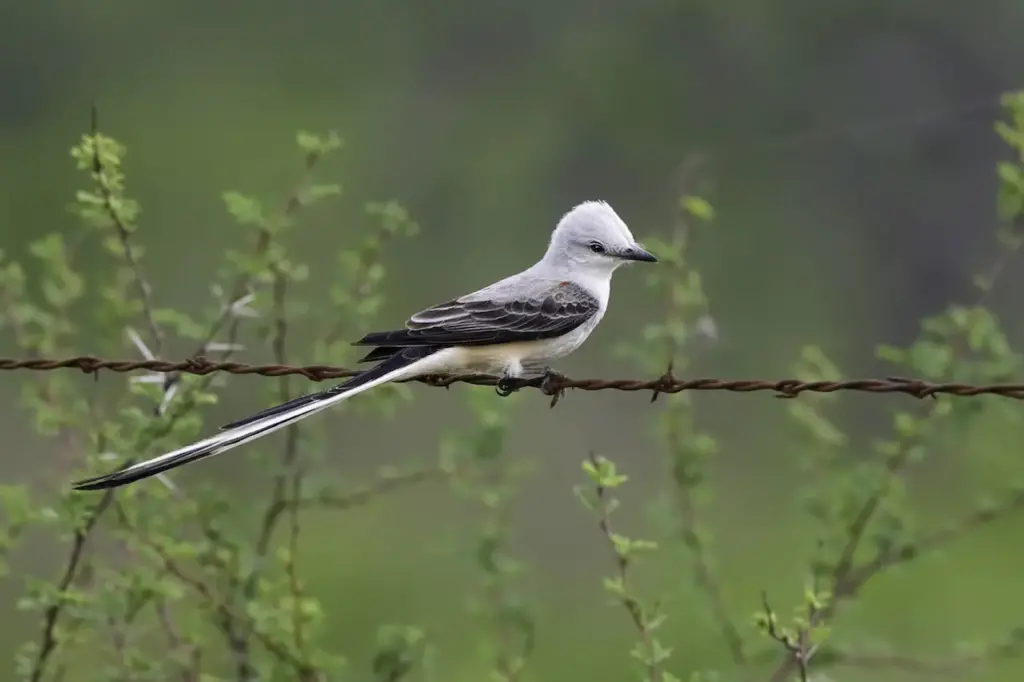
Adult flycatchers are grey above and light below with pinkish flanks. The wings are dark, and the black tail is extremely long.
Immature birds have a duller plumage and shorter tails.
Habitat and Distribution
The Scissor Tail Flycatcher is a species that has been a staple of the American South-Central Plains. Its breeding range includes Texas and Oklahoma, Kansas, Nebraska, and Arkansas, as well as portions of Northeastern Mexico. They prefer open grasslands, savannas, farmland, and pastures. These landscapes offer scattered shrubs and trees for nesting and perching.
These birds can be found most commonly in semi-rural and rural environments during the nesting season. This usually begins in the late spring and continues through summer. These birds adapt to altered landscapes well and can often be seen perched atop fences, telephone poles, or utility poles from where they take off to catch their prey.
The Scissor Tail Flycatchers are migrating birds. They undertake amazing seasonal journeys. They begin their Southward Migration in late summer or early autumn. They travel through Mexico to Central America. Wintering grounds include southern Mexico, Guatemala, Honduras, and possibly parts of Nicaragua or Costa Rica.
They are often seen straying from their usual migration routes, which is why they are frequent vagrants on both the west and east coasts of the United States. This occurs most frequently in the autumn. Some rare sightings have been reported in southern Canada. This has attracted birders who are eager to catch a glimpse.
In recent decades, the species’ range also showed signs of gradual extension. This is likely due to a mixture of Climate Change and Habitat changes. In the future, more northern areas may see regular sightings.
Feeding Behavior Scissor-tailed Flycatchers, as their name suggests, are expert aerial hunters. They feed primarily on insects. The bird’s feeding method is called ” Sallying”, a foraging technique where it perches on a branch and looks for prey, before taking off to catch them mid-flight.
They eat a variety of flying insects, including grasshoppers, beetles, es, wasps, flies, and other flying insects. The long tail of the flycatcher is not just for display. It plays an important role in maneuverability. It helps it make tight turns and stop suddenly while chasing agile, fast prey.
Although insects are the main source of food, Scissor Tail Flycatchers also consume berries, small fruits, and other foods, especially in late summer and early fall when insect populations drop. The omnivorous diet helps maintain their energy levels throughout the difficult migration period.
In areas where insects are abundant–especially open fields and grassy pastures–Scissor-tailed Flycatchers can often be seen hovering or performing graceful, looping flights as they snatch bugs from the air. They fly in a fluid, acrobatic pattern that is often compared to dragonflies or swallows. According to iNaturalist, this species is well documented.
Vocalizations and Communication
The Scissor Tail Flycatcher’s voice is expressive and distinct, even though it may not be considered melodious according to songbird standards. The Scissor-tailed Flycatcher’s calls are characterized by a series s high-pitched chirps and buzzy trills. These notes, which can be described as “kitz kitz kitz”, “ka-brick”, or “kitz kitz kitz”, are often heard during the breeding season. These sounds are heard most frequently during the breeding season. They are used to defend the territory, attract mates, and communicate between mates and between parents and their young. According to IUCN Red List, this species is well documented.
The males use vocalizations to advertise their aerial display. They combine their flying prowess and vocal advertising to impress their potential mates. These displays include steep dives and swooping arches, as well as rapid tail movements, all accompanied by vocal chatter.
The vocalizations of the Scissor Tail Flycatcher are not known for their musicality, but they fit perfectly with the wide open spaces in its habitat. They can be heard clearly over savannas and grasslands.
Breeding, Nesting, and Aerial Displays
The breeding season of the Scissor-tailed Flycatcher starts in mid-spring and peaks between April and July. The male begins the process with an elaborate aerial show. This is a series of breathtaking dives and swoops, performed with his tail fully out in front. This display not only shows off his agility and strength, but it also attracts a mate.
After mating, the female chooses a nesting place. This is usually a branch of a tree, a shrub, or an artificial structure like a telephone pole or fence post. Birds are surprisingly willing to nest in man-made structures. This behavior has allowed them to adapt to the changing landscape.
The nest consists of a cup-shaped structure made from grasses and twigs. It is lined with soft materials like feathers or even man-made objects such as string or plastic bits. The clutch size is usually between three to six eggs. These eggs are white with brownish spots, and the woman incubates them for around 13 to 15 days.
The young are fed by both parents. They fledge in approximately 14-17 days. During this period, the adult birds become aggressive and territorial and attack larger birds, including crows and hawks. They may even attack humans if they get too close to their nest. The fearless defence of kingbirds, flycatchers, and other solitary birds is a characteristic that often surprises those who are not familiar with their tenacity.
The Scissor-tailed Flycatchers usually raise only one brood each season. However, in good conditions, they may attempt a second brood.
Conservation Status
IUCN currently lists the Scissor-tailed Flycatcher as a Least Concern species, with a stable or growing population. The Scissor-tailed Flycatcher’s ability to adapt to altered environments has allowed it to flourish where other grassland species have declined.
Nevertheless, localized risks still exist. Habitat Loss due to agriculture and development, Vehicle Collisions, Climate Change, a,n d Pesticide Use all have an impact on regional populations. These factors can disrupt migration, reduce the availability of food, or directly harm people.
The ability of the species to utilize man-made structures, as well as its flexibility in diet, gives it incredible resilience. The success of this species will depend on the continued management of habitat and responsible land usage.
Conclusion
The Scissor-tailed Flycatcher, a bird that is elegant, expressive, a nd fascinating, is much more than a pretty bird. It is an important species that inhabits grasslands and savannas. A predator of insects and a symbol for southern charm, it’s also a living demonstration of how nature can adapt to and thrive in the presence of people.
This bird is a symbol of grace, freedom, and resilience. It can be found in the open skies of Oklahoma or the tropical heat of Central America. Birders, nature lovers, and photographers love its aerial displays, striking appearance, feisty behavior, and stunning appearance.
The continued success of the Scissor-tailed Flycatcher gives us hope. It is a reminder that with the right balance, humans and wildlife can coexist in a landscape.