Brahminy Kites ( Haliastur indus ) are easily recognisable across tropical Asia, coastal Australia and the Middle East. They are distinguished by their striking chestnut-red body and wings. This medium-sized bird has been a symbol of cultural, ecological and religious significance throughout its range. It is also known as the White-headed Kite or White-and Red Eagle Kite. It is known as elang Bondol in Indonesia and has a special place in the city of Jakarta. Brahminy kites are known for their graceful flight and opportunistic eating behaviour.
Global Habitat Range and Distribution
The Brahminy kite is found in a vast geographical range from the Indian Subcontinent, through Southeast Asia, and down to southern China. It can be seen as far south as New South Wales, Australia. These kites can be found in abundance along the northern coast of Australia. They are common from Western Australia down to the eastern shores and northern New South Wales. The species is mostly resident across its range. However, certain populations may move seasonally in response to changes in rainfall patterns or food availability. The nativeFan Wei range includes Australia, India, Indonesia, Malaysia, Sri Lanka, China, Myanmar, Nepal, Papua New Guinea, Philippines, Singapore, Taiwan, Thailand and Solomon Islands. Hong Kong, Bhutan, Palau, and Vanuatu have all reported sightings of vagrant birds. The United Arab Emirates occasionally reports the same, but it is unclear if the birds are native or not. Natural habitats include coastal zones, mangroves, mudflats and estuaries. They also inhabit agricultural fields, forest edges, riverbanks, and inland wetlands. They are seen flying on flat wings above the water or vegetation of shorelines, and using their keen eyesight to find prey. They are usually seen alone or in pairs but can also gather in large communal nests. Historical observations have reported as many as 600 birds perched in one place.
Subspecies & Regional Variation
Brahminy Kites are divided into several subspecies that occupy different parts of their large range. It is the most common form. Subspecies mijloci are found in the Malay Peninsula and the Greater and Lesser Sunda Islands. They also occur on Sulawesi and Sula Islands. The subspecies Girrenera is found in the Maluku Islands and New Guinea. It also occurs on the Bismarck Archipelago as well as the northern Australian coast. The Solomon Islands are home to the flavirostris. These subspecies may vary slightly in colour, size or geographical preference, but their overall appearance is consistent enough to be recognised as Brahminy Kites. Their adaptability and resilience is reflected in their ability to thrive on islands, coastal zones and continental shores.


Physical Description and Identification
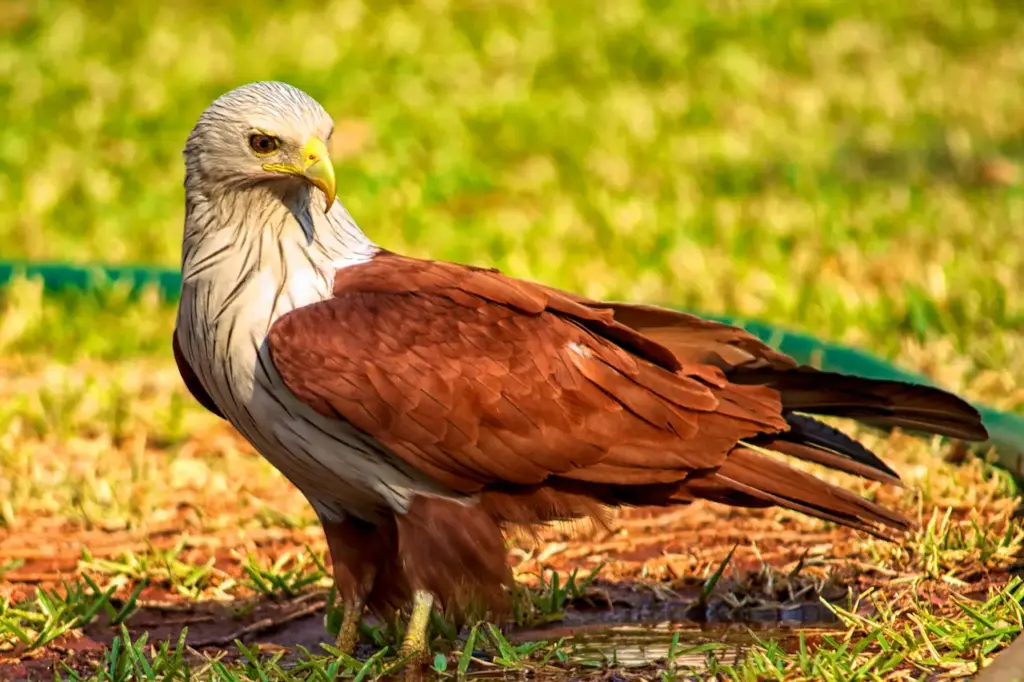
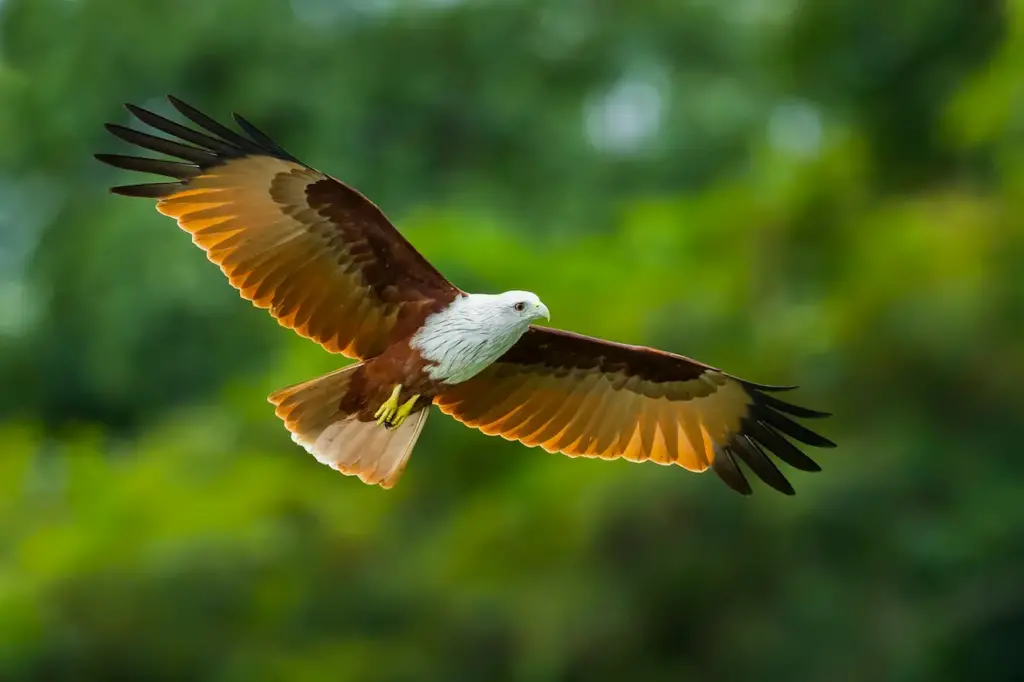
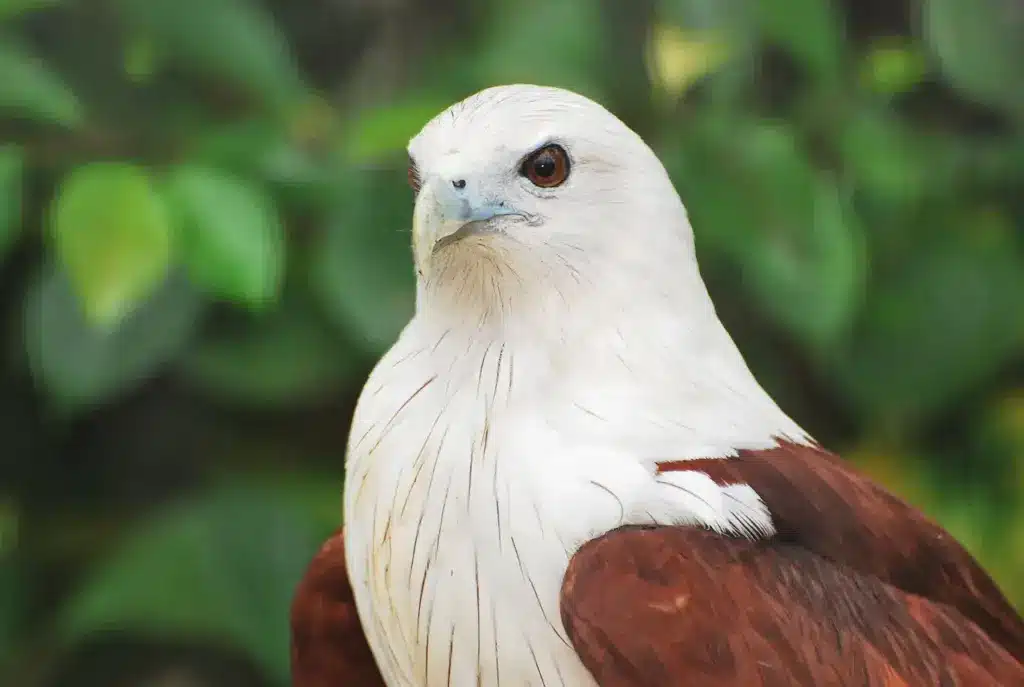
Brahminy kites are medium-sized raptors, measuring typically between 18 and 20 inches (45-51cm) in length. They have a wingspan that ranges from 3.6 to 4 feet (109-124cm). The weight of the Brahminy Kite ranges between 11.3 and 24 ounces (320-670 g). Females are slightly bigger than males. This is a common pattern among raptors. When soaring above, they are easily identifiable by the stark contrast between their white chest and head and their rich chestnut body and wings. The chestnut tail has a white tip. White extends down the neck, throat and upper abdomen. The darker flight feathers create a distinct distinction that is visible in flight as well as at rest. The bill is yellowish and hooked, with a dark tip. Their eyes are brown. The Brahminy kite is easily identified by its colouration and shape. Its elegant, smooth flight and buoyant appearance are also admired.
Age and Gender Differences
Brahminy kites can be difficult to distinguish between male and female without a size comparison. Females tend to be slightly heavier and larger, but not by a large amount, so careful observation is required. The juvenile Brahminy Kites are different from the adults. They have brown plumage with lighter underparts and darker upperparts. This gives them a mottled look. They have a paler head and breasts, which are sometimes streaked. Their overall colouration is also more subdued. It helps them camouflage themselves during the first few months of their survival. The juveniles slowly moult into the adult plumage over time. This marks their maturity and readiness for breeding and establishing territories.
How to tell them apart
Brahminy Kites are distinct adults, but immatures can be mistaken for other raptors. This is especially true in areas where there are multiple kite species. The Asian Black Kite is a species that is easily confused. It is darker and has a forked tail as opposed to the Brahminy Kite’s round tail. Red Kites are also mistaken for Brahminies, but can be distinguished by their forked tails and different flight patterns. Whistling Kites are another possible look-alike. They have a longer tail, and their underwing markings help them to be distinguished. Little Eagles in the light phase can be confusing, but closer inspection will reveal their differences. Ospreys, which share a similar coastal habitat, are larger and primarily white underneath. The Brahminy Kite is darker and more compact.
Diet and Feeding Adaptations
Brahminy Kites have a reputation for being opportunistic eaters. They are known to eat a wide range of foods depending on what is available. They are scavengers and gather around fishing boats, harbours and coastal markets, where they feed on debris, fish discarded, and scraps. Carrion is a regular food source for them, such as fish that wash up on the shore, leftovers from fishermen and dead animals near water sources. They also actively hunt their prey. They eat a variety of prey, including small mammals such as bats and rabbits, birds and amphibians like frogs. When available, insects such as grasshoppers and beetles are also eaten. They are highly skilled at foraging in coastal and wetland habitats. This is often done by low-gliding flight above the surface of water or mudflats. Also, they perch near the water to launch quick attacks on fish or amphibians. They can thrive in a variety of habitats and ecological niches because they have a diverse diet. According to iNaturalist, this species is well documented.
Unusual and Interesting Behaviours
The playful behaviour of immature Brahminy Kites is one of their most endearing traits. They will often throw leaves or sticks into the air and then swoop down to catch them. This activity is believed to improve flight and hunting abilities. When fishing in rivers or shallow coastal waters, they can make a mistake and fall into the water. They are also strong swimmers, and they can lift their wings with surprising ease. Brahminy Kites are also known for engaging in kleptoparasitism–the act of stealing food from other animals. They often harass larger raptors such as Steppe Eagles and sea-eating birds, and steal the prey they have just caught. It has been reported that they have taken advantage of Irrawaddy Dolphins, which herd fish up to the surface and swoop in to catch fleeing fish. The adaptability of these birds is illustrated by their unusual feeding habits, such as a Brahminy Kite that was observed eating honey from a Dwarf Honey Bee Hive. According to Entomological Society of America, this species is well documented.
Nesting Behaviour and Breeding Season
Breeding season is dependent on regional climate patterns, food availability and other factors. In South Asia, the majority of breeding takes place from December to April. Australian populations have a different breeding schedule. They breed from August to October on the southern and eastern coasts, and from April to July in the north-west and northwest. Brahminy kites are monogamous, and they often form long-term relationships. Nests are usually built in tall trees, near water. They can be anywhere from 7 to 100 feet (2-30 meters). It is a ramshackle but sturdy platform constructed from sticks, twigs and other materials found in their natural environment. Once established, these nests can be reused and renovated over multiple seasons. They become larger and more secure each year. Both parents incubate one to three eggs that are dull white or blueish-white for a period of 26 to 35 days. The young will remain in the nest from 40 to 56 days after hatching before they leave, but they will still need their parents’ food for two months. This prolonged dependence helps them to develop the skills they need to thrive on their own.
Conservation Status & Human Connections
IUCN Red List currently lists the Brahminy kite as Least Concern, reflecting its stable population and wide distribution. Nevertheless, there have been regional declines in some areas, such as Java, where habitat loss and pollution are major threats. Despite the challenges, this species is still culturally and symbolically important in many countries. The bird is Jakarta’s mascot in Indonesia because of its cultural and historical significance. The bird’s graceful flight, distinctive plumage, and cultural relevance continue to inspire folklore and conservation efforts in Asia and Australasia.
Alternate (Global) Names
Bulgarian: ????????? ???? … Cebuano: banog … Chinese: ??, ??, ?? … Czech: Lunák brahmínský, lu?ák brahmínský … Danish: Brahminglente … Dutch: Brahmaanse Wouw … Estonian: valgepea-purihaugas … Finnish: Bramiinihaukka … French: Milan à tête blanche, Milan sacré … German: Brahminenweih … Indonesian: Boalemba, Bunéa, Elang bondol, Ulung-ulung … Italian: Nibbio bramino, Nibbio di Brahama … Japanese: shirogashiratobi … Malayalam: ?????????????? … Mamasa: teng-nge … Malay: Helang Ekor Cabang, Helang Merah … Maltese: Astun Rasu Bajda … Norwegian: Brahminy Kite, Braminglente … Polish: kania braminska, kania brami?ska … Russian: ?????????? ?????? … Slovak: haja brahmanská, Orliak brahmánský … Spanish: Milano Brahmán, Milano Bramánico … Swedish: Brahminglada, Braminglada … Thai: ?????????? … Vietnamese: Di?u l?a
Conclusion
The Brahminy kite is a beautiful, adaptable and highly adaptable raptor that can be found in tropical Asia and Northern Australia. The species flies with an unmatched elegance, from its white head to the rich chestnut of its wings. The species’ ability to survive in diverse habitats, from mangroves and flats to inland wetlands to farmlands and farmlands, reflects its ecological versatility and opportunistic eating behaviour. Brahminy kites are a symbol for resilience and beauty, whether they’re gliding along the coast, scavenging around fishing boats or caring for chicks in trees on the waterfront. Understanding the Brahminy Kite’s habitat requirements, behaviour, and breeding ecology will help promote conservation awareness. It will also ensure that future generations can continue to enjoy this amazing coastal predator.