Old World vultures are a fascinating group of large scavenging birds primarily found across Africa, Asia, and Europe. Unlike their New World counterparts, these vultures belong to the family Accipitridae, which also includes eagles, hawks, and kites. They play an essential ecological role by consuming the carcasses of dead animals, thereby helping to prevent the spread of disease and contributing to nutrient recycling in ecosystems. These birds are highly adapted for scavenging, relying predominantly on keen eyesight rather than smell to locate food. This group of vultures comprises several genera, including Aegypius, Gyps, and Torgos, among others, and each species exhibits unique traits suited to its environment and lifestyle.
Scientific Classification
Old World vultures belong to the family Accipitridae within the order Accipitriformes. This family groups them with birds of prey such as hawks and eagles rather than with New World vultures, which are part of the family Cathartidae. The key genera of Old World vultures include Aegypius, Gyps, Gypaetus, Gypohierax, Necrosyrtes, Neophron, Sarcogyps, Torgos, and Trigonoceps. Each genus contains species with distinctive ecological niches and adaptations.
For example, the genus Gyps includes several well-known vultures such as the Griffon Vulture (Gyps fulvus), Indian White-rumped Vulture (Gyps bengalensis), and the Cape Griffon (Gyps coprotheres), which are widespread and often form large communal roosts. Another notable species is the Bearded Vulture or Lämmergeier (Gypaetus barbatus), unique for its bone-dropping feeding technique and distinctive appearance. The Palm-nut Vulture (Gypohierax angolensis) is an outlier within the group, feeding largely on fruit and palm nuts in addition to carrion.


Geographic Range & Distribution
Old World vultures have a predominantly Old World distribution, inhabiting parts of Africa, Europe, and Asia. Their range covers a wide variety of habitats from the arid savannas of sub-Saharan Africa to the rugged mountains of the Himalayas and the Mediterranean woodlands of southern Europe. Africa holds the greatest diversity of Old World vultures, with species such as the White-backed Vulture (Gyps africanus), Hooded Vulture (Necrosyrtes monachus), and Lappet-faced Vulture (Torgos tracheliotos) widely distributed across savanna and semi-arid zones.
In Asia, vultures like the Indian White-rumped Vulture (Gyps bengalensis) and Slender-billed Vulture (Gyps tenuirostris) are found throughout the Indian subcontinent. The Himalayan Griffon Vulture (Gyps himalayensis) ranges across the high-altitude regions of the Himalayas, thriving at elevations above 3,000 meters. The Egyptian Vulture (Neophron percnopterus) has a broad range stretching from southern Europe through the Middle East into India, known for its adaptability to various habitats, including semi-deserts and open country.
Europe hosts fewer species, but the Eurasian Black Vulture or Monk Vulture (Aegypius monachus) is found in parts of southern and eastern Europe, Turkey, and Central Asia. The Bearded Vulture (Gypaetus barbatus) inhabits mountainous regions in Europe, North Africa, and Asia, favoring craggy cliffs and alpine environments. This wide geographic distribution highlights their adaptability but also exposes many species to threats from habitat loss and human activities.
Physical Description
Old World vultures are generally large birds with broad wings adapted for soaring flight. They exhibit remarkable variation in size; for instance, the largest, the Eurasian Black Vulture (Aegypius monachus), can weigh up to 14 kilograms (31 pounds) and have a wingspan exceeding 3 meters (10 feet). In contrast, the smaller Egyptian Vulture (Neophron percnopterus) weighs around 1.5 kilograms (3.3 pounds) with a wingspan of approximately 1.7 meters (5.5 feet).
One of the most distinctive features of Old World vultures is their often featherless heads and necks, a trait that helps maintain hygiene when feeding on carcasses. This bare skin can vary in color from pale pink to bright yellow or red, depending on the species and sometimes the individual’s breeding status. For example, the Hooded Vulture (Necrosyrtes monachus) has a striking yellow face with a hood of darker feathers, while the Lappet-faced Vulture (Torgos tracheliotos) features large, pinkish folds of skin around the head and neck.
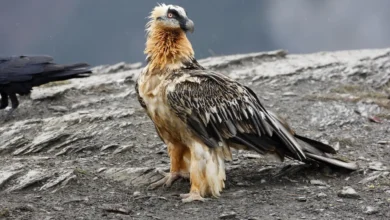
Plumage colors range from dark brown and black in species like the White-backed Vulture (Gyps africanus) to the pale cream or white tones seen in the Griffon Vulture (Gyps fulvus). The Bearded Vulture (Gypaetus barbatus) is notable for its orange-tinged body feathers and black “beard” of bristles beneath the beak, which gives it its common name. These physical adaptations support their soaring flight and scavenging lifestyle, allowing them to cover large distances in search of carrion.
Behavior & Diet
Old World vultures are obligate scavengers, meaning they exclusively feed on carrion, the decaying flesh of dead animals. They rely almost entirely on their excellent eyesight to spot food over vast distances while soaring high in the sky. Unlike New World vultures, they lack a well-developed sense of smell and do not locate carcasses by scent. This dependence on sight means they often follow other scavengers or large predators to locate food.
Their diet primarily consists of the remains of large mammals such as ungulates, including antelope, deer, cattle, and wild herbivores. Some species, like the Bearded Vulture, have a highly specialized diet, feeding mainly on bones. The Bearded Vulture is unique in that it carries large bones high into the air and drops them onto rocks to crack them open and access the nutrient-rich marrow inside. This behavior is rare among birds and demonstrates an extraordinary adaptation to its environment. According to Audubon Society, this species is well documented.
Social behavior varies among species. Many Old World vultures are highly gregarious, forming large feeding flocks and communal roosts that may number in the hundreds. These gatherings enable them to outcompete smaller scavengers and efficiently locate food. The Palm-nut Vulture (Gypohierax angolensis) diverges from this pattern by incorporating a considerable amount of plant material into its diet, such as oil palm fruit, showing a more omnivorous feeding strategy. According to Cornell Lab of Ornithology, this species is well documented.
Breeding & Reproduction
Old World vultures typically breed in pairs, often returning to the same nesting sites year after year. They nest on cliffs, tall trees, or rocky outcrops, depending on the species and habitat. Nest construction is usually a loose platform made from sticks, lined with softer materials such as leaves or grass. Some species, like the White-backed Vulture (Gyps africanus), build nests in colonies, while others, such as the Lappet-faced Vulture (Torgos tracheliotos), prefer more solitary nesting sites.
The clutch size is generally small, with most species laying a single egg per breeding season. Incubation periods range from around 40 to 55 days, with both parents sharing incubation duties. After hatching, the chick is altricial, meaning it is born helpless and requires extended parental care. Nestlings are fed regurgitated food and remain in the nest for several months before fledging. This slow reproductive rate, combined with high juvenile mortality, makes population recovery challenging for many species.
Conservation Status
Old World vultures face numerous conservation challenges, and many species are currently threatened with extinction. The International Union for Conservation of Nature (IUCN) Red List classifies several vultures as critically endangered or endangered, largely due to habitat loss, poisoning, and human-wildlife conflict. For example, the Indian White-rumped Vulture (Gyps bengalensis) experienced catastrophic population declines of over 99% in the 1990s and 2000s due to poisoning by the veterinary drug diclofenac, which is toxic to vultures when they consume treated livestock carcasses.
Other threats include direct persecution, collision with wind turbines and power lines, and reduction of available carrion due to changes in livestock management. Conservation efforts have focused on banning harmful veterinary drugs, establishing vulture safe zones, captive breeding and release programs, and public education to raise awareness about the importance of vultures in ecosystems. Some species, like the Palm-nut Vulture, have more stable populations, but the overall trend for Old World vultures is one of decline, emphasizing the urgent need for continued conservation action.
Interesting Facts
Old World vultures possess several fascinating adaptations and behaviors that make them unique among birds. Their ability to soar for hours using thermal updrafts allows them to cover vast distances with minimal energy expenditure. The Bearded Vulture’s bone-dropping behavior is one of the most remarkable examples of tool use in birds, showing intelligence and problem-solving skills.
Another interesting aspect is their role in cultural and religious symbolism. In some regions, vultures are revered for their ecological role and associated with rituals involving sky burials, where human remains are left exposed to be consumed by vultures. This practice highlights the species’ importance in nutrient recycling and sanitation.
Despite their somewhat gruesome diet, vultures have highly acidic stomachs capable of neutralizing dangerous pathogens like anthrax and botulinum toxin, which helps prevent the spread of diseases from carcasses to other wildlife and humans. This makes them crucial in maintaining healthy ecosystems and reducing the risk of zoonotic diseases.
Their communal roosting behavior also plays a social role, allowing vultures to share information about food sources and maintain social bonds. These large gatherings can be a spectacular sight for birdwatchers and wildlife photographers, showcasing the impressive scale and grace of these often misunderstood birds.
In summary, Old World vultures are vital components of their ecosystems, endowed with unique adaptations that enable them to thrive as scavengers. Their declining populations serve as a stark reminder of the delicate balance between wildlife and human activities, underscoring the need for concerted conservation efforts to ensure these remarkable birds continue to soar across the skies of the Old World.