The Eurasian Black Vultures (Aegypius monachus) is also known as the Black Vulture, Monk Vulture, or Cinereous Vulture. It is a member of the family Accipitridae, which also includes many other diurnal raptors such as kites, buzzards, and harriers.
This bird is an Old World vulture and is only distantly related to the New World vultures, which are in a separate family, Cathartidae, of the order Ciconiiformes. It is therefore not directly related to the American Black Vulture despite the similar name and coloration.
Description
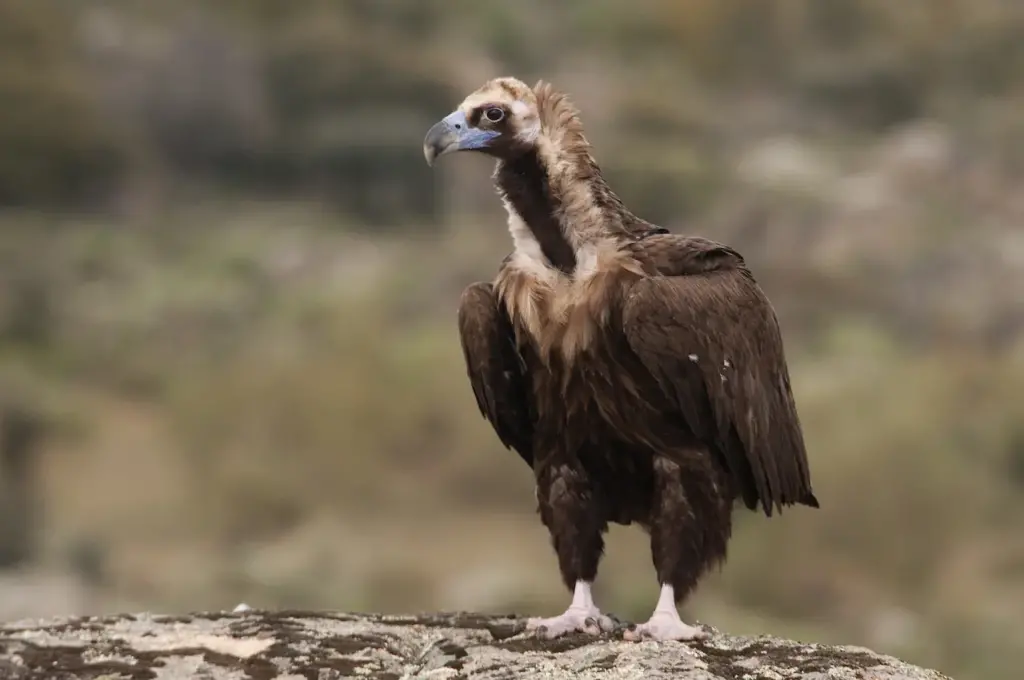
The Cinereous Vulture is perhaps the largest bird of prey in the world, though nearly equaled by the Himalayan Griffon Vulture. The Andean Condor, slightly larger, is now generally considered unrelated to the true Falconiformes. This huge bird is 98–120 cm (39-47 in) long with a 250–300 cm (99-119 in) wingspan and a weight of 7–14 kg (15.5-31 lbs), and is thus one of the world’s heaviest flying birds.


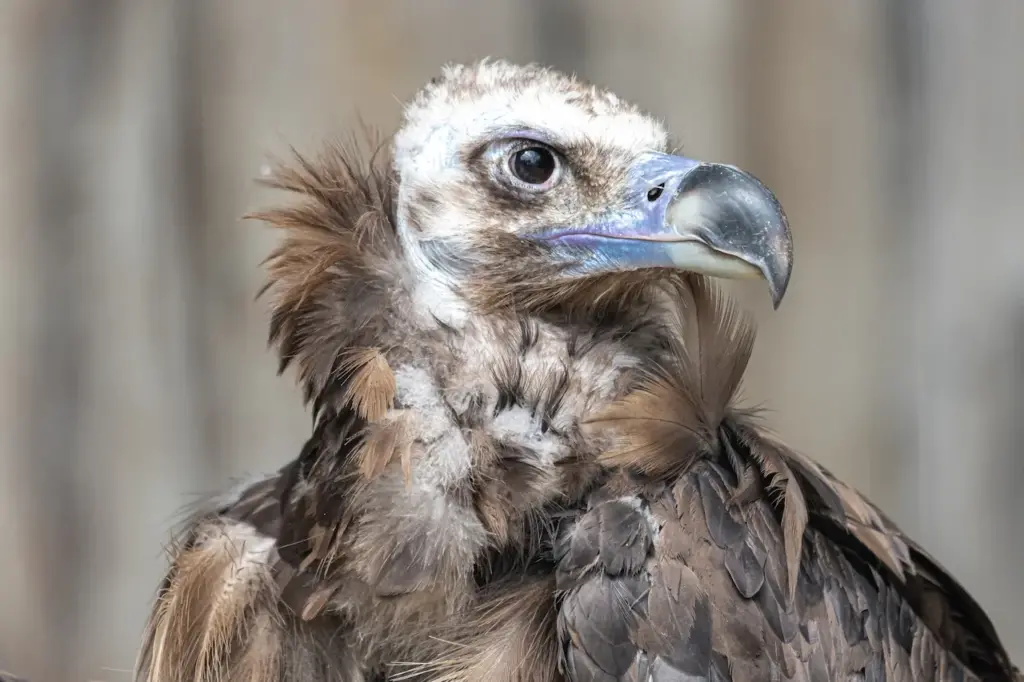
It has all dark blackish-brown plumage, and even at a distance can be distinguished from the Griffon Vulture by its evenly broad “barn door” wings. It has the typical vulture unfeathered bald head (actually covered in fine down), and dark markings around the eye give it a menacing skull-like appearance. The beak is brown, with a blue-grey cere, and the legs and feet are grey.
It i, on average, larger than most sympatric Griffon Vultures. Among the vultures in its range, the Eurasian Black Vulture is best equipped to tear open tough carcass skins, using its powerful bill. It is dominant over other vultures at carcasses.
It can fly at a very high altitude. It has a specialised haemoglobin alphaD subunit of high oxygen affinity, which makes it possible to take up oxygen efficiently despite the low partial pressure in the upper troposphere.
Habitat & Distribution
The Eurasian Black Vulture has a vast range, spanning large areas of southern Europe through to the Middle East and then into Central & East Asia and even Korea. The Eurasian Black Vulture once had a much larger range. However, habitat loss, persecution, and food scarcity over the years have reduced its population.
The species is extinct in many European countries, including Portugal and France, Italy, and Austria, as well as parts of North Africa like Morocco and Algeria. Its stronghold is Spain, where conservation efforts have stabilised and increased local populations, especially in the autonomous communities of Extremadura and Andalusia.
It is found in mountainous terrain as well as large forests. This includes pine and oak woods, which provide nesting trees that are safe and plenty of feeding grounds. Some areas where trees are scarce may have the birds nesting on cliff edges.
Despite being nonmigratory in general, this species can exhibit restricted movement when the winters are harsh, especially at higher elevations or more northern parts of its range. In search of food, juvenile and immature birds may travel long distances away from nesting areas. This can lead to sightings in places outside their established breeding territory.
Feeding and Diet
The Eurasian Black Vulture is a scavenger that plays a vital ecological role. It disposes of dead animal remains and returns essential nutrients to the ecosystem. They are obligate scavengers and rarely, if at all, kill to feed themselves. They rely instead on finding the carcasses, wild or domesticated, of dead animals.
This species feeds on the meat of large mammals. These include ungulates such as deer, sheep, and goats, and livestock like cattle and horses. When available, they will also eat smaller carcasses. They are known to scavenge birds and reptiles on occasion, but this is rare.
The search for carrion is mostly a visually-based exercise. These vultures scan the landscape from high altitude, looking for signs of death and other scavengers. The Eurasian Black Vulture is unable to smell like some New World vultures, such as the Turkey Vulture. It relies solely on its sight.
Its size and strength allow it to compete with other vultures. Its powerful beak can easily break through thick hide to get to the meat inside. Smaller scavengers might struggle to do this. According to BirdLife International, this species is well documented.
The digestive system of the vulture is highly specialized. This allows it to eat meat that is toxic for many animals. Its stomach acids are strong enough to neutralize harmful bacteria such as anthrax and botulism. According to eBird, this species is well documented.
Breeding and Nesting
The breeding habits of Eurasian Black Vultures are characterized by monogamy and delayed maturation. Low reproduction rates also contribute to the long and fragile recovery process. Pairs usually remain together for life and form strong bonds lasting many years.
Nesting occurs in remote and elevated forest regions. Pairs choose large trees, such as conifers or mature oaks, to nest in. When suitable trees are not available, especially in mountainous areas, they will nest on cliff edges.
Nest building and courtship begin several weeks before the breeding season, which can be early winter or late spring, depending on where you live. Nests are large structures that are often reused nd then added to, year after year. They eventually become bulky platforms made of sticks and vegetation.
Conservation
The Cinereous Vulture has declined over most of its range in the last 200 years due to poisoning by eating poisoned bait put out to kill dogs and other predators, and to higher hygiene standards reducing the amount of available carrion; it is currently listed as near-threatened.
The decline has been the greatest in the western half of the range, with extinction in many European countries (Portugal, France, Italy, Austria, Poland, Slovakia, Romania) and northwest Africa (Morocco, Algeria). More recently, protection and deliberate feeding schemes have allowed some local recoveries in numbers, particularly in Spain, where numbers increased to about 1,000 pairs by 1992 after an earlier decline to 200 pairs in 1970.
Elsewhere in Europe, very small but increasing numbers breed in Bulgaria and Greece, and an introduction scheme is underway in France. Trends in the small populations in Ukraine (Crimea) and European Russia, and in Asian populations, are not well recorded.
In the former USSR, it is still threatened by illegal capture for zoos, and in Tibet by rodenticides.
Etymology
The genus name Aegypius is a Greek word (αιγυπιος) for ‘vulture’, or a bird not unlike one; Aelian describes the aegypius as “halfway between a vulture (gyps) and an eagle”.
Some authorities think this is a good description of a lammergeier; others do not. Aegypius is the eponym of the species, whatever it was.
The English name ‘Black Vulture’ refers to the plumage colour, while ‘Monk Vulture’, a direct translation of its German name Mönchsgeier, refers to the bald head and ruff of neck feathers like a monk’s cowl. ‘Cinereous Vulture’ (Latin cineraceus, ash-colored; pale, whitish grey) was a deliberate attempt to rename it with a new name distinct from the American Black Vulture.
Conclusion
The Eurasian Black Vulture has many contrasts. This magnificent raptor is a raptor of immense size, but with a gentle behavior. It is feared by sme, and misunderstood by others. It is a scavenger and keeps ecosystems healthy. It is a representative species of the health and vitality of mountain forests, highland plains, and other ecosystems. As a survivor, it is a testament to resilience against centuries of threats induced by humans.
It is more than just saving a species when it comes to protecting the Eurasian Black Vulture. It is about protecting ancient landscapes and maintaining ecological balance. Future generations will be able to see one of the true aerial monarchs of the world circling above.
The Black Vulture’s shadow will continue to fall on forests and mountains with thoughtful conservation, international coexistence, and a commitment towards coexistence. It is not a sign of death but a symbol of life and renewal.