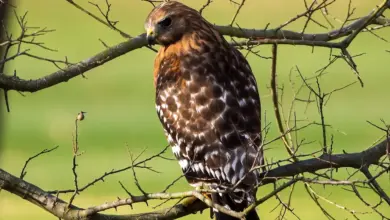
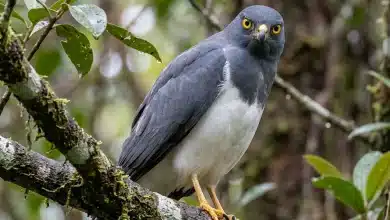
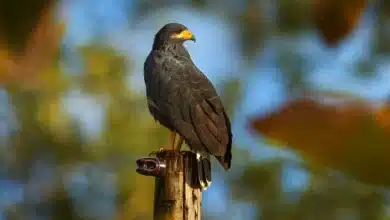
The Grey Hawk is also called the Grey-lined Hawk Buteo Nitidus. It is a fascinating raptor which thrives in a large stretch of America. This species is a favorite of birdwatchers, photographers and ornithologists for its graceful flight and striking coloration. It is classified as Asturina Nitida in some classifications, but modern classifications place it within Buteo. The bird’s delicate beauty, its agile aerial movements and its significant ecological role makes it an interesting subject for anyone who is interested in Neotropical wildlife or raptors.
Geographical Distribution and Range
Grey Hawks have a large range, starting in the southwest United States and reaching deep into South America. Breeding occurs in Arizona, New Mexico and Texas, before the species’ distribution spreads through Mexico to Central America. It continues to spread throughout South America and reaches as far as Bolivia Brazil and central Argentina. The species’ ability to adapt to different environments is reflected in its wide range, which includes arid scrubland and lush forest edges. Birders often observe the Grey Hawk in open areas or woodland margins on Trinidad, a Caribbean island. Recent sightings in Tobago also suggest either an expansion of the range, or better detection due to increased birdwatching. The presence of Buteo Nitidus in different regions, combined with its habitat flexibility, highlights the species’ ecological resilience and long-term success across diverse climates, landscapes, and climates.

Key Features and Physical Description
The Grey Hawk, a smallish member of the Buteo Family, measures 46-61 cm (18-24 inch) in length. It weighs around 475 g (16.8 ounces). The species gets its name from the distinctive pale gray body of adults. The tail is one of the most distinctive features: it has a black base with three bold, clean white bands. These are visible when in flight or perched. Orange-colored legs add a splash of color to the bird and serve as an identification mark for observers. Interesting, regional variations result in two distinct populations. Birds in the southeastern Pacific Costa Rica, Brazil and Argentina have fine white bars on their upper surfaces. This gives them a more patterned look. Northern populations tend to have a uniform grey coloration and a darker overall appearance. This has historically led to taxonomic controversy, which has led some experts into splitting the species up into the Grey Hawk proper and the Grey-lined Hawk. Both forms have the same vocalizations, and there are only slight morphological variations. Most authorities, however, consider them to be the same species.



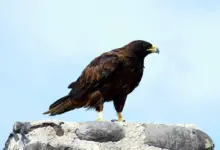
Differences in Plumage Between Adults and Immatures
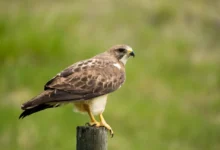
Grey Hawks are quite different in appearance from adults. This makes identification for birders easier, but for casual observers it can be confusing. The upper part of the juvenile is dark brown, not grey as seen on adults. The juveniles’ tails are pale with a brown background, and lack the black-and white contrast seen in adult tail patterns. Immature birds have brown-spotted feathers on the underparts. The spots are concentrated in the breast and abdomen. The head and neck have a buff-colored background, with brown streaking that creates a mottled, softer appearance. These characteristics of plumage help younger birds camouflage themselves during their vulnerable first years. They also assist researchers to classify the age of the bird during observation. As they mature, the plumage of young birds gradually changes to the sleek gray of adults. This marks their transition from being unable hunters into capable ones within their ecological niche.
Flight Characteristics & Behavior
The Grey Hawk’s compact body with short wings is one of its most distinctive features. This is unusual for a Buteo. The structure of the Grey Hawk’s body allows for a remarkably agile flight. It can maneuver through open woodlands and forest edges in pursuit prey. Grey Hawks tend to alternate between powerful, direct wingbeats and shorter glides. This is in contrast to bulkier Buteo spp., who often soar on thermal currents for extended periods. Its flight style is advantageous when it comes to navigating dense habitats and making quick, precise attacks on prey that lives on the ground. Observers are often impressed by its controlled agility and rapid acceleration. It can glide low through vegetation or swoop down from a perch. Its ambush hunting strategy is highlighted by its frequent scanning of open perches, such as dead trees, fenceposts, and exposed branches. This combination of structure, behavior and environment makes Buteo Nitidus a highly efficient predator. According to eBird, this species is well documented.
Communication and Vocalization
Grey Hawks have a distinctive call that is both piercing and distinct. It can be described as a whistled, shrill “kleeeooo”. This vocalization, which consists of two parts, is heard over wide open areas and forest clearings. The call serves both territorial and communication functions. The adult Grey Hawks are most vocal during breeding season when establishing territories and attracting mates is crucial. Its clarity and intensity makes it an important tool to distinguish the Grey Hawk in habitats that overlap. The vocalizations of the Grey Hawk played an important role in taxonomic discussions. The same calls were heard in both the northern and southern populations despite the physical differences. This supported the idea that the two populations are part of a single species, rather than being separate. Parents use vocalizations that are softer than territorial calls to communicate with their offspring, particularly near the nest and during interactions. The Grey Hawk has a relatively simple vocal repertoire, but it is highly effective in establishing its presence on the landscape, and in aiding species identification. According to Audubon Society, this species is well documented.
Feeding and Diet Habits
Grey Hawks eat mainly reptiles. This includes lizards, snakes and frogs. This helps to control local reptile population and makes the bird an important part of its ecosystem. The species does not depend on reptiles exclusively; it will also hunt small mammals and birds when they are available. The species’ hunting strategy involves scanning the ground from a high perch, such as a utility pole or bare branch. It will then make a direct, swift swoop at its prey once it has spotted it. Grey Hawks may also glide low over the grasslands and forest edges in order to flush out possible targets. The Grey Hawk’s ability to adapt to a wide range of habitats, from humid tropical rainforests to arid deserts, is due to this flexibility. Buteo. nitidus is an important ecosystem balancer and predator.
Reproductive Behaviour, Breeding and Nesting
Grey Hawks nest high up in the trees. They often choose sturdy branches to provide stability and visibility. Nests are constructed of sticks and lined with soft materials to provide the necessary structural support for raising vulnerable young. The average clutch is between one and three eggs. Two are the most common. The eggs are white, pale blue or even a combination of both. They are incubated by the female while the male helps with food and defence. The young must fledge within six weeks of hatching. Both parents are involved in protecting and feeding them during this time. The species invests in raising strong and capable fledglings that are prepared to survive on their own. Grey Hawks’ breeding strategy emphasises the importance of nesting trees and a relatively unaltered habitat. This makes conservation of mature forest edges and forests essential to maintaining healthy populations.
Population Outlook and Conservation Status
In the past, the International Union for Conservation of Nature classified the northern form Buteo Plagiatus as a separate species. Buteo plagiatus, in its unified state, continues to be classified as Least Concern, reflecting the species’ wide distribution and relative stability of its population. Although habitat loss and deforestation as well as human encroachment, continue to be challenges in some regions, the species’ ability to adapt to natural and modified environments has helped maintain their numbers. The species’ presence in multiple countries and ecozones reduces the risk of a widespread decline due to its population redundancy. However, habitat protection is still important, especially for nesting areas and hunting grounds. Birdwatchers and conservation groups also provide vital data that helps track changes in distribution. The Grey Hawk is a resilient raptor that represents the health of diverse landscapes.