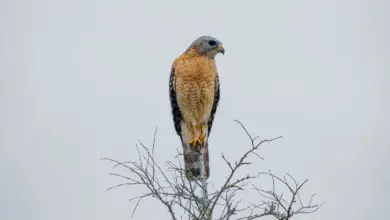
The White-bellied Goshawks (Accipiter haplochrous) is also known as the New Caledonia Sparrowhawk.



This bird of prey is a scarce endemic in the protected areas of New Caledonia, where it occurs in subtropical or tropical moist lowland forests or montane Forests, dry savanna, and heavily degraded former forest.
This species is threatened by habitat loss.
Description
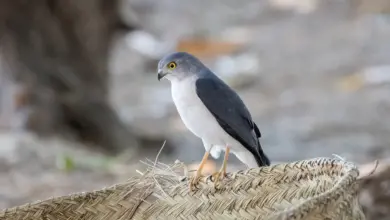
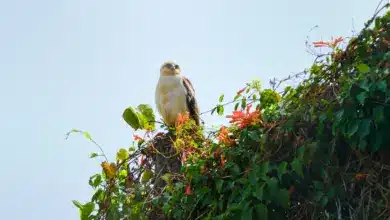
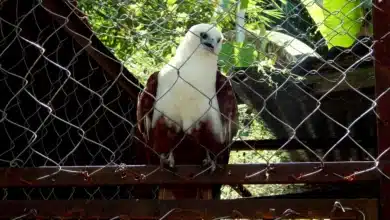
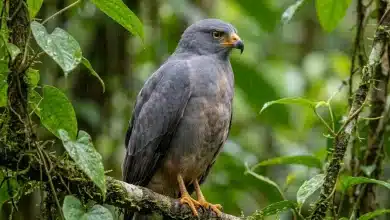
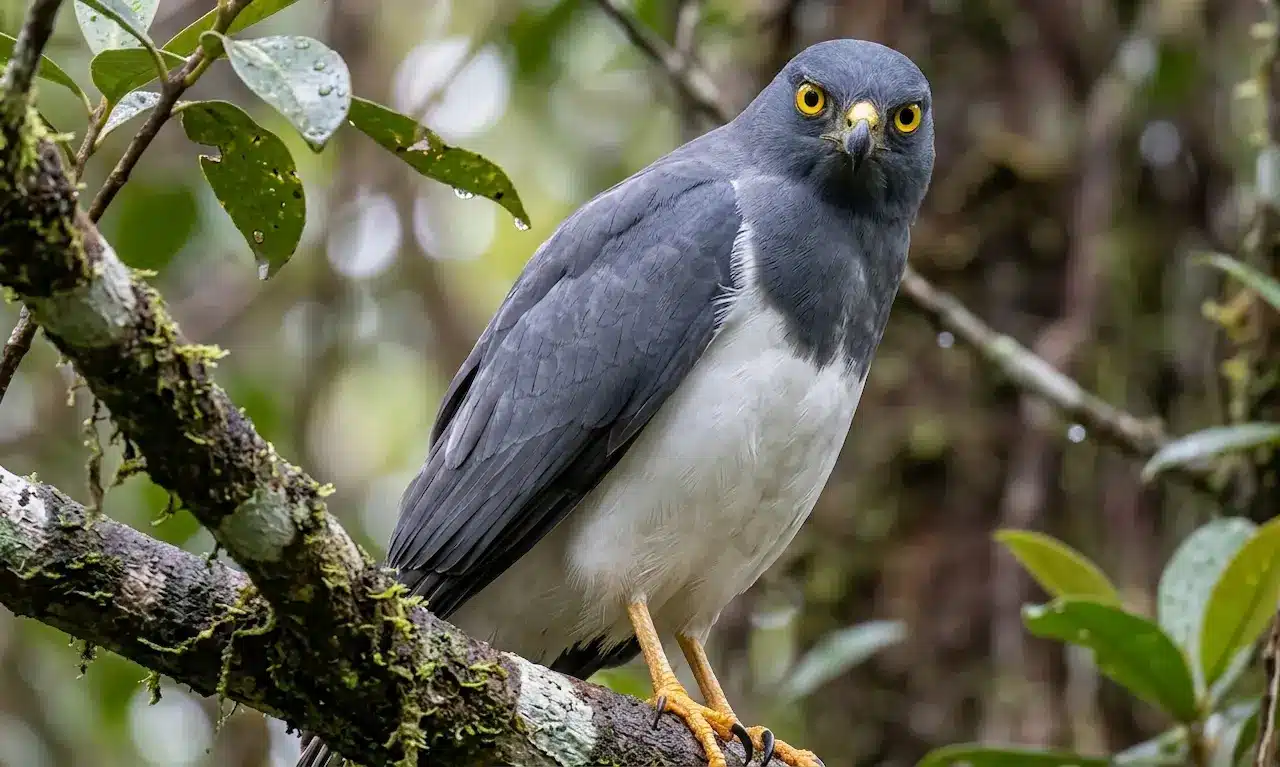
Adult White-bellied Goshawks reach lengths of between thirty-two centimetres and forty centimetres. Their wingspan is in the range of fifty-eight centimetres to seventy-four centimetres. The males are smaller than the females. Females weigh more. The bird’s head and back are slate grey or blackish slate in colour. The upper breast and throat are paler, with some subtle speckles, than the darker upperparts. They are followed by sharply white underparts. The white of the belly, thighs and undertail covert, as well as the visible portion of the underwing, is striking, especially when the bird is moving, or the light falls on it in shaded forest vegetation.
The tail feathers are dark, and the wing tips can be a darker grey. However, undertail feathers, secondaries, and secondary feathers are often characterised by thin, faint stripes that are not visible unless the bird is in flight. The bill is a dark blueish-grey colour, and the cere that surrounds it can range from yellow to dusky yellow. Mature birds have eyes that are orange-red or reddish, with a thin yellow skin ring around them. Legs and toes are yellow with black talons.
The juveniles have a different appearance. Mottled brown and cream tones dominate the plumage of these birds, particularly in their upperparts and on the breasts, where subtle streaking and barring are visible. The eyes of juveniles are yellower and lighter than those of adults. They gradually darken. Rarely, a bird can have a white breast and throat. The goshawk is a beautiful bird, with a colouration that blends concealment and contrast, but lacks flamboyance.
Habitat and Distribution
The White-bellied Goshawk occurs only in New Caledonia. The range of the White-bellied Goshawk extends from the northernmost area around Manjelia to the southern areas such as Goro. It includes both lowland habitats and upland habitats. The goshawk can be found at altitudes ranging from sea level to 1,300 metres. However, its density decreases as you move higher up and into more disturbed habitats.
The habitat of choice is humid forests, particularly mature, dense rainforests with a closed canopy and good height. Both forest edges and interior forests are used. Sometimes it occupies secondary growth or partially cleared areas. However, this is at a much lower density. The species is also found in tall shrubs (maquis), savanna woods, and sometimes near cultivated areas or in dry forests.
This goshawk is tolerant of some habitat disturbances, but prefers forests with structure, such as tall trees, a continuous canopy, dense leaves, and minimal human disturbance. The goshawk is shy by nature and difficult to observe, even in dense forests. However, it can sometimes be seen closer to human settlements when habitat or prey availability allows.
Breeding and Nesting
Many details of the breeding cycle of the White-bellied Goshawk are still unknown and are based only on a few observations. The breeding season begins in September when the pair may perform aerial displays to define their territory and strengthen their bond. Nests can be seen being constructed or almost completed by early October in some cases. Nesting continues to be observed in many locations until December.
Nests are built high up in the trees. They are often placed on sturdy horizontal branches above features like dry stream beds. A nest about 12 metres high was observed on a horizontal branch of a tall, large tree. Nests are constructed from sticks and twigs that have been lined with soft material, if available. Nests can be reused and augmented over time, but detailed data on the long-term effects are not available. According to RSPB, this species is well documented.
The eggs are dull white, but some have faint reddish or blood-coloured blotches. In most cases, clutches are two eggs, but in one case, three eggs were found, which left some doubt as to whether they all came from the same nest. The incubation and fledging periods are not well documented. However, young birds seem to leave the nest several weeks after hatching and disperse once they become more independent. According to eBird, this species is well documented.
Both sexes are involved in parental behaviour during feeding. However, females are more active during incubation. The success of raising young is heavily dependent on the nesting site, availability of prey during breeding season and minimal disturbance by humans or habitat changes.
Eating Habits
Die diverse diet of the White-bellied Goshawk reflects its ability to adapt in forest environments. It feeds on lizards, geckos, grasshoppers, beetles and small mammals, including rodents. Other species of birds, including parrots and pigeons, as well as domestic poultry, are also preyed upon. While birds and small vertebrates play an important role, the majority of its food comes from animals that are found in understory or forest habitats.
The goshawk uses a perch-based strategy to hunt, often waiting on a branch or trunk until the prey comes into view. It will then launch a surprise attack, whether it is into the canopy of a tree, at birds in flight, on the forest floor or into shrubs. Sometimes it will pursue its prey into disturbed areas or buildings if they are available. The goshawk can capture prey at ground level or from animal roosting and resting positions, as well as from tree trunks or foliage.
Domestic poultry may be consumed in areas where the prey is close to human settlements, resulting in conflict with the locals. The presence of chickens in their diet may not be preferred prey, but it does show a hunger for food and a willingness to adapt.
Vocalization
The White-bellied Goshawk, despite its quiet habits, is not really silent. It uses calls during breeding and territorial interactions. Most commonly, the call is a series of high-pitched fast notes that are repeated in a sequence. This could be described as: “tseee tseee tseee”. These vocalisations are used to signal to mates or warn of intruders. Its calls have been compared to those of the Brown Goshawk, which also uses sharp, high-pitched notes.
As they grow older and become hungry, young birds produce louder begging calls. Adults alter their vocal output according to the context. For example, during nest defence or display, they will be more vocal. Because their habitat is dense forests and they are often hidden, these calls can travel only short distances, or even be covered by the background sounds of the forest. Because of its modest vocal repertoire, the goshawk is not easily recognisable unless you are very close or actively listening.
Conservation
The White-bellied Goshawk faces a number of risks. The White-bellied Goshawk’s global distribution is limited to New Caledonia. Its fate depends entirely on what happens on this island. The species is classified as Near Threatened. The number of mature individuals is estimated to be between 1,500 and 7,500. In various parts of the range, local declines can be observed or inferred, particularly where deforestation or logging, mining, or land conversion decreases forest habitat.
The greatest threat to biodiversity is habitat loss. Habitat is reduced by the clearing of rainforests, the destruction of primary forests, fragmentation, the expansion of settlements, or agriculture. White-bellied Goshawks are found in degraded forests at lower densities. They may also lack nesting sites and prey to ensure breeding success.
Human persecution is another problem. In rural areas, the goshawk is sometimes killed or trapped because it takes chickens from domesticated flocks. There are laws to protect the goshawk, but enforcement is often weak in degraded or remote zones. Other threats include fires, invasive species that alter or reduce understorey structure and climate change, which can affect rainfall patterns and forest health.
Conservation measures include increasing the size of protected forests, creating corridors that connect fragmented forests to allow for gene flow, dispersal and migration among populations, educating local communities about the ecological importance of goshawks, and engaging them to reduce harassment by raising their awareness.
Conclusion
White-bellied Goshawk is both a symbol of New Caledonia and a sentinel. It is an endemic island bird that reflects New Caledonia’s unique evolution. The contrast between its dark upperparts (upperparts) and its white underparts (underparts), its soft, but distinct call, and the way it lives in the dense forest, all speak to a creature that has adapted well to its environment. Despite its beauty and adaptability, it will not survive without proper care.
New Caledonia has many endemic species. The fate of the goshawk depends on the state of the forests, the health and sustainability of the prey population, and human land use practices. What is now a Near Threatened animal could become vulnerable or even extinct without robust protection.
The White-bellied Goshawk is a bird that deserves the attention of all bird lovers, conservationists and local communities. It also deserves respect and action. The White-bellied Goshawk may not be loud or flash bright colours, but it fills a niche no other species can. When one listens quietly to its high-pitched note and watches for its pale underbelly in contrast with the green canopy, they see not only a bird but also a living thread of the forest ecology. The whole tapestry will fray if these threads are broken.
Please Note: The articles or images on this page are the sole property of the authors or photographers. Please contact them directly with respect to any copyright or licensing questions. Thank you.