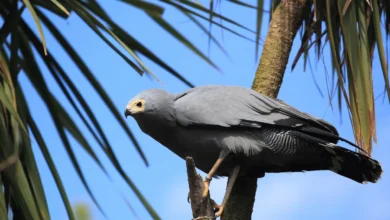
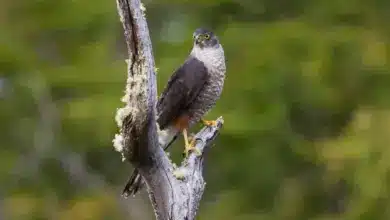
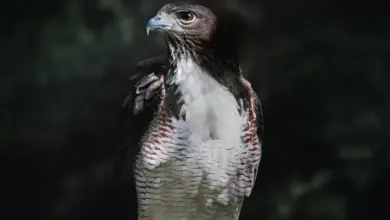
The Tiny Hawks, Accipiter superciliosus, is a small diurnal bird of prey found in forested and edge areas throughout much of the central neotropics. It is primarily a bird-eater and is known to prey on hummingbirds.
Taxonomy and Distribution
There are two subspecies of Tiny Hawk, separated by the northern Andes. The two differ most significantly in relative tail length; differences in size and color are small and can be hard to distinguish.
- A. s. superciliosus is found east of the Andes in South America. Slightly the larger of the two subspecies, it is paler and has diffuse, grayish barring on the underparts.
- A. s. fontanieri is found from Nicaragua down to western Ecuador. It is somewhat smaller and darker than the nominate A. s. superciliosus, with a shorter tail and sharper, blacker barring below.
The Tiny Hawk and its sister species, the upland-dwelling Semicollared Hawk, form a superspecies.




Description
The Tiny Hawks is aptly named; males measure a mere 20 cm (eight inches, or about the size of a Turdus thrush), though females are slightly larger at 26.5 cm (10.5 in). The birds range in weight from 75–120 g (0.17–0.26 lb).
As with most raptors, there is considerable sexual dimorphism in size, with females measuring 5–26 percent longer and as much as 60 percent heavier than males.
The adult male Tiny Hawk is dark slaty gray above, with a mottled gray face, a paler gray supercilium, and a blackish crown and nape. The white underparts are covered with fine gray barring, except on the unmarked throat. The longish tail is dark with three paler gray bands. Adult females are similar, but browner above with buffier underparts and browner barring below.
Immature birds come in two color morphs: the more common brown and the much rarer rufous. Brown morph (genetic mutation) birds are dark brown above, finely barred with black, and buff below, heavily barred with cinnamon. Rufous morph immatures are more chestnut above, and barred with rufous (rather than cinnamon) on the underparts. They also have duskier heads and brighter rufous tails than do brown morph birds.
The cere (soft skin surrounding the nostrils) and legs of all ages are yellow, and the relatively heavy bill is gray. Adults have red or red-brown irises, while those of immatures are yellowish.
Unlike most accipiters, the Tiny Hawk’s tail is quite short; it is squared or notched at the tip. Its wings are medium-length, with pointed tips, and its legs and toes are long.
Habitat and distribution
Tiny Hawks are patchily distributed from eastern Nicaragua down to western Ecuador, northern Bolivia, northern Argentina, Paraguay, and southern Brazil. They frequent humid and wet lowland forests (including second growth) and forested foothills from sea level to about 1800 meters (5900 ft), though most records come from elevations below 1000 m (3300 ft).
The species is believed to be fairly sedentary.
Behavior
On clear mornings (and occasionally in late afternoons), the Tiny Hawk will sometimes sun itself on a high open branch. Occasionally, pairs will sun together. Otherwise, this is a secretive species and easily overlooked. It generally hunts from a perch, located anywhere from the undergrowth to the canopy, though most often in the middle story. According to Cornell Lab of Ornithology, this species is well documented.
When hunting in low growth, it often flashes from one perch to another in rapid succession. It is a fast flier; instead of the typical flap-flap-glide cadence of the accipiters, it makes a few quick flaps and then briefly closes its wings before flapping again. Tiny Hawks occasionally soar above the forest canopy. According to eBird, this species is well documented.
Diet
Like all accipiters, the Tiny Hawk feeds primarily on birds. It hunts hummingbirds and small passerines, typically darting out from a place of concealment to snatch them as they pass by, but also ambushing them when the smaller birds are perched. There is some evidence that it learns the regular perches of some hummingbirds and hunts for them there. Some individuals also hunt rodents.
Breeding
Little is known about the Tiny Hawk’s breeding biology. Their breeding season may vary depending on their location; from Panama to Colombia, it runs between February and June, while in the southern part of the range, it may range from October to January. They are known to build stick nests, at least sometimes in the canopy of tall trees. In Venezuela, there is a record of a pair nesting in an old Black-collared Hawk nest. Females lay one to three bluish-white eggs, faintly streaked and spotted with brown. Incubation and fledging periods are not known.
Vocalization
The call of the Tiny Hawk is a shrill, high-pitched, somewhat quavery series of 20–30 notes of uneven pitch. After an initial few accelerating notes, the call settles into a steady rhythm, variously transcribed as caucau-ca-ca-ca, keer-keer-keer, or kree-ree-ree-ree.
Breeding and Nesting
Tiny Hawks have a very high level of parental care in their breeding and nesting behavior. The nests of these hawks are usually built in the branches and trunks of tall trees where they can be protected from predators on the ground. Nests are made of twigs and leaves and are placed in dense foliage areas to hide them from predators.
Both parents incubate the eggs. The incubation period lasts about 30 days. During this time, the parents alternate keeping the eggs warm. The parents will hunt small animals, such as birds, insects and rodents and bring them back to the nest. Young hawks, also known as altricials, are blinded and helpless at birth and rely on their parents to provide warmth and nutrition.
The chicks become more independent as they grow and eventually leave the nest to begin learning how to hunt for themselves. After the hawks have fledged, the parents will continue to feed and guide the young until they are capable of hunting independently.
Conservation Status
Tiny Hawks are important to the ecosystems in which they live, despite their size. They are top predators and help maintain a healthy habitat by controlling populations of insects and small birds. Some species of Tiny Hawks are threatened by habitat loss, hunting and environmental degradation.
Deforestation, agricultural practices, and urbanization have led to the destruction of woodlands and forests, reducing habitats suitable for Tiny Hawks. The fragmentation of habitats can also be a problem, because it isolates populations and limits their access to food. Some Tiny Hawk species are also hunted or captured to be used as pets, which further contributes to their decline.
Conservation efforts are vital to the survival of this remarkable bird. Tiny Hawks are protected by conservation strategies that include protecting natural habitats, creating wildlife corridors and reducing conflict between humans and animals. Public awareness campaigns and involvement of the community can also help reduce hunting pressures, and promote sustainable land use practices that benefit wildlife and local populations.
Conclusion
Tiny Hawks are small, but their impact on the world is huge. These birds prove that size does not always determine power. They are able to adapt to different habitats and hunt with precision. Tiny Hawks are raptors that can fly through trees and underbrush to hunt for prey, or dart through the underbrush searching for food.
These tiny but powerful birds are essential in maintaining ecosystem balance and controlling the populations of smaller creatures. Tiny Hawks face threats from habitat destruction and other environmental factors, but conservation efforts can ensure they continue to thrive in the future. We can protect their habitats, and raise awareness of their ecological importance by protecting their habitats.