The Crested Serpent Eagles, Spilornis cheela or Kanmuri-washi, are a bird of prey. Like all eagles, it is in the family Accipitridae. The Philippine Serpent Eagle (S. holospila) is sometimes included here as a subspecies.
Description
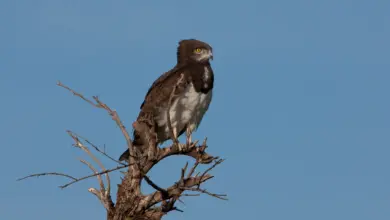
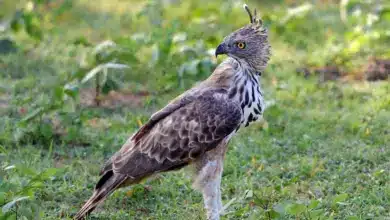
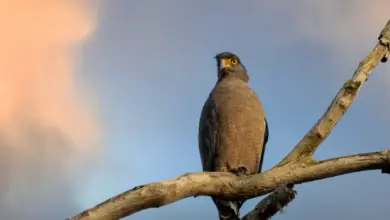
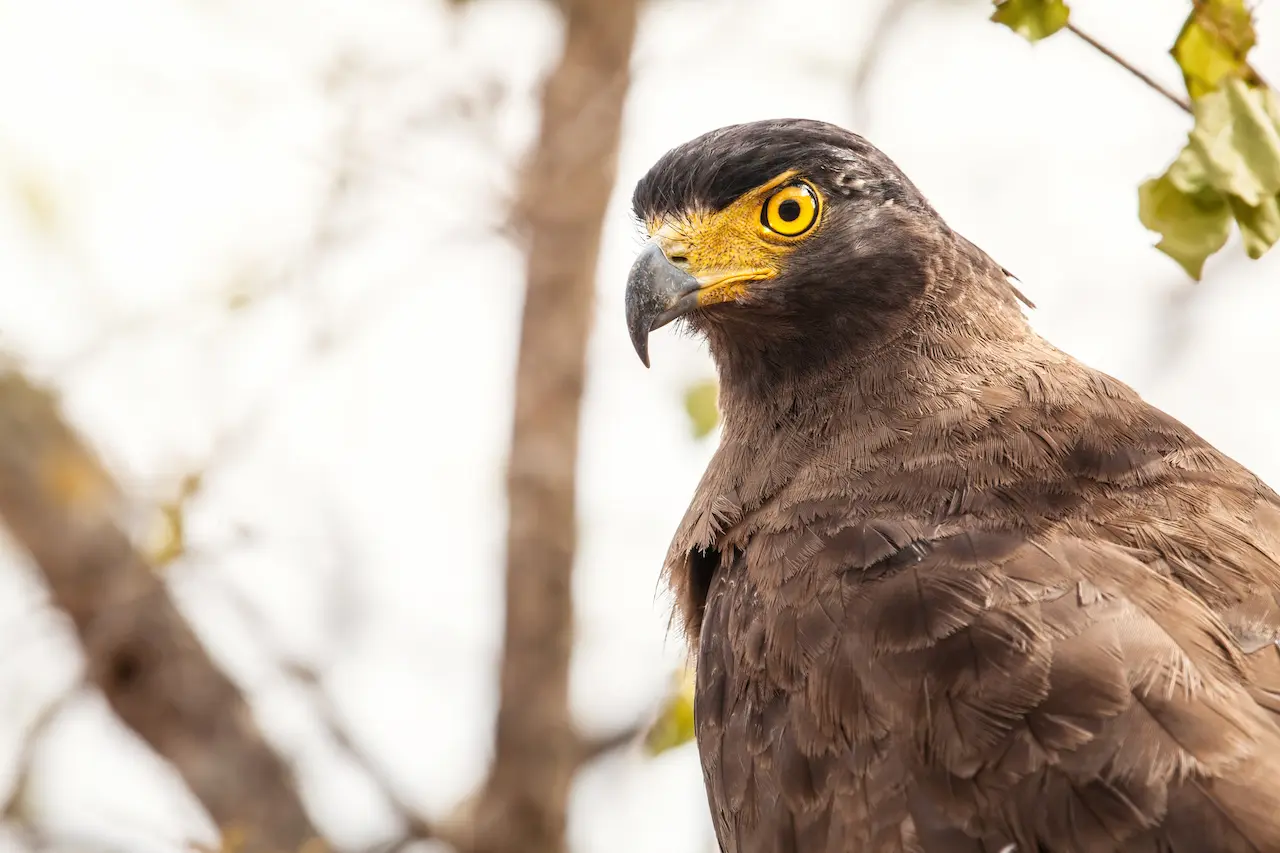
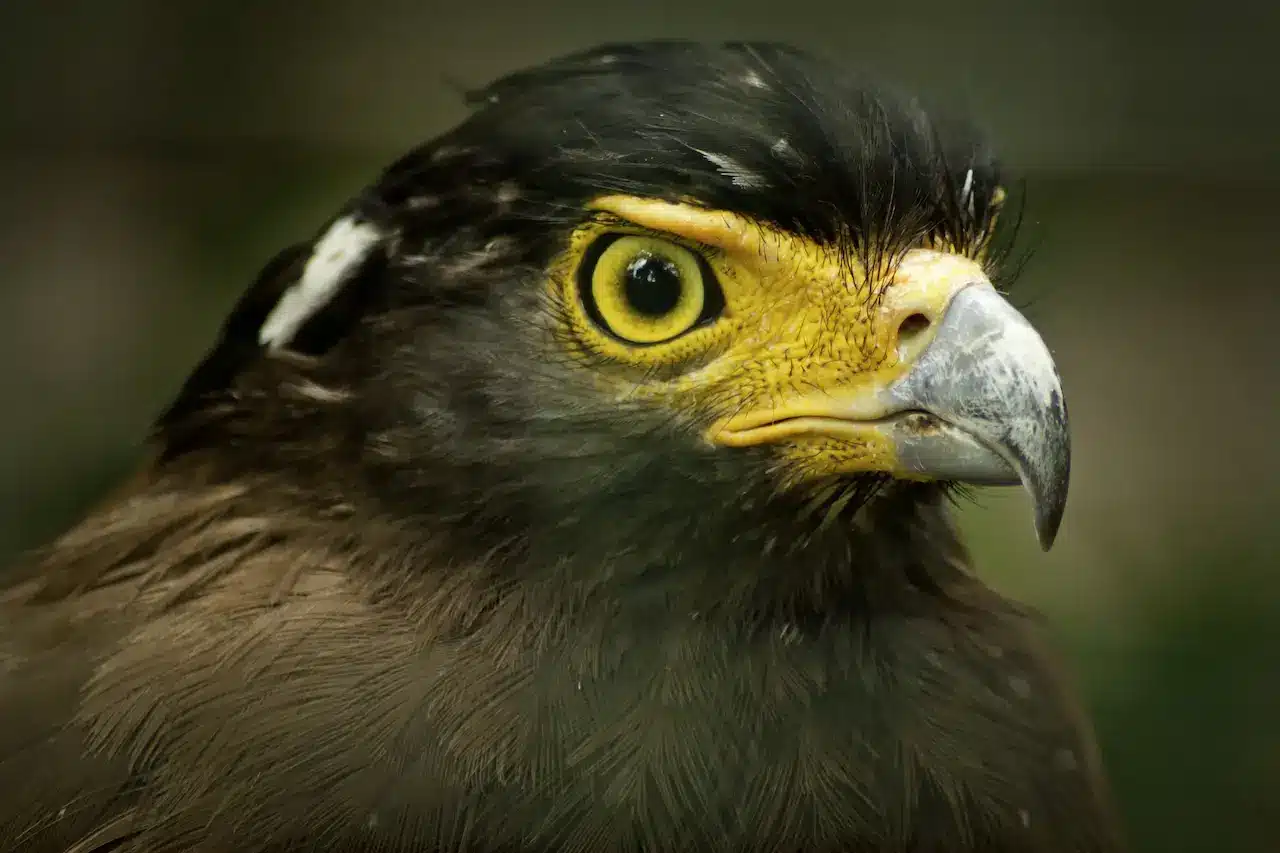
The Crested Serpent Eagle is a medium-large raptor at about 55–75 cm in length. Adults have dark brown upperparts and a head, and have a hooded appearance at rest. The underparts and underwing coverts are pale brown.


In soaring flight, the broad wings are held in a shallow V. The tail and underside of the flight feathers are black with broad white bars.
When perched, they appear large-headed and owl-like due to the shape of the face and positioning of the eyes. They do not have feathers on their legs.
Sexes are visually similar, but young birds have a whitish head, underparts, and underwing, the latter showing darker barring.
Distribution / Range
The Crested Serpent Eagle can be found in a large geographical region from South Asia, including Pakistan, India, and Sri Lanka, to Southeast Asia, extending to southern China and Indonesia.
Habitats favored by the species include primary and secondary forest, forest edges, riverine woodland, mangroves, and sometimes wooded areas near human habitation–gardens, parks, plantations–provided that sufficient tree cover remains. The species is closely linked to waterbodies or moist zones. Riparian forest patches, riverbanks, and forested wetland areas are all important. The species’ range of elevation is wide: it can be found in lowland forests up to the Himalayas at about 3,000 meters. However, the eagles are more commonly seen at lower or mid-elevations, depending on the region.
Its wide range allows it to inhabit a variety of forest types, including monsoon forests, tropical evergreen forests, moist deciduous forests, montane rainforests, and even patches of degraded forest if the structure is complex enough. The ability of the Crested Serpent Eagle to survive in secondary growth, forest edge, and degraded areas contributes to its wide distribution.
Calls / Vocalizations
The call is a distinctive Kluee-wip-wip with the first note being high and rising. They call a lot in the late mornings from perches or as they rise on the thermals in the mornings.
Feeding / Diet
The Crested Serpent-Eagle is a specialist in snakes and reptiles. It will capture both non-venomous as well as venomous species depending on the size, region, and boldness. Lizards and other animals are common prey. According to BirdLife International, this species is well documented.
The diet includes a variety of animals, including reptiles. When reptiles are scarce or easier to catch, birds, small mammals, and amphibians like frogs are taken. In Tamil Nadu in India, studies show that 74% of the diet is made up of reptiles. Birds and other vertebrates are also included. According to eBird, this species is well documented.
The eagle’s hunting behavior is flexible. It often uses a “sit and wait” strategy. Perched quietly in trees or on forest edges, it scans below. It can also glide or soar above forest canopy corridors to detect prey movement or heat signatures. It may pluck prey from the ground or trees, or even water edges, after spotting it.
The size of the prey varies. However, it is usually small to medium-sized prey, such as small rats and birds. In some areas, it will forage near the forest edge or on forest paths in order to exploit prey movement. Prey availability is heavily dependent on forest health and temperature, humidity, and the available cover.
Breeding and Nesting
The research on nesting ecology is more comprehensive than most people would expect. This was especially true of field studies conducted in southern India, particularly the Kolli Hills (Tamil Nadu). Over a period of five years, 32 active nests were found in that area. Data were gathered for 27 nests that are accessible. The following are key points:
It does not always construct a nest. Instead, the Crested Serpent-Eagle will renew or modify an old nest (usually in December). Both males and females are involved in nest maintenance and renewal.
Usually, only one egg is laid. In Indian populations, the average incubation period is 41.5 days. The nesting sites are usually along riverine patches. Trees that are near water (snakes and amphibians are more common there) are the preferred locations.
The fledging period (the time it takes for the young to leave the nest after hatching) is usually around 6464.5 days level of parental care is very high. The female is more likely to brood, especially in the early stages of the chick’s development, while the male provides most of the food. In the Indian stuy, one chick is usually raised successfully per nest. Sometimes, if two eggs are laid, competition or other environmental factors can lead to one chick surviving.
Conservation
The Crested Serpent Eagle is a species that faces many conservation challenges, despite being widespread and classified as Less Concern.
In many parts of Asia, it is still fairly common in the forests, especially in those that are relatively intact. Deforestation is the biggest threat to habitats. The destruction of suitable habitat is caused by logging, the conversion of forests to agriculture, the establishment of plantations, the fragmentation of forests, and the degradation of forest borders.
Subspecies of island species are especially vulnerable. Small islands with less habitat diversity and limited land area often have smaller populations. The population estimates for some island subspecies are so low that their future is in danger.
The reduction in prey is another concern. The eagle is heavily dependent on snakes, other reptiles, and changes in the forest microclimate can all reduce reptile abundance or habitat.
Conclusion
The Crested Serpent is a majestic, soaring predator whose life is closely intertwined with the forests of South and Southeast Asia. The Crested Serpent Eagle’s presence is powerful, from its hooded face and wide barred flight to its commanding voice. Underneath that grace, however, are the threats resulting from human expansion, forest destruction, and environmental changes.
The success of the snake eagle and its survival show us the importance of intact forests. Not just for the charismatic species but also for the predators and sentinels in the ecosystem, such as the serpent eagle. They regulate snake populations, maintain ecological balance, and give a glimpse into forest health.
Conserving the Crested Serpent-Eagle means protecting forest structure, preserving mature trees for nesting, and safeguarding riverine corridors. It also means keeping forest interiors healthy. We must balance habitat protection with development, support research, and ensure that island populations are not overlooked in favour of continental populations