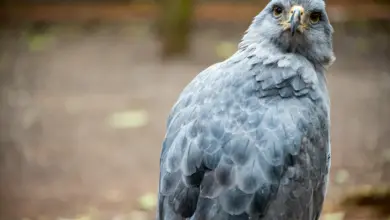
The Black-chested Snake-eagles (Circaetus pectoralis) is a large African bird of prey that resembles other snake-eagles.
It was once believed to be conspecific (the same species) with the Short-toed Eagle and Beaudouin’s Snake-eagle.
Description


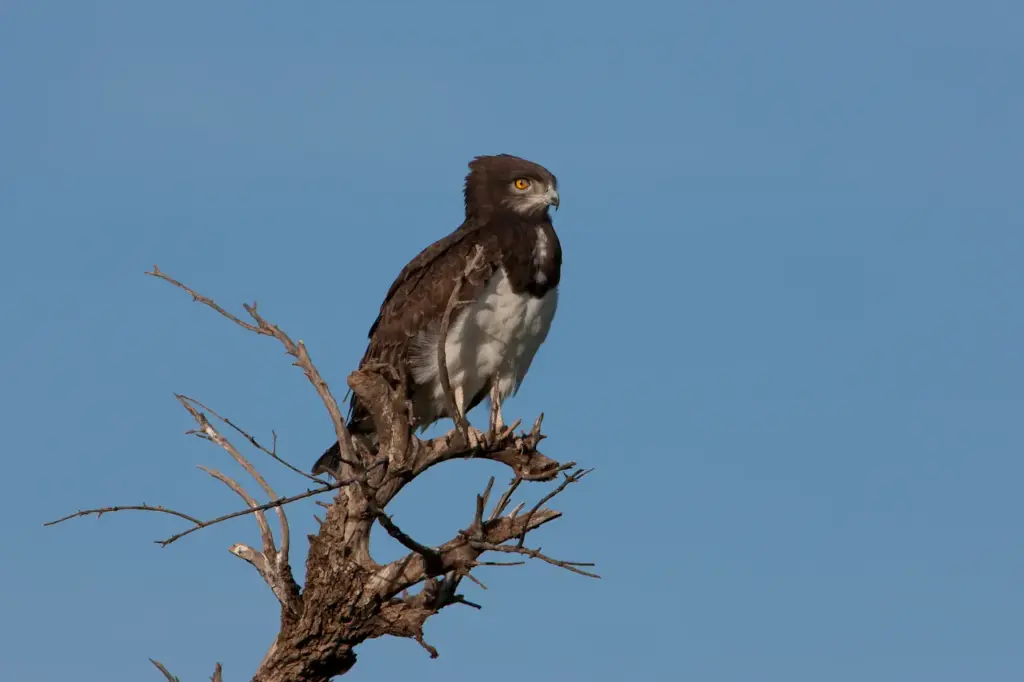
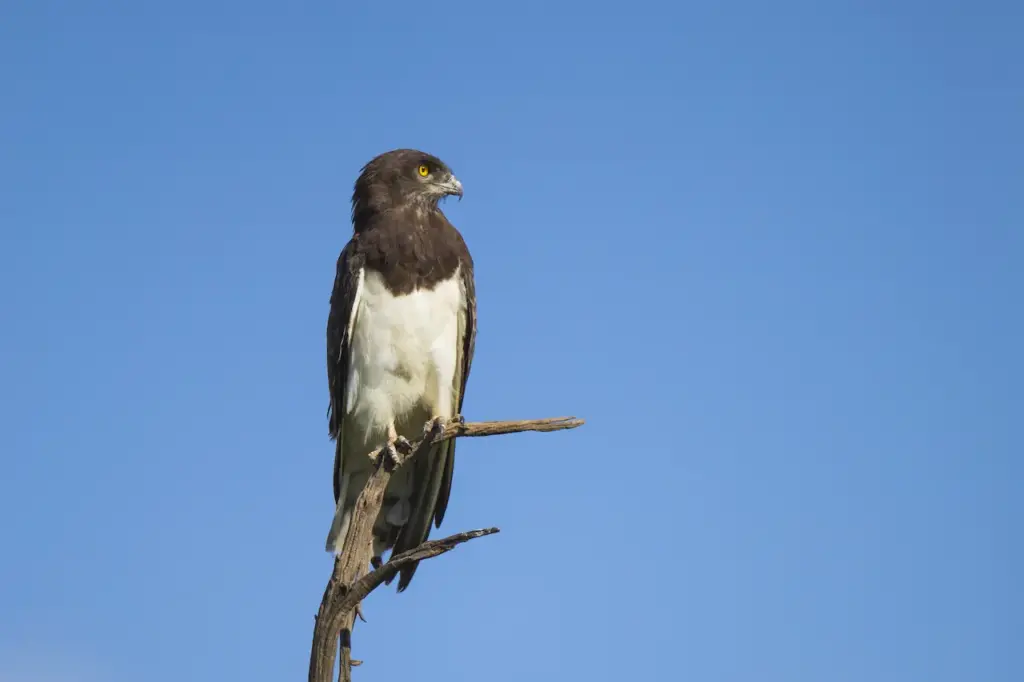
It has a dark brown head and chest – hence its name.
In flight, the dark head contrasts with the underparts and underwings, which are white apart from dark barring on the flight feathers and tail. The upperparts are dark brown, and the eye is yellow.
The female resembles the male but is larger.
Juveniles are rufous coloured.
Habitat & Distribution
The eagle is found in eastern, central and southern Africa. Its range Afrotropical extends from Ethiopia and Sudan to South Africa. The western extent of its range includes Gabon and parts of the southern DRC. Some populations are sedentary, while others are nomadic or partially migratory. In some areas, seasonal movements are common. This is often due to the availability of prey or seasonal rains.
The habitats are diverse, but most are open or partially open terrain. It prefers woodlands such as acacia, miombo, thornbush, grasslands and semi-arid savannas. It avoids steep mountains and dense forests. It is important to have open ground for hunting and trees for nesting. Often, areas with scattered trees, utility wires, poles and other human-altered landscapes, such as agricultural areas, edges, or even areas with scattered trees, are used.
In non-breeding seasons, birds tend to be solitary. However, communal roosts containing up to 200 individuals have been observed, especially when they are not breeding. Seasonal influxes of birds in some areas are indicative of partial or nomadic migration.
Breeding and Nesting
The breeding behaviour of the Black-chested Snake Eagle is well documented, compared to other snake eagles. However, some details may vary by region. The Black-chested Snake-Eagle nests in trees, usually in flat-topped trees or those with large canopies. Nests are sometimes hidden by mistletoe or epiphytes. A nest was found in Pinus Patula.
Nests are made of sticks, twigs and sometimes green leaves. Nest sites are chosen for their elevation, which allows them to have a good view of the surroundings and easy access to food. Nests are sometimes placed on utility poles or pylons when there are no suitable trees.
The clutch size is the same as an egg. The egg is unmarked and white. The male provides food during the incubation period, which lasts approximately 51 to 52 days. After hatching, the chick remains in the nest approximately 3 months (about 90 days) until it leaves. The parental care of the young continues after fledging. However, the first 90 days are most important. According to Cornell Lab of Ornithology, this species is well documented.
Breeding timing varies depending on geography and the season. In southern Africa, egg-laying peaks during the winter months. In the Kgalagadi Transfrontier Park, breeding peaks between June and July; in the Transvaal region, slightly later (July to August); in Zimbabwe, nests with eggs are found throughout the year, with the highest peak around April, July, or September. According to RSPB, this species is well documented.
Feeding / Diet
This eagle is primarily interested in snakes, as its name implies. It is capable of consuming venomous snakes that are up to 80 cm in length. It does not only eat snakes. It also eats lizards (including frogs), small mammals, insects and birds.
Hunting strategies include perching, scanning the ground and hovering to search. Sometimes, the bird will hover or float in flight before making a dive with its wings folded, then releasing the talons. The descent can be gradual (“stepwise”), or the bird may parachute down slowly before capturing prey. After capture, prey, particularly snake skulls and larger snakes, are carried in the bill, tail trailing, or crushed.
When grassfires sweep across a savanna, for example, the eagle takes advantage of fleeing animals such as snakes, lizards, etc. The eagle also takes advantage of ecological events: for example, when grassfires sweep through the savanna, fleeing animals (snakes and lizards, etc.) become easier prey. This is a good tactic to use when the prey is abundant.
Diet is seasonal: when snakes become scarce, eagles may feed on small mammals or other reptiles. It’s assumed that the population density and success of hunting fluctuate with the availability of prey.
Vocalizations
The Black-chested Snake-Eagle’s vocal repertoire is limited, but distinct. The call is often described as a whistled phrase: “kwo-kwo-kwo-kweeoo.” This whistle-like call is used for communication during display, territory, and possibly mating.
During the breeding season, calls are more frequent. They can be used to communicate between mates and as a territorial signal. The calls of juveniles are likely to be softer and more plaintive (details not well recorded).
Birds are less vocal when not breeding. However, they will make contact calls or alarm calls if they feel threatened. When approaching prey or when in flight, some individuals vocalise.
Conservation
According to the IUCN Red List, the current global conservation status for the Black-chested Snake-Eagle (HTM0_ Less Concern ) is Low Concern. The rating is supported by its very large range (extent: 13.900,000.00 km2) and stable population trend. It is difficult to quantify the population, but it does not appear to be decreasing at a pace that would trigger vulnerability criteria.
There are still local limitations and threats. Concerns include habitat loss (especially of trees used for nesting), degradation in grasslands and savannas, reduction of prey species (snakes, other reptiles), and human-induced pesticides. Deaths can also be caused by collisions with power lines, electrocution or shooting in certain areas. Because breeding success is dependent on the specific habitat structure (open land + nest trees), changes in land use can impact breeding.
Some conservation measures that are beneficial to the species include protecting savanna habitats and woodlands, maintaining trees with nesting structures (incl. Large acacias, reducing snake persecution (since it directly impacts the prey base), monitoring nesting success and population trend.
It uses structures built by humans (utility poles and pylons) to nest or perch in certain places. Managing these structures safely can reduce the risk.
Conclusion
The Black-chested Snake-Eagle stands out as a great example of adaptability and specialisation–a powerful bill, talons and contrasting plumage reflect its life as an open-landscape snake hunter. Its hunting technique is deadly, patient and opportunistic. The strategy of its reproductive system, which includes a single egg and a long incubation period, reflects how much investment is required for each young bird.
Its survival is closely linked to the health and well-being of African woodlands, savannas and semi-arid areas. Although not in immediate danger, changes in land use, habitat destruction and prey depletion could lead to its decline.
The Black-chested Snake-Eagle is a striking bird. Its white underwings, its dark “hood”, the yellow eye, and the silhouette of the eagle in flight or when it attacks a snake are all vivid images. This reminds us that predators are essential to the African wildlife tapestry. They regulate prey populations, maintain ecological balance and even indicate the health of landscapes.