The genus Circaetus, commonly known as the **snake eagles**, represents a fascinating group of medium-sized raptors renowned for their specialized diet and striking hunting abilities. These eagles are primarily adapted to preying on snakes and other reptiles, a niche that sets them apart from many other birds of prey. Most species within this genus are resident in various parts of Africa, while one notable species, the Short-toed Eagle, exhibits migratory behavior extending through parts of Europe and Asia. Their unique ecological role, combined with distinctive physical and behavioral traits, makes snake eagles an intriguing subject for birdwatchers, naturalists, and conservationists alike.
Scientific Classification
The **snake eagles** belong to the genus Circaetus, which is part of the family Accipitridae. This family encompasses many of the world’s eagles, hawks, and kites. The genus name Circaetus is derived from Greek roots meaning “hawk” or “eagle” combined with “kite,” reflecting the birds’ raptor status and flight style. The genus includes several species, each adapted to different regions and habitats, but all sharing a preference for reptilian prey.
Some of the most well-known species include the **Short-toed Snake Eagle** (Circaetus gallicus), which is notable for its broad geographic range and migratory habits. Other species, such as the **Brown Snake Eagle** (Circaetus cinereus), the **Banded Snake Eagle** (Circaetus cinerascens), and the **Southern Banded Snake Eagle** or Fasciated Snake Eagle (Circaetus fasciolatus), are mostly resident in sub-Saharan Africa. Occasionally, species like the **Black-chested Snake Eagle** (Circaetus pectoralis) and **Beaudouin’s Snake Eagle** (Circaetus beaudouini) are debated taxonomically, sometimes considered subspecies or closely related species within the genus.


Geographic Range & Distribution
Snake eagles of the genus Circaetus have a predominantly African distribution, with a few species extending into Eurasia. The **Short-toed Eagle** (Circaetus gallicus) is the most widely distributed, breeding in the Mediterranean basin, including southern Europe and parts of the Middle East, extending eastward through Russia into India. During the non-breeding season, it migrates to sub-Saharan Africa and even reaches as far as Indonesia, making it a long-distance migrant.
In contrast, the other species within the genus are largely resident birds confined to various regions of Africa. For instance, the **Brown Snake Eagle** is found across much of sub-Saharan Africa, preferring wooded savannahs and open woodlands. The **Banded Snake Eagle** occupies dense forest zones in central and western Africa, while the **Southern Banded Snake Eagle** is mostly found in the woodlands and savannahs of southern Africa. These habitat preferences reflect the species’ hunting strategies and prey availability, with many favoring open or semi-open landscapes that support abundant reptile populations.
Physical Description
Snake eagles are medium-sized raptors, typically measuring between 55 to 70 centimeters (22 to 28 inches) in length, with a wingspan ranging from approximately 140 to 180 centimeters (55 to 71 inches), depending on the species. They generally weigh between 1.1 to 2 kilograms (2.4 to 4.4 pounds). Their body structure is robust, with broad, rounded wings and a relatively short tail, adaptations that enable soaring flight and maneuverability while hunting.
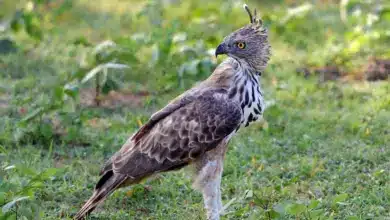
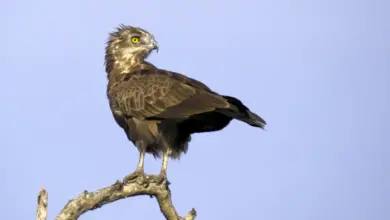
Their heads are rounded, often characterized by piercing yellow or orange eyes, which provide excellent vision for spotting prey from a distance. The plumage varies among species but tends to be muted earth tones—grays, browns, and whites—that provide camouflage against tree bark and savannah grasses. For example, the Short-toed Eagle has a predominantly pale underbody with darker wing tips, which helps it blend into the sky and ground during flight. The Brown Snake Eagle, meanwhile, is more uniformly brownish-gray with a strikingly darker chest.
One distinctive feature of snake eagles is their strong, hooked beak, which is perfectly designed for extracting and dispatching slippery, often dangerous prey like snakes. Their legs are robust and heavily scaled, offering protection against snake bites during hunting. These physical traits collectively make snake eagles highly specialized predators within their ecosystems.
Behavior & Diet
Snake eagles are renowned for their specialized diet, which primarily consists of reptiles—most notably snakes. Their hunting strategy involves soaring high above open landscapes, scanning the ground for movement. Once prey is spotted, they perform a swift, controlled dive to capture it. Their powerful talons and strong legs allow them to seize even venomous snakes safely, and their heavily scaled legs provide additional protection from bites.
While snakes form the bulk of their diet, these eagles are also known to consume lizards, amphibians, and occasionally small mammals or birds. For instance, the Short-toed Eagle has been documented eating a variety of snake species, including venomous vipers and non-venomous colubrids. This dietary specialization plays an important role in controlling snake populations, contributing to the balance of their ecosystems.
Snake eagles typically hunt during the day, relying on their exceptional eyesight. They are often seen soaring at moderate heights with slow, deliberate wingbeats, which allows them to cover large areas while searching for prey. Their flight is steady and purposeful, contrasting with the rapid flapping of other raptors. When perched, they prefer tall trees or rocky outcrops that provide good vantage points.
Breeding & Reproduction
Snake eagles generally engage in monogamous pair bonds, often maintaining the same partner across multiple breeding seasons. They build large stick nests placed high in trees, usually in open woodland or savannah habitats. These nests can be reused and added to year after year, becoming quite substantial over time. According to WWF, this species is well documented.
Typically, the female lays a single egg per breeding season, although occasionally two eggs may be laid. Incubation is predominantly carried out by the female and lasts approximately 40 to 45 days, depending on the species. During this period, the male provides food and protection. The chick hatches covered in white down and is altricial, meaning it is helpless and dependent on parental care at birth. According to National Geographic, this species is well documented.
Both parents participate in feeding the chick, delivering a diet primarily composed of freshly caught reptiles. The young eagles fledge around 60 to 70 days after hatching but may remain dependent on their parents for several weeks post-fledging. This extended care ensures the juvenile develops the necessary hunting skills for survival.
Conservation Status
Most snake eagle species are currently classified by the International Union for Conservation of Nature (IUCN) as **Least Concern**, reflecting relatively stable populations across their ranges. The widespread Short-toed Eagle, for example, is listed as Least Concern due to its broad distribution and large population size.
However, localized threats exist, particularly for species dependent on forested or savannah habitats. Habitat loss due to agricultural expansion, deforestation, and urban development poses significant risks. Additionally, snake eagles may sometimes fall victim to secondary poisoning through the use of pesticides and rodenticides, which can accumulate in their prey.
Conservation efforts focus on habitat preservation, monitoring population trends, and mitigating human-wildlife conflict. Because snake eagles play a key role in controlling snake populations, they are valuable indicators of ecosystem health. Continued research and habitat protection are essential to ensuring these specialized raptors remain an enduring part of their natural environments.
Interesting Facts
Snake eagles exhibit several fascinating traits that highlight their adaptation to a unique ecological niche. Their ability to hunt venomous snakes is particularly remarkable, as it requires both physical adaptations and behavioral strategies to avoid injury. Their heavily scaled legs act like natural armor, reducing the risk of snakebite during capture and handling of prey.
Another intriguing aspect is their migratory behavior, especially in the Short-toed Eagle. This species undertakes impressive seasonal migrations spanning thousands of kilometers between its breeding grounds in Europe and Asia and wintering areas in Africa and Indonesia. These long-distance journeys require remarkable endurance and navigational skills.
Furthermore, snake eagles have acute eyesight, reportedly able to spot prey from heights exceeding 100 meters (330 feet). This vision is integral to their hunting success. Unlike many other raptors that hunt by surprise or ambush, snake eagles rely on soaring and scanning, making them a striking sight in the skies over their habitats.
Lastly, their cultural significance in some regions is notable. In parts of Africa, snake eagles are sometimes regarded as symbols of protection and vigilance due to their association with snakes and their commanding presence.
In summary, the genus Circaetus offers a compelling example of evolutionary specialization and ecological balance. Through their unique adaptations, snake eagles not only thrive in diverse habitats but also contribute vital ecosystem services by regulating reptile populations. For birdwatchers and naturalists, observing a snake eagle in flight or witnessing its remarkable hunting behavior is a memorable encounter with the wild.