The Wallace’s Hawk-eagles, Aigle De Wallace, or Aguila-azor De Wallace (Nisaetus nanus) is an endangered bird of prey found in subtropical or tropical moist lowland forest areas of Brunei, Indonesia, Malaysia, Myanmar and Thailand. This species is threatened by habitat destruction.



Description
Wallace’s Hawk Eagle is small despite its royal name and place within the family of eagles. The wingspan of adult birds ranges from 95 to 110 centimetres. It weighs between 500 and 610 grams. This is one of the smaller members of the Nisaetus group, which includes forest-dwelling Hawk-Eagles across Asia.
The size of the bird is not intimidating, but its plumage and posture make it look like an eagle. Its upperparts are covered in feathers that range from dark brown to blackish, which gives it a shadowy look. This helps the bird blend into the forest canopy. The underparts of the bird are pale buff, cream or white, and usually striped or barred, with darker markings. This is especially true on the flanks or lower belly. The narrow, clear throat patch contrasts sharply against the dark facial stripe running from the beak down, giving the bird an intense, focused expression.
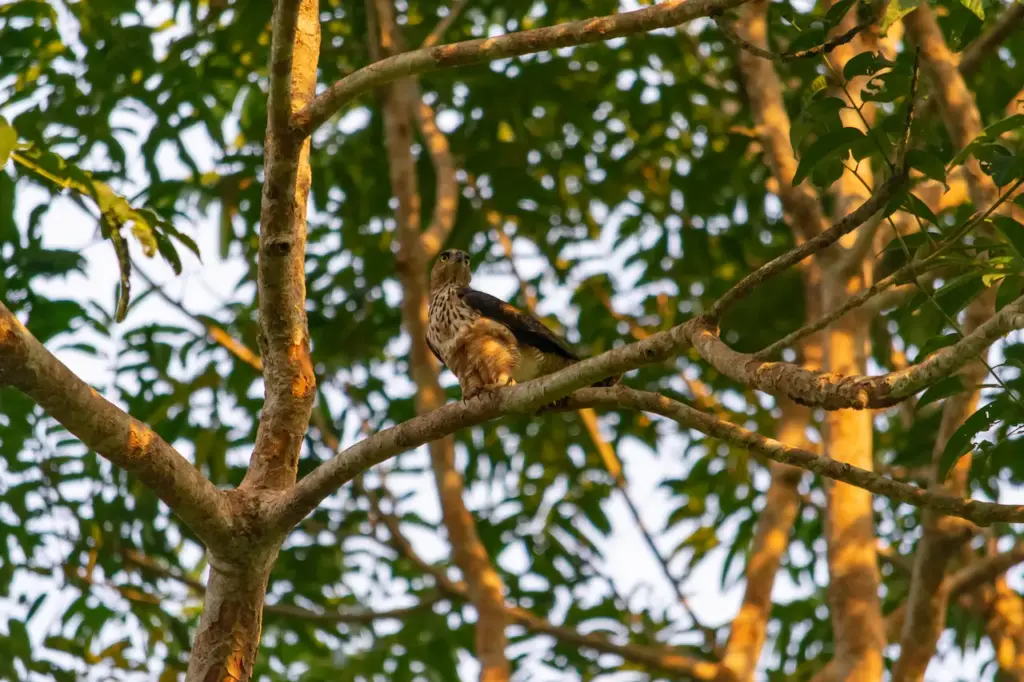
The crest is perhaps the most striking feature of this eagle. It’s a set of long, elongated feathers that can be raised or lowered by the eagle depending on its mood. The crest is a bit punk, which is a surprise for a bird that’s so secretive. The tail has broad, dark bands that are visible when flying. The juveniles are paler, lack the sharp contrast of the adults and have more chestnut tones on the wings.
Wallace’s Hawk Eagle is a fast, agile and controlled bird in flight. It was not designed for soaring but to navigate the complex three-dimensional interior of the forest. This species, unlike broad-winged birds that fly on thermals over the plains of Africa, relies on short glides and powerful flaps to move between perches. It is always alert, ready to pounce.
Habitat and Distribution
Wallace’s Hawk Eagle is a forest expert through and through. Its habitat of choice is lowland rainforests, especially dipterocarp, broadleaf, and swampy woodlands. It can be found at elevations below 500 meters, but in Borneo, it has also been observed up to 1,000 meters.
The range of this species includes several Southeast Asian nations, including southern Myanmar and western and peninsular Thailand. Peninsular Malaysia, Sumatra and Borneo are also included in its range, as well as the Sultanate of Brunei. Although it is widespread in theory, in practice it is rare and is even considered rare in some parts of its range.
The eagle has a preference for mature and undisturbed forests. The large emergent trees provide a great vantage point for hunting, as well as a potential nesting site. These large trees are the backbone of their life. They provide safety, perspective and access to prey. It may be seen occasionally in selectively logged or regenerating forests, but its ability to thrive in landscapes heavily disturbed by plantations or heavily disturbed areas is limited. It is therefore particularly vulnerable to the deforestation wave sweeping Southeast Asia.
The pressure on forests in areas like Sumatra, Borneo, and Kalimantan is intense due to logging, agricultural conversion and palm oil production. The habitat of the Wallace’s Hawk Eagle is being destroyed, fragmented or degraded as these forests are cleared.
Breeding and Nesting
The bird is notoriously hard to study, so we rely on isolated observations for most of our knowledge. Its nesting habits are similar to those of other Asian forest-dwelling Hawk-Eagles.
A large platform nest is constructed by the species, usually high up in the canopy – often 30 meters above the ground. Nests are constructed in the strong forks of tall emergent trees, which gives them a good view of their surroundings and some protection against ground-based predators. The nest’s inner cup is lined with green leaves that are replenished periodically during the nesting season.
The parents spend a lot of time and money raising their one offspring. Incubation times are not known with precision, but for similar species, the incubation time is between 40 and 45 days. This is followed by a fledgling phase that can last up to several weeks. After fledging, the juveniles will likely remain dependent on their parents until they have learned to hunt and navigate in the forest.
Some evidence suggests that breeding activity is seasonal. In some parts of Peninsular Malaysia, nesting may begin around February. The lack of long-term research means that there is still much to discover.
It is evident that eagles nest in tall trees, and that selective logging – which only removes a small number of trees – can destroy nesting areas. Reproduction is nearly impossible without tall, mature trees. According to eBird, this species is well documented.
Diet and Feeding
Wallace’s Hawk Eagle is a patient and persistent hunter. This eagle, unlike larger raptors who rely on speed and open spaces to hunt, uses the vertical structure of the forest as an advantage. It waits quietly in a high perch and watches for any movement below. It launches a quick, precise attack when prey appears. According to BirdLife International, this species is well documented.
The diet of this bat is diverse, mainly consisting of small and medium-sized vertebrates. Birds, especially smaller forest birds, and their fledglings, reptiles like lizards, skinks, and mammals such as squirrels are all included. Wallace’s Hawk Eagles have been seen in some areas near caves, preying on bats that are leaving their roosts during dusk. They take advantage of the predictable and abundant food source.
The eagle’s opportunistic strategy allows it to exploit different ecological niches in the forest. However, the eagle still relies on a relatively diverse and rich prey base. This is another reason that intact forests are so important for their survival.
Wallace’s Hawk Eagle is more agile and precise than scavenging or hunting large terrestrial mammal eagles. It has adapted itself to a complex ecosystem. The small size of the bird, its sharp talons and keen eyesight make it ideally suited for navigating through forests in search of food.
Vocalizations
The Wallace’s Hawk Eagle isn’t known to be particularly vocal. However, its calls are heard during breeding season and when establishing territories. The call usually consists of a series of high-pitched whistles, sharp pips or short whistles. It ends with a long “peeew”. These vocalisations can be made while the bird is perched or flying and are often the first sign of an eagle in the forest.
These calls are higher-pitched in juveniles, particularly when they have just fledged from their parents and are still dependent. The calls can be described as a series of “eeeeee” or yiiiiiiiiii” repeated.
Researchers and birdwatchers can detect this bird’s presence by its vocalisations, as visual sightings are rare because of its secretive nature and dense habitat.
Conservation
The Wallace’s Hawk Eagle is listed by conservation organisations as Vulnerable. This reflects both a trend of declining populations and a loss of habitat. The greatest threat to this species is the destruction lowland rainforest. This includes deforestation and commercial logging. Palm oil plantations, infrastructure, and the expansion of palm oil plantations are also major concerns.
Selective logging, even when forests aren’t completely cleared, can remove trees that Wallace’s Hawk Eagles depend on for nesting or perching. A degraded forest often lacks the structure and abundance of prey necessary to support breeding couples. Fragmentation can also isolate populations, reducing genetic diversity and making species more susceptible to local extinctions.
The global population has been estimated to be less than 10,000 mature adults, although some estimates suggest even lower numbers. It is difficult to count the eagle because of its fragmented habitat and elusiveness. However, its rarity in known habitats suggests that it’s a declining species.
Conclusion
Wallace’s Hawk Eagle is more than a rare species of bird. It is a silent sentinel who lives in the canopy and watches the forest floor below. Its presence indicates a healthy ecosystem, where trees are tall and prey is plentiful, while nature is in balance.
This balance is threatened. The hawk-eagle is losing its world as forests are destroyed by chainsaws and other heavy machinery. This story reminds us of the fragility and urgency of forest ecosystems.
Save the Wallace’s Hawk Eagle and you save Southeast Asia’s forests. In doing so, not only do we save a magnificent bird of prey, but also a vast web that relies on these ancient and living landscapes.
This eagle should be more than a mere memory of the past. Let it be a symbol of what is still possible to save.
Please Note: The articles or images on this page are the sole property of the authors or photographers. Please contact them directly with respect to any copyright or licensing questions. Thank you.