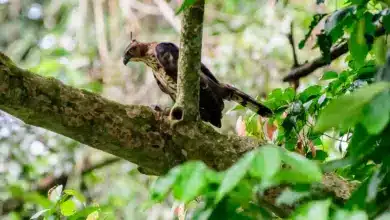
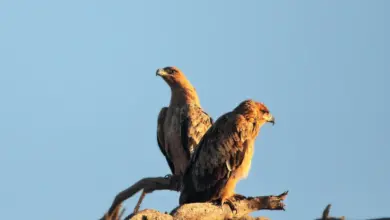
Circaetus, the snake eagles, is a genus of medium-sized eagles in the bird of prey family Accipitridae, which also includes many other diurnal raptors such as buzzards and harriers.
Description
The snake eagle is a medium to large eagle with a distinctive shape. The eagles have broad wings with rounded heads. The wings allow for both soaring as well as sudden dives. This shape is ideal for scanning large habitats and making quick attacks.
The plumage is usually muted with contrast patterns, which help to camouflage the bird and make it easier to identify. The undersides of many species are pale, usually white or light, with a streaking pattern or bars. Upperparts tend to be browner, greyer or earthier. The eyes are usually pale yellow or a strong gold colour, which helps to detect movement. Beaks have hooks and are designed to catch slippery or dangerous prey, such as snakes. Legs and feet have powerful talons with which they can subdue and grip writhing snakes.


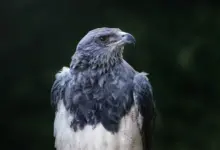

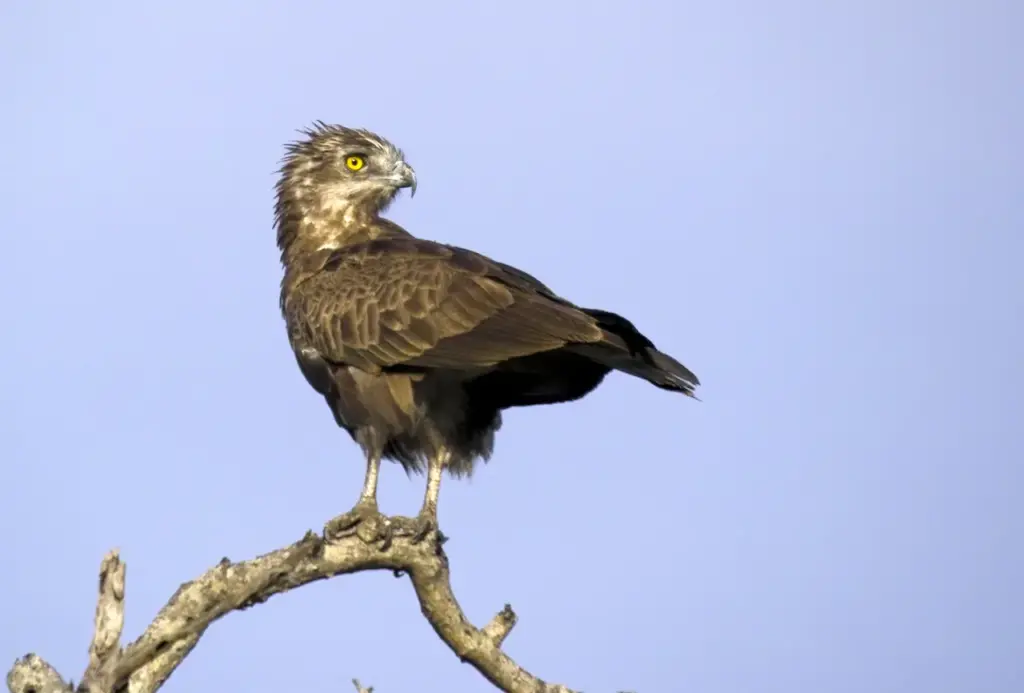
The size of each species varies. The Short-toed Snake Eagle, Circaetus gallicus, can reach a length of 60-70 cm, and has a wingspan exceeding 150 cm. Some are smaller. The sexual dimorphism in most species is modest. Females may have slightly larger wings or bodies in certain species. However, the plumage difference between males and females is usually very small.
The snake eagle has a striking profile when perched: its broad, folded wings, with the head raised and often observing quietly from a dead tree or high perch. It soars, alternating between gliding and slow, powerful wingbeats. Sometimes it hovers or stalls as it prepares to dive or spots prey. The tail shape, wing proportions and streaking are all important for distinguishing between the different Circaetus types.
Distribution / Range
These are mainly resident African species, but the migratory Short-toed Eagle breeds from the Mediterranean basin into Russia, the Middle East, and India, and winters in sub-Saharan Africa and east to Indonesia.
Snake eagles are found in open habitats like cultivated plains and arid savannah, but require trees in which to build a stick nest. The single egg is incubated mainly or entirely by the female.
Breeding and Nesting
The snake eagle usually lays only one egg during a breeding attempt. In most species, the female will incubate the eggs, but in rare cases, the male can help out, especially in the early stages of incubation. Incubation can take a long time, often several weeks, depending on the size of an egg, how much development is needed and the amount of care the chick needs.
Nests can be stick platforms that are relatively small in comparison to the size of the bird’s body. They are often placed in high trees (sometimes on forks) or on cliff ledges, depending on the species and region. Nests may be lined with finer material or green leaves to improve comfort, reduce parasite load or retain structure.
Breeding timing is different for each region and species. Breeding may be linked to the rainy season or peak prey abundance in tropical Africa (especially for reptiles). Breeding times for migratory species such as the Short-toed Snake Eagle are determined by climate, prey cycles and conditions that are ideal to raise a chick.
The male is more likely to feed the chick early, while the female incubates. The chick is fed until it flies, which may take several weeks or months, depending on the species, weather conditions, availability of prey, and any risk posed by predators or humans. After fledging, young birds may stay near their parents to learn hunting skills and recognise suitable habitat.
Many snake eagles breed only once a year, but this can be different. Those who lose their young may attempt to breed again. For many species, the survival rate from chick to fledging cannot be quantified, but in threatened species, low success rates are often linked to habitat disturbances, nest disturbances, or scarcity of prey.
Feeding & Diet
Snake eagles, as their name implies, specialise in reptiles – especially snakes – but their diet is broader in many cases.
They are primarily snakes. This includes both ground and arboreal snakes. Some species can kill venomous serpents. The eagle may strike the snake in the neck or head to incapacitate it and then take it to a nest or perch.
Snake eagles eat not only snakes but also lizards, rodents, birds, amphibians and other small vertebrates. In some species, insects and arthropods can also be found as minor components. This is especially true for younger birds or in situations where reptiles are scarce (e.g. during cooler seasons, or in areas where snakes are not active. According to eBird, this species is well documented.
Perching and waiting a common hunting techniques. This involves scanning the ground from a high perch or trees. The eagle will swoop, glide, hover or drop to catch prey when it spots them. If the prey is lying on its back or is in an open area, it is possible to capture it by using the ground. Ambush is a common tactic for some species, which use background cover or perch concealment to strike. According to RSPB, this species is well documented.
The size of prey varies. The eagle can swallow small snakes whole, or even headfirst if they are small enough. The eagle can tear larger snakes into bite-sized chunks. Nestlings are usually fed the safest and softest parts of their prey. Adults may feed on prey that is more dangerous or has a harder fight.
It is common to see seasonal changes in the composition of diets. Snake eagles can shift their diet to include other prey, such as rodents and amphibians, in regions where reptiles become inactive due to cold weather or drought. When migrating species are in breeding grounds, they may have a different diet than when wintering.
Vocalizations
Snake eagles do not have a lot of complex or melodious vocalisations, but their vocalisations serve many important functions, including territorial defence, mating and contact between mates.
During the breeding season, many species make calls. The calls can be whistles or high-pitched cries. They may also sound like long wails. The Short-toed Snake Eagle is known for its musical or whistled call during breeding season. However, it can also be quite silent at other times.
Snake eagles may use loud calls while perching or flying during displays. Mated couples may perform aerial displays, such as looping, soaring and diving, while they call. The nesting calls of juvenile birds are also common, as well as softer calls from parents when they are feeding or close to each other.
Their calls can travel a long distance because they live in open habitats, and perch often on trees or other high vantage points. This is particularly useful in sparse environments where terrain is more important than vegetation for limiting visibility.
Diet / Feeding
They prey on reptiles, mainly snakes, but also take lizards and occasionally small mammals. Species in taxonomic order
- Short-toed Eagle Information, Circaetus gallicus / Short-toed Eagle Photo Gallery
- Black-chested Snake-eagle, Circaetus pectoralis – sometimes included in C. gallicus
- Beaudouin’s Snake-eagle, Circaetus beaudouini – sometimes included in C. gallicus
- Brown Snake-eagle, Circaetus cinereus
- Southern Banded Snake-eagle or Fasciated Snake-eagle, Circaetus fasciolatus
- Banded Snake-eagle, Circaetus cinerascens
Conservation
Although many snake eagles do not face a critical threat, there are several species that are. The genus is also sensitive to habitat changes, changes in prey availability and human pressures.
Habitat loss is a major threat. The conversion of open woodlands, plains, savannahs grasslands to urban areas or for charcoal, fuel and roads is increasing. The removal of trees directly affects nesting and perching opportunities. Even in habitats that remain intact, fragmentation can increase vulnerability and reduce prey accessibility.
Prey decline is another concern. As many snake eagles depend on snakes and reptiles for food, any change in the environment that decreases their population, whether it is habitat destruction, pesticides, climate change or persecution of reptiles, can have a ripple effect up the food chain, reducing eagle success or survival.
C. gallicus, a migratory species, faces threats along migration routes and in wintering grounds: habitat change, hunting or persecution during migration; exposure to pesticides and pollutants; collisions with power lines. Gallicus is threatened by threats on migration routes as well as in wintering grounds: habitat changes, persecution or hunting during migration, pesticides, pollutants, collisions with power lines and electrocution.
Conclusion
The snake eagle is a group of remarkable raptors that specialise in eating tiles and snakes, which are among nature’s most difficult prey. The adaptations of their evolutionary history–broad wings, powerful talons and beaks with a stout shape–reflect this specialisation. Many species are relatively safe, but the pressures from habitat loss, declining prey, human disturbance and environmental changes put others at risk.
The study of snake eagles provides more insight than their life history. It also offers an understanding of ecosystem health. Snake eagles are more likely to thrive in areas with enough snakes and open habitat. They also nest in trees. When snake eagles are absent, this is usually a sign that the ecological web is weakening.
Snake eagles are worthy of attention for birders, nature lovers and conservationists. They are worthy of protection and admiration for their subtle beauty, fierce predatory abilities, and quiet presence high up and scanning the earth below. The efforts to protect the riverine trees and open woodland savannahs are not only for one species but also for others. We protect snake eagles by protecting the balance of the habitats they call home.