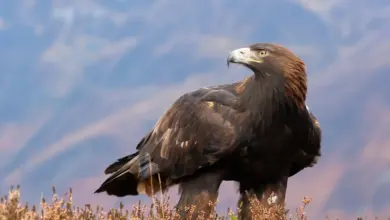
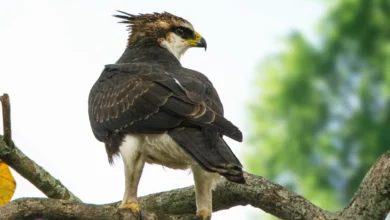
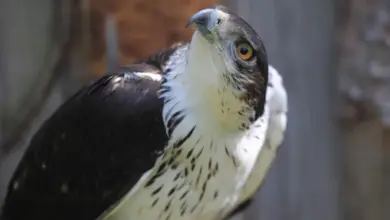
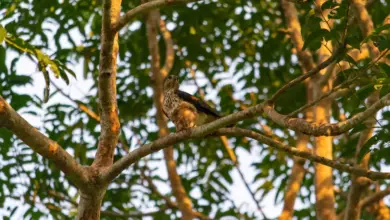
The Western Banded Snake Eagles (Circaetus cinerascens) is a grey-brown African raptor with a short tail and a large head. Juveniles have paler and browner upperparts than adults, with white-edged feathers. For more information, see our guide on birds.
The head, neck, and breast are dark-streaked. The underparts are white with pale brown streaks, mainly on the belly and thighs.
Subadults may be all dark grey-brown without any streak on the underparts. The eyes, ears, and legs are yellow. They have crested chests.


Habitat
Western Banded Snake Eagles inhabit a wide range of habitats in sub-Saharan Africa. They prefer areas like open woodlands and forest edges. They also enjoy riverine forests, savannahs with trees, and wooded savannahs. They avoid dense, closed canopy forests but are found in wetlands and rivers where they can find a variety of prey such as snakes, lizards and frogs. These habitats are typically found at altitudes between sea level and 2,000 meters.
The range of this species is extensive, extending from West Africa, through countries such as Senegal and Gambia, to Nigeria, eastwards to Ethiopia and Kenya and southwards to Angola and Zambia. Western Banded Snake Eagles can be difficult to see despite their widespread distribution.
These eagles have interesting migration patterns that are erratic or localised, and they do so in response to seasonal rain. In eastern Africa, movements were recorded between August and October. In western regions, the eagles tend to follow rain to track the availability of prey. Every breeding season, they build a new nest in tall trees close to their hunting grounds. This emphasises their dependence on healthy woodland ecosystems both for nesting and feeding.
Behaviour
Western Banded Snake Eagles are solitary, highly secretive, and feed primarily on snakes. This includes both venomous and non-venomous snakes. It ambushes its prey by quietly perching in the trees and then descending quickly to a tree, to foliage or to the ground. It also eats amphibians, small vertebrates and snakes. These can be caught on the ground or in low foliage. It can conserve energy by waiting and hunting in its woodland or savannah habitats.
This eagle is sedentary and prefers to stay hidden in dense cover. During the wet seasons, it may travel locally, searching for food. However, it usually stays within its own home range. It is difficult to detect because of its elusive nature and its preference for hiding in dense vegetation. These vocalisations become more important during the breeding season and when marking territories. Listening to its calls can be a very effective way for birdwatchers or researchers to find this species, which is otherwise difficult. According to Audubon Society, this species is well documented.
Songs & Calls
The Western Banded Snake Eagle occasionally soars high above canyons, using its loud, high-pitched “kok-kok-kok-kok-kok” call to communicate across its territory. The vocalisations of the Western Banded Snake Eagle are essential for marking its territory and finding mates in rugged terrains. Birdwatchers and scientists can identify the eagle by listening to its calls, even if it is hiding among trees or cliffs. According to RSPB, this species is well documented.
Food
Western Banded Snake Eagles eat snakes, both venomous and non-venomous. Its specialisation allows the Western Banded Snake Eagle to thrive in habitats with a high number of snakes, which makes it an important predator for controlling reptile populations. Its diet includes not only snakes but also lizards and amphibians such as frogs and fish.
This technique demonstrates the eagle’s agility and precision. It can navigate dense forests while snatching prey hidden in the foliage. Understanding the diet of the Western Banded Snake Eagle and its hunting behaviour sheds light on the ecological role of this bird. It also highlights the importance of preserving its natural habitat, where food sources like these are plentiful.

Geographic range
They are found in Africa in the northern tropics from Senegal and Gambia east through to Ethiopia and then south to southern Angola and Zimbabwe, mostly west of the Rift Valley, but are mostly absent from the western lowland equatorial forests. They inhabit woodland and forest edges. This is an uncommon bird that is often difficult to spot. Its distribution is patchy, and it is vulnerable to loss of its riverine habitat. It feeds primarily on reptiles and amphibians, which it captures either on the ground or in trees.
Flight
The Western Banded Snake-eagle sometimes rises to soar while it calls above the canyon. They utter a high-pitched ‘kok-kok-kok-kok-kok’, and it is loud.
Reproduction
The Western Banded Snake-eagle nests among creepers and foliage. It builds a small stick nest, well concealed within vegetation. The female lays only one egg. Incubation may last between 35 and 55 days, mainly by females. The young fledge after 10 to 15 weeks.
Source
BirdLife International 2004. Circaetus cinerascens. 2006 IUCN Red List of Threatened Species. Downloaded on 24 July 2007.
References
- Bouglouan, Nicole. “Western Banded Snake-Eagle.” http://www.oiseaux.net. 2 July 2008. Ecopains d’abord. 25 Feb. 2008 http://www.oiseaux.net/birds/western.banded.snake-eagle.html>.
- Sinclair, Ian, and Phil Hockey. The Larger Illustrated Guide to Birds of Southern Africa. Princeton University Press, July 24, 1995.