The White-eyed Slaty Flycatcher (Melaenornis fischeri) is a striking bird species native to the highland forests and wooded regions of East Africa. Recognizable by its distinctive pale eyes and slate-gray plumage, this flycatcher is an intriguing member of the Old World flycatcher family. Known for its active foraging behavior and melodious calls, the White-eyed Slaty Flycatcher plays a vital role in the ecosystems where it resides. This article delves into the species’ taxonomy, distribution, physical characteristics, behavior, reproduction, and conservation status, offering a comprehensive overview for birdwatchers, nature enthusiasts, and students alike.
Scientific Classification
The White-eyed Slaty Flycatcher belongs to the family Muscicapidae, commonly known as the Old World flycatchers. Its scientific name is Melaenornis fischeri, with the genus Melaenornis comprising several other flycatcher species characterized by their insectivorous habits and often drab coloration. The species was first described by the German ornithologist Anton Reichenow in 1884. The genus name Melaenornis derives from Greek, meaning “black bird,” which refers to the generally dark plumage of these species, although the White-eyed Slaty Flycatcher has a distinct slate-gray coloration.
Taxonomically, the White-eyed Slaty Flycatcher is closely related to other African flycatchers in the genus, such as the Northern Black Flycatcher (Melaenornis edolioides) and the Southern Black Flycatcher (Melaenornis pammelaina). Its classification within the family Muscicapidae places it among a diverse group of birds known for their agile aerial insect hunting and complex vocalizations. The species has no recognized subspecies, indicating a relatively stable taxonomy, although genetic studies continue to refine understanding of its relationships within the group.


Geographic Range & Distribution
The White-eyed Slaty Flycatcher is primarily found across the highland regions of East Africa, where it inhabits montane forests, forest edges, and wooded savannas. Its range extends from southern Ethiopia through western and southern Kenya, including the central and eastern highlands of the Democratic Republic of the Congo, and down to northern Malawi. This distribution highlights the species’ preference for elevated, cooler habitats, often above 1,500 meters in altitude.
Within this range, the White-eyed Slaty Flycatcher favors dense undergrowth and mid-canopy layers of forests where it can hunt for insects with relative ease. Although it is mostly resident, some local seasonal movements may occur in response to food availability and breeding cycles. The species is notably absent from lowland forests and arid regions, emphasizing its affinity for moist, montane environments.
Its presence in several protected areas, including national parks and forest reserves across Kenya and Tanzania, helps maintain stable populations. However, habitat fragmentation and deforestation in parts of its range, especially in the Democratic Republic of the Congo and Malawi, pose potential threats to its distribution. Despite this, the White-eyed Slaty Flycatcher remains relatively widespread within suitable habitats.
Physical Description
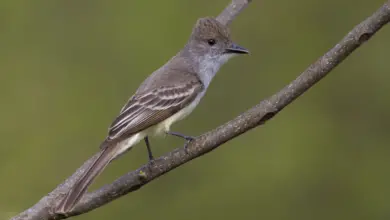
The White-eyed Slaty Flycatcher is a medium-sized passerine bird measuring approximately 16 to 18 centimeters in length, with a wingspan ranging from 22 to 26 centimeters. It typically weighs between 25 and 35 grams, reflecting its lightweight build suited for agile flight. The species’ most distinctive feature is its pale, almost white eyes, which contrast sharply against its dark slate-gray plumage. This eye coloration gives the bird its common name and aids in identification in the field.
Adults display a uniform slate-gray color across the head, back, wings, and tail, while the underparts tend to be slightly paler gray. The bill is slender and black, adapted for catching insects mid-air or gleaning from foliage. Legs and feet are similarly dark, supporting perching and quick movements through dense vegetation. Juvenile birds resemble adults but have a slightly duller plumage and darker eyes that lighten as they mature.
In flight, the White-eyed Slaty Flycatcher exhibits rapid wingbeats and a somewhat flicking tail motion, typical of many flycatchers. Its overall silhouette is slender and streamlined, allowing for quick aerial maneuvers during insect hunting. Vocalizations include a series of sharp whistles and trills, which are often heard within its forest habitat, especially during dawn and dusk.
Behavior & Diet
The White-eyed Slaty Flycatcher is an active and agile forager, primarily insectivorous, feeding on a variety of flying insects, spiders, and other small arthropods. It employs a classic flycatcher hunting technique, perching quietly on a branch before darting out to snatch prey mid-air or picking insects from leaves and bark. This species is known for its persistent hunting style, often observed flitting through forest understory with quick, deliberate movements.
In addition to aerial hawking, the White-eyed Slaty Flycatcher sometimes gleans insects from foliage or captures prey on the ground. Its diet includes flies, beetles, moths, ants, and occasionally small caterpillars, making it an important insect predator in its habitat. Feeding usually occurs during the early morning and late afternoon when insect activity is highest.
Socially, this flycatcher is generally solitary or found in pairs, especially during the breeding season. Outside of this period, it may join mixed-species feeding flocks, which provide increased foraging efficiency and protection from predators. The bird’s vocalizations play a role in territory defense and mate attraction, with males often singing from exposed perches to advertise their presence. According to eBird, this species is well documented.
Breeding & Reproduction
The breeding season of the White-eyed Slaty Flycatcher generally coincides with the rainy periods across its range, which vary geographically but typically occur between March and June or September and November. During this time, males establish territories and perform vocal displays to attract females. Nesting sites are usually located in dense shrubs or low tree branches, often concealed to avoid predation. According to BirdLife International, this species is well documented.
The nest itself is a small cup-shaped structure made from fine grasses, moss, and spider webs, carefully woven to provide camouflage and durability. Females typically lay between two to three eggs per clutch. The eggs are pale with subtle speckling, camouflaging them against the nest lining. Incubation is primarily the female’s responsibility and lasts approximately 14 to 16 days.
Once hatched, both parents participate in feeding the chicks, offering a steady supply of insects to support rapid growth. The nestlings fledge after about two weeks but may continue to receive parental care for several more days as they learn to forage independently. The species may raise two broods in a single breeding season if conditions are favorable, contributing to population stability.
Conservation Status
According to the International Union for Conservation of Nature (IUCN), the White-eyed Slaty Flycatcher is currently listed as Least Concern on the Red List. This status reflects its relatively wide distribution across East African highlands and presumed stable population trends. However, like many forest-dependent birds, it faces threats from ongoing habitat loss caused by deforestation, agricultural expansion, and human encroachment.
Protected areas within its range have helped mitigate some risks, but continued monitoring is necessary to ensure long-term viability. The species’ reliance on montane forests makes it vulnerable to climate change, which could alter the availability and quality of these habitats. Conservation efforts focusing on preserving forest ecosystems and promoting sustainable land use are critical for maintaining healthy populations.
Despite these challenges, the White-eyed Slaty Flycatcher demonstrates a degree of adaptability by occupying a range of forest types and sometimes utilizing secondary growth or edge habitats. Its presence in relatively undisturbed forest patches underscores the importance of preserving these environments not only for this species but for the broader biodiversity of East Africa’s highlands.
Interesting Facts
The White-eyed Slaty Flycatcher’s pale eyes are more than just a striking feature; they may aid in communication and species recognition within dense forest environments where visibility is limited. Its contrasting eye color is unusual among African flycatchers, making it a favorite subject for bird photographers and enthusiasts.
Unlike many flycatchers that migrate long distances, this species is mostly sedentary, adapted perfectly to its montane environment. It exhibits remarkable agility while hunting, capable of quick directional changes mid-flight to capture elusive insects. This behavior not only highlights its evolutionary adaptation but also contributes to controlling insect populations within its habitat.
Additionally, the White-eyed Slaty Flycatcher’s vocal repertoire includes a variety of whistles and trills that vary regionally, suggesting some degree of local dialects, a phenomenon observed in other passerines. Birdwatchers often rely on these vocal cues to locate and identify the species in dense forest settings.
Interestingly, despite its name, the White-eyed Slaty Flycatcher is not closely related to the true flycatchers of the Americas but shares convergent ecological niches, showcasing how similar environmental pressures shape species across continents.
In conclusion, the White-eyed Slaty Flycatcher is a captivating and ecologically important bird of East Africa’s montane forests. Its unique physical features, dedicated insectivorous diet, and adaptable behavior make it a fascinating subject for observation and study. Continued conservation efforts are key to preserving the vibrant ecosystems that support this species and countless others that depend on healthy forest habitats.