
Description
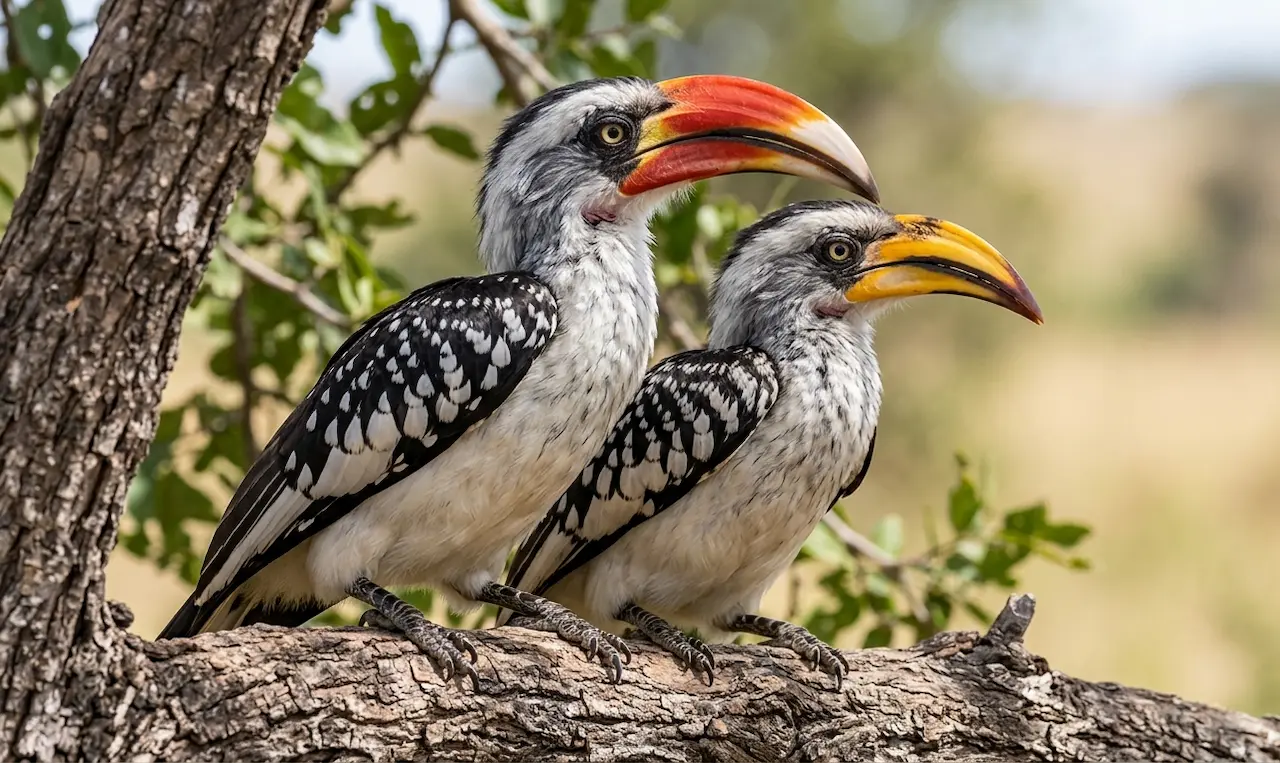
Jackson’s Hornbills are medium-sized African Hornbills, measuring usually 35 centimetres. The body shape of this hornbill is similar to that of other members in the Tockus genus, which have a long bill and curved tail. It also has a relatively slim frame. Jackson’s Hornbill is easily distinguished from other close relatives like Von der Decken Hornbill by its plumage. The wing coverts are heavily spotted with white spots, giving them a more patterned look. Von der Decken tends to be darker with fewer white markings.
The bird’s underparts are pale or creamy white, which contrasts sharply with its dark upperparts. The long tail of Tockus is black and usually edged with white. The bills of males and females are slightly different. This is a form of sexual dimorphism that is easily noticeable. Males have a bright red bill with a pale tip. They also display a casque (the ridge on the top of the mandible). The females have a completely black bill and no casque. This helps in both field identification as well as possibly in mate recognition.
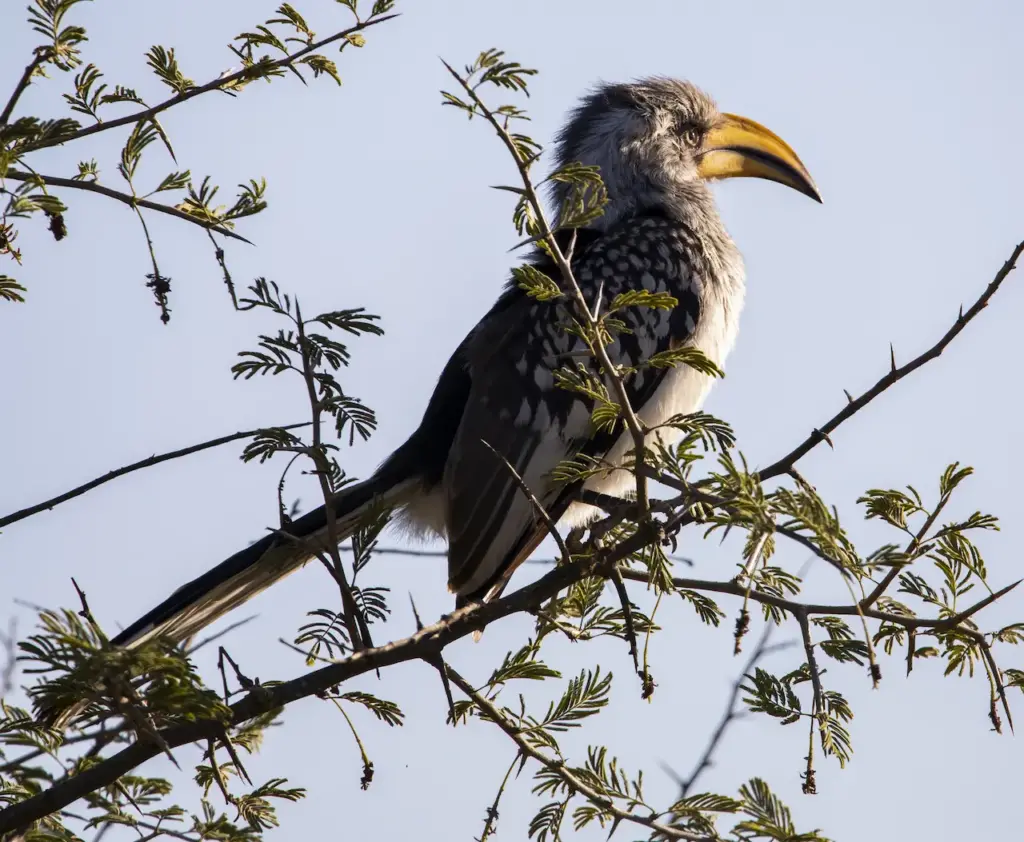
Jackson’s Hornbills have a dark crown on their heads that contrasts with their white cheeks, underparts, and undertail feathers. The iris of the Jackson’s Hornbill is dark and is surrounded by greyish or even pinkish skin. The legs and feet of the crow are black or dark grey and are adapted to perch on tree branches and forage on the ground. The juveniles are similar to adult females, but have duller plumage. They also have a shorter bill.
Jackson’s Hornbill is elegant in its own right, even though it may not be as showy as tropical hornbills. The colouration of the Jackson’s Hornbill is striking and adaptable to the open acacia scrub and sun-drenched bushland where it lives.
Habitat and Distribution
Jackson’s Hornbill can only be found in the dry savannas of East Africa. The range of the bird includes parts of northwestern Kenya and northeastern Uganda, as well as the southern border with South Sudan. The bird prefers semi-arid and arid habitats with a sparse or moderate amount of tree cover. It prefers open woodlands and thornveld in addition to dry acacia shrub.
Its distribution overlaps that of Von der Decken’s Hornbill, but its ecological preferences are often different, leading to niche separation. Jackson’s Hornbill prefers drier habitats with less dense cover of trees, as well as more northern areas. It is also found in areas with fewer frugivores.
The bird is not migratory and remains in its home territory all year round, though some local movements have been observed as a result of rainfall or food availability. These movements are minor and do not form part of a long-distance migration. During times of drought or when the environment is stressed, birds can extend their ranges.
In Kenya, the most common areas where it has been reported are around Lake Baringo and Lake Bogoria and in lowlands with acacias and dry bush. In Uganda, it has been observed near the northeastern border, where similar habitat conditions are prevalent. South Sudan has fewer documented sightings due to the limited birding activities in this region.
Habitat is important not only for feeding, but also for nesting. The availability of mature, natural-cavity trees is crucial to the Hornbill’s reproductive success. Deforestation and habitat destruction are therefore serious threats to the hornbill, even where it is relatively common.
Breeding and Nesting
Jackson’s Hornbills reproduce in a similar way to other hornbills, although the specific information on this species has been limited because of its misclassification. It is also a cavity-nester like its relatives. Breeding pairs seek out tree holes to raise their young. These cavities can be found in mature, large trees, especially those with soft interior wood or that have decayed, creating hollow spaces.
The female will enter the cavity once a suitable location is chosen and remain there for the duration of incubation, and the early stages of chick rearing. She seals the cavity with mud, plant material and droppings. The male can only feed her through a small slit. This behaviour protects the nest from predators like snakes, monitor lizards and mammals. It also creates a stable microclimate.
The size of the clutch is usually between two and four eggs. However, environmental conditions and food supply may affect this number. As is common for species that nest in cavities, the eggs are unmarked and white. The incubation period is approximately three weeks. However, exact timing can vary. The male will continue to feed the female through the small hole once the chicks have hatched. The female will break out of the nest when the chicks have reached a certain size and help the male to feed them.
Breeding can be done during the rainy season or immediately afterwards, when food is abundant. In East Africa, this means that breeding generally occurs between March and July. However, local variations may occur depending on rainfall patterns and regional climate patterns.
Feeding and Diet
Jackson’s Hornbills are omnivores and rely on a variety of foods to survive in their challenging environment. It feeds on insects, mainly large species such as beetles and grasshoppers. They are captured both from the air and on the ground. The bird’s curved beak allows it to probe leaf litter, bark and crevices, where insects are hidden. According to BirdLife International, this species is well documented.
The hornbill also eats seeds, fruit, berries and berries. During fruiting season, it will visit trees such as figs and acacias in order to eat ripe fruit. This provides sugar as well as moisture. Fruit is also important for hydration. This is especially true in environments with limited water resources. According to eBird, this species is well documented.
Sometimes, smaller vertebrates, like lizards or nestlings from other birds, are taken. This is especially true when the demand for protein is high, as it would be during chick rearing. The bird can be seen foraging in trees as well as on the ground. It is often seen hopping and walking across the dusty soil, grabbing prey with its bill.
Jackson’s Hornbills have also been seen following herds to catch insects disturbed as a result of their movements, similar to some ground-hornbills or cattle egrets.
It is rare that water is consumed directly, but it can be obtained through food. Jackson’s Hornbills will visit open water to drink and bathe if it is available.
Vocalizations
Jackson’s Hornbills make a series of lucking and chuckling noises, which are often repeated in a particular pattern. Observers describe a typical vocalisation of a soft and repetitive “wuk wuk wuk” or kuk kuk kuk”, used for pair communication as well as territorial displays. Males tend to be more vocal than females. This is especially true during breeding season when males use their calls both to attract mates as well as to ward off competitors.
Hornbills are not melodious songbirds and do not sing complex songs. Instead, they use simple calls to communicate over long distances. Their habitat is open, which allows sound to travel and makes even the quietest clucks audible.
Males can accompany their vocalisations during courtship with bobbing movements, bill gestures and wing-fanning to show the female they are monogamous with. Both sexes can call each other to keep in touch when they are foraging separately or to coordinate the care of their chicks.
Conservation Status
Currently, the Jackson’s Hornbill has been classified as a species with Least Concern (LC) by international conservation authorities. The reason for this is that the species has a relatively large range and a stable population in places where habitats are still suitable. This classification does not, however, mean that the species is safe from all threats.
Habitat loss is the biggest concern for the long term. Clearing dry woodlands to make way for agriculture, charcoal production, and human settlements reduces the amount of large trees that are available for nesting. Because cavity-nesting bird species depend on old or decaying trees to nest, young reforestation projects rarely provide the same benefits.
Climate change is a risk because shifting patterns of rainfall could affect breeding cycles and the availability of food. Drier years can lead to reduced breeding success. They may also result in fewer insect populations and fruiting events. All of these factors could impact chick and adult survival.
Human disturbances, especially in areas where settlement and deforestation are increasing, can lead to fewer nesting places and an increased risk of nest predators. To ensure long-term stability, it is important to take protective measures such as protecting acacia forests and preventing the cutting of trees with cavities.
Conclusion
Jackson’s Hornbill has a subtle difference. It has been overshadowed for a long time by its more well-known relatives, but it’s now a bird with heightened ecological and biological importance. Jackson’s Hornbill, with its complex nesting habits and adaptability to harsh environments, is an excellent example of avian specialisation.
This species shows us that biodiversity can thrive in semi-arid environments. It highlights the importance of accurate taxonomy and detailed fieldwork, as years of confusion with other species almost wiped out its unique position in the world of birds.
The preservation of this bird is a way to preserve the delicate balance in East Africa’s Savanna Ecosystems. Trees, insects and fruiting shrubs are all connected, as well as the birds. Recognising and appreciating such species is important for us as observers and stewards. It helps to ensure that the Jackson’s Hornbill will continue to echo in the open bushlands and thorny Acacia groves.
Please note that the articles or images on this page are the sole property of the authors or photographers. Please contact them directly with respect to any copyright or licensing questions. Thank you.