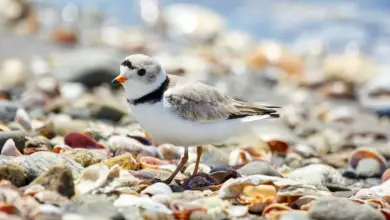
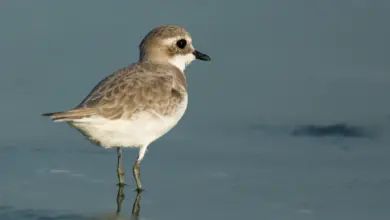
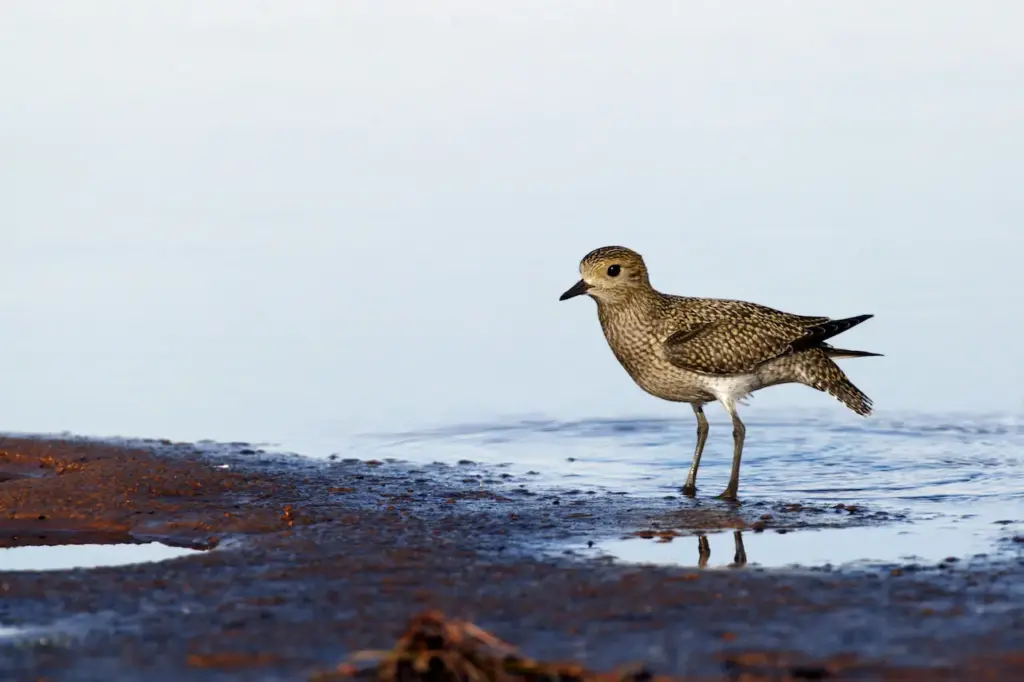
The Eurasian Golden Plovers, Pluvialis apricaria, is a large plover.
This species is similar to two other golden plovers. American Golden Plover, Pluvialis dominica, and Pacific Golden Plover, Pluvialis fulva, are both smaller, slimmer and relatively longer-legged than Eurasian Golden Plover, and both have grey rather than white axillary feathers (only properly visible in flight).
Description


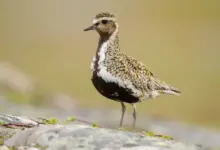

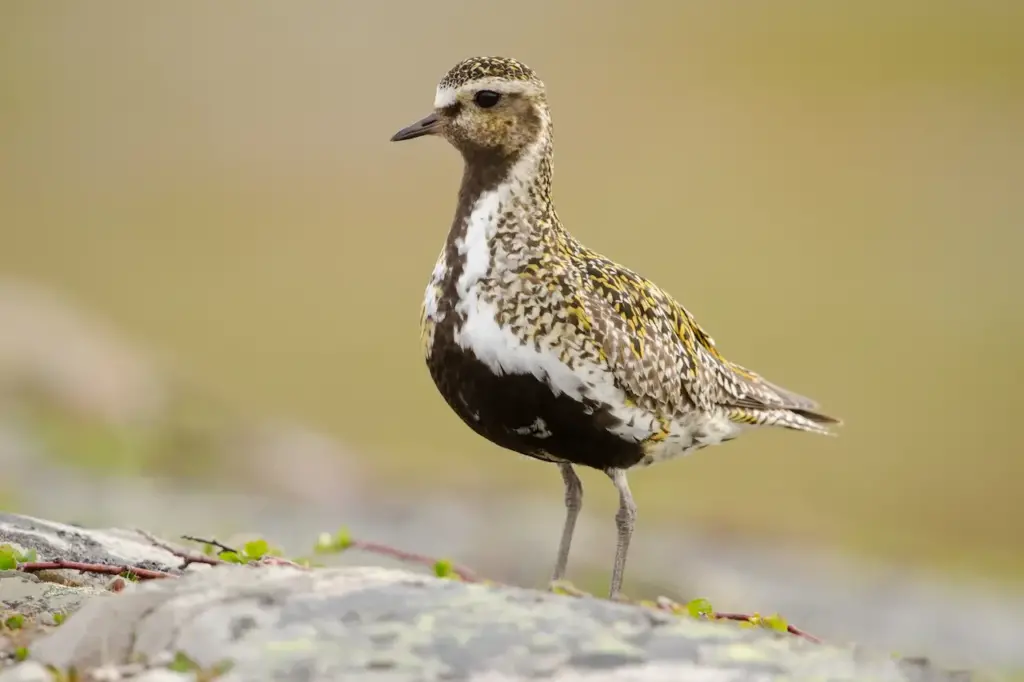
Breeding adults are spotted gold and black on the crown, back, and wings. Their face and neck are black with a white border; they have a black breast and a dark rump.
The legs are black. In winter, the black is lost, a nd the plover then has a yellowish face and breast and white underparts.
Habitat and Distribution
The Senegal Thick Knee is an African species that lives in the regions between the Sahara Desert and the Equator. The range of the Senegal Thick-knee extends over a large area in sub-Saharan Africa, including the fertile Nile Valley. This wide distribution includes multiple countries, as well as diverse ecosystems on the continent.
This bird prefers open, dry habitats. Savannahs are a good example. They also include dry grasslands and scrubland, as well as semi-deserts where sparse vegetation is scattered amongst bare ground. It prefers areas with some bare ground or stony substrates that facilitate its foraging lifestyle.
The Senegal Thick Knee prefers arid environments, but it is often found near water sources such as rivers or lakes. These water bodies are vital for their survival because they attract the insects and crustaceans they rely on.
The adaptability of this bird is evident in its ability to survive in harsh environments. This specialisation means that the bird is also closely linked to the availability of specific habitat features and therefore sensitive to changes caused to it by human activities, such as agriculture, water management projects, and urbanisation.
Breeding Habitat
Their breeding habitat is moorland and tundra in the northernmost parts of Europe and western Asia. They nest on the ground in a dry, open area. They are migratory and winter in southern Europe and north Africa.
Around 500,000 birds winter in Ireland and Great Britain. Although generally common, its range has contracted somewhat in the past due to habitat destruction.
For example, in the 19th century, it disappeared as a breeding bird in Poland and only occurs there as a migrant nowadays; its breeding population in Central Europe apparently was a relic of the last ice age (Tomek and Boche?ski, 2005).
Diet and Feeding
The Senegal Thick Knee is primarily nocturnal and crepuscular. This means that it is active at dusk and night. This adaptation allows it to avoid the heat and compete with diurnal prey.
The main components of its diet are insects and crustaceans. Its diet is dominated by insects such as grasshoppers, beetles and ants. Crustaceans are also a significant part of its diet. They tend to be more common around water bodies. The bird will eat a variety of small prey, as it is available.
The thick-kneed uses a strong bill to probe or sift the soil and leaf litter to find hidden prey. The thick-kneed’s sensitive hearing and excellent night vision help it detect movement in the darkness, making it a successful hunter. According to RSPB, this species is well documented.
The Senegal Thick Knee will occasionally prey on small vertebrates, such as lizards and small mammals. However, invertebrates are its main diet. According to eBird, this species is well documented.
The Senegal Thick Knee maintains the ecological balance of its habitat by controlling the populations of insects, small creatures and other organisms.
Protection
Moorland and protection of species in West Lower Saxony
The Eurasian Golden Plover is one of the species to which the Agreement on the Conservation of African-Eurasian Migratory Waterbirds (AEWA) applies.
References
- BirdLife International (2004). Pluvialis apricaria. 2006. IUCN Red List of Threatened Species. IUCN 2006. Retrieved on 11 May 2006. The database entry includes justification for why this species is of least concern.
Conservation Status and Challenges
The IUCN Red List does not currently list the Senegal Thick Knee as threatened. It is also generally believed to have a stable population within its range. It faces several challenges that could threaten its long-term existence if they are not addressed.
The most serious threat is habitat loss caused by agricultural expansion, urbanisation and infrastructure development. When dry, open habitats become farmland or settlements, and the nesting and feeding areas of birds are destroyed or fragmented.
Indirectly, water management projects that alter the river flow and reduce wetland area can affect species because they decrease prey availability.
Even though they are not usually targeted by hunters or other humans, the Senegal Thick Knees can be disturbed, especially in breeding season, when they are most vulnerable.
To maintain healthy populations, it is essential to focus conservation efforts on habitat protection, sustainable land usage, and population monitoring.
The bird’s cryptic nature and its tendency to be nocturnal mean that it is often overlooked, which highlights the need for dedicated research and campaigns of awareness in order to bring attention to the ecological importance of the bird.
Conclusion
The Senegal Thick Knee is an amazing example of the adaptability and subtlety of nature. It thrives in harsh environments, thanks to its reptilian-like eyes, cryptic feathers, and distinct calls.
The thick-kneed bird may not be as colourful or large, but it plays an important role in ecological communities in dry open habitats. It is both a predator and a prey, in a web of complex life.
Understanding the biology, behaviour and conservation needs of African birds helps us understand the intricate balance in African ecosystems. It also highlights the importance of protecting even the lesser-known members of the bird world.
The Senegal Thick Knee is a silent but powerful reminder, as we continue to protect and explore Africa’s biodiversity. Every species, however elusive, adds to the rich tapestry of life on Earth.
You can ensure that future generations enjoy the wonders of Africa’s natural heritage by learning about species such as the Senegal Thick Knee.