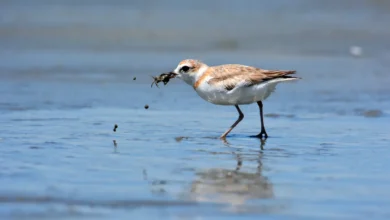
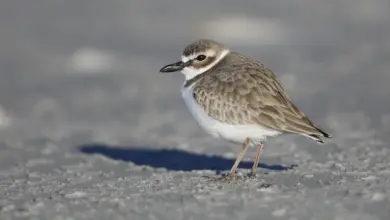
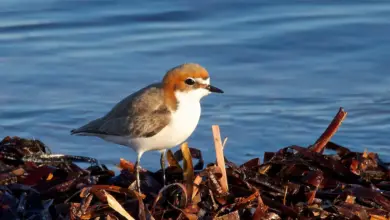
The Piping Plovers (Charadrius melodus) is a small plover.
Description
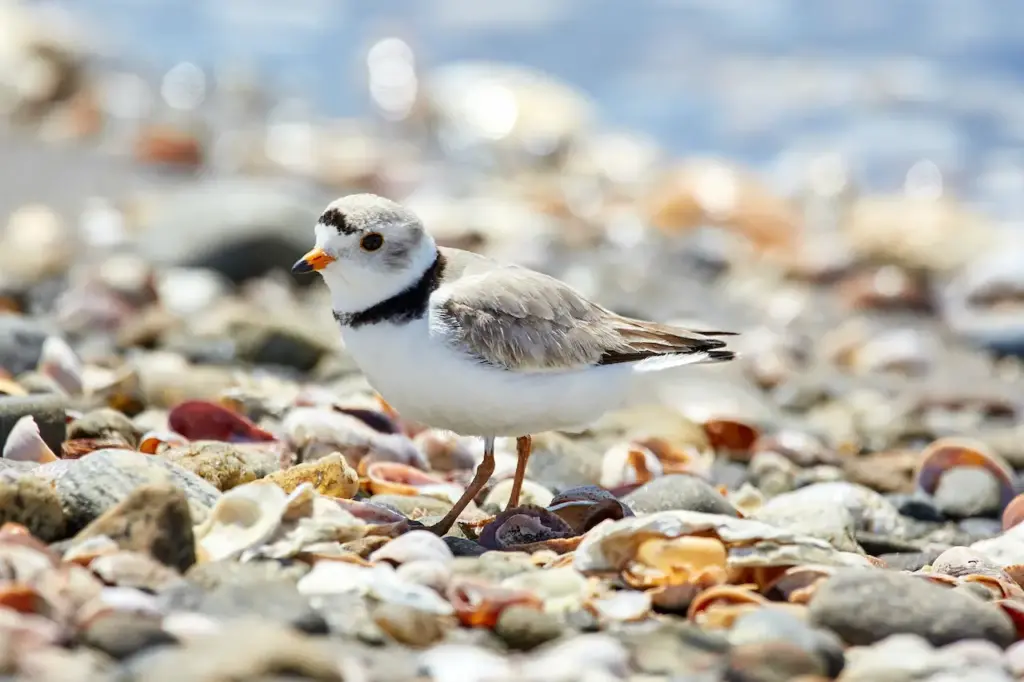
The Piping Plover is a sand-colored, sparrow-sized shorebird that nests and feeds along coastal sand and gravel beaches.
The adult has yellow-orange legs, a black band across the forehead from eye to eye, and a black ring around the neck during the breeding season. It runs in short starts and stops.






It is difficult to see when standing still, as it blends well with open, sandy beach habitats.
Distribution / Range
Their breeding habitat is beaches or sand flats on the Atlantic coast, the shores of the Great Lakes, and in the Midwest of Canada and the United States. They nest on sandy or gravel beaches or sandbars.
They are migratory in northern areas and winter on the coasts of the Gulf of Mexico, the southern Atlantic coast of the United States, and the West Indies.
This bird is endangered, and its range has been reduced recently due to habitat loss and human activity near nesting sites. Some critical nesting habitat is now protected. In coastal areas such as Cape Cod, beach access by ORVs is prohibited near nesting piping plovers – a cause of some conflict over the years – as a result of management plans.
In Eastern Canada, the Piping Plover is only found on coastal beaches. In 1985, it was declared an endangered species by the Committee on the Status of Endangered Wildlife in Canada.
In 198,6, it was declared to be endangered within the watershed of the Great Lakes and threatened in the remainder of its range in the United States, which resulted in the permanent closing of Moonstone Beach in South Kingston, Rhode Island.
Diet / Feeding
The diet of the Piping Plover is modest, but perfectly adapted to its habitat. It hunts by sight, running along the wet sand and beach while pausing to peck or scan at any prey visible above or below the surface. Its primary prey includes marine worms and insects. Other invertebrates can be found on the beach substrate or along the wrackline. It hunts in the wrack zone at high tide, which is the line of seaweeds, shells, and debris left behind by waves. This zone contains many small invertebrates.
Foot trembling is another behavior that some plovers use. They place their foot in the sand, vibrate it gently to disturb any invertebrates beneath the surface, and then peck at them if they emerge. This helps the bird to find food in stable substrates and flushes hidden prey. The majority of feeding takes place within 5 meters from the waterline, or in damp areas near tide edges. However, breeding adults will venture further inland to find suitable prey patches. According to eBird, this species is well documented.
The substrate condition is a major factor in feeding success. Prey may be reduced in abundance if beaches are compacted due to heavy recreational use or by machinery. The removal of wrack or dunes (divitting, shell fragments), as well as the flattening of dunes and removal of microhabitats, can reduce prey hiding places. Conservation of feeding habitats is therefore as important as protecting nesting territories. According to Cornell Lab of Ornithology, this species is well documented.
Vocalization
The bird’s name is derived from its plaintive, bell-like whistles, which are often heard before the bird is visible.
These birds produce a soft whistle that is similar to a bell. The vocal repertoire of these birds is small but essential for communication, mate coordination, and warning of anger.
The standard “peep”, or “peep peep”, is often made while the bird is in flight, or perched. The whistle is loud and audible from a short distance, and can often be heard before the bird is actually seen. Plovers may make more intense, insistent calls in alarm or threat situations, sometimes a trilling or rattling sound, to warn chicks and ward off invaders. Vocalizations can increase in volume, pitch, or frequency during territorial displays and courtship to attract mates and defend nesting territories. Even moderate noises can disrupt communication in their open, flat nesting areas. Quiet zones are therefore desirable near nests, as even mild noises can be disruptive.
For Piping Plover,s sound is a lifeline that’s small, but important: it allows them to stay in touch, warn others of danger, and show their presence.
Breeding and Nesting
The Piping Plovers return to their nesting sites year after year. This shows a high level of site loyalty and highlights the importance of protecting this important habitat. Pairs engage in courtship displays before nesting. These include short runs, high-stepping walks, and soft calls. The nest-building and incubation duties are shared almost equally by males and females. Parents are very cautious during incubation. They scan for predators and humans constantly, sometimes freezing to avoid detection. The eggs are spotted with brown and tan spots that act as natural camouflage on the sandy background. Within hours of hatching, the chicks can run. However, they still rely on their parents for guidance on food and shelter. The chicks become increasingly independent as they grow older, but their parents still protect them until they leave the nest. Human disturbance is a major challenge during this time, as even minor disruptions can cause nests to be abandoned or chicks to be abandoned, affecting reproductive success.

Conservation
The majority of threats to Piping Plovers are caused by humans. Their eggs and chicks are vulnerable to disturbances from recreational activities, pets that have been let loose, vehicles, and trampling. Nesting habitat is also reduced or destroyed by coastal development, beach engineering, and sea level rise. Survival is further threatened by predators such as raccoons and gulls. Domestic animals, including foxes and raccoons, are also attracted to human waste.
Long-term conservation efforts helped despite these challenges. In some areas, nesting protection, habitat restoration, control of predators, and public education have all contributed to a modest increase in population. Despite this, the recovery is still fragile and uneven. The success of the project will depend on the cooperation between communities, conservationists, and local governments. The Piping Plover remains a species of high priority for protection.
Conclusion
Piping Plovers may be small, but they play a major role in reminding people of the delicate balance that exists between humans and nature. Respecting these birds’ need for space in their habitat should not be disturbed. Their survival is a reflection of the health and diversity of our coastal ecosystems.
It’s more than just a moment of birdwatching when you see one skittering across the sand, or hear its soft whistle. You can also witness resilience in action. The Piping Plover is a symbol of many things: biodiversity, beach health, and our shared natural heritage. By making space for this tiny bird, we are choosing to live responsibly with land and ocean.