The White Fronted Plover is also known as the White Fronted Sandplover. It can be found in much of sub-Saharan Africa. This species is not a long-distance migrant. It lives permanently along sandy, muddy, or rocky coastlines as well as near large rivers and lakes. The species’ preference for sandy, open beaches and sparsely vegetated shorelines makes it a familiar bird to birdwatchers who explore African coastal ecosystems. The White-fronted Plover, despite its diminutive size, is resilient and well adapted for living in environments that are shaped by wind, tides and shifting sands. The White-fronted Plover is one of the most fascinating plovers in Africa. Its appearance, behaviour and nesting strategy make it a very interesting bird.
Taxonomy & Scientific Classification
The White-fronted Plover is a member of the family Charadriidae. This group includes plovers and lapwings. The scientific name Charadrius Margatus reflects the species’ taxonomic position among small waders, which are known for their active feeding style and dependence on coastal habitats. There are five different subspecies within this species. Each has subtle colour variations, especially in the breast shading and collar. These adaptations are mostly a result of regional habitats. The White-fronted Plover, although closely related to the other African Plovers, is easily distinguishable by its strikingly white forehead and unique pattern on the head, especially during breeding season.
Dimensions and Structure
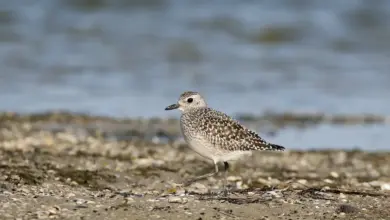
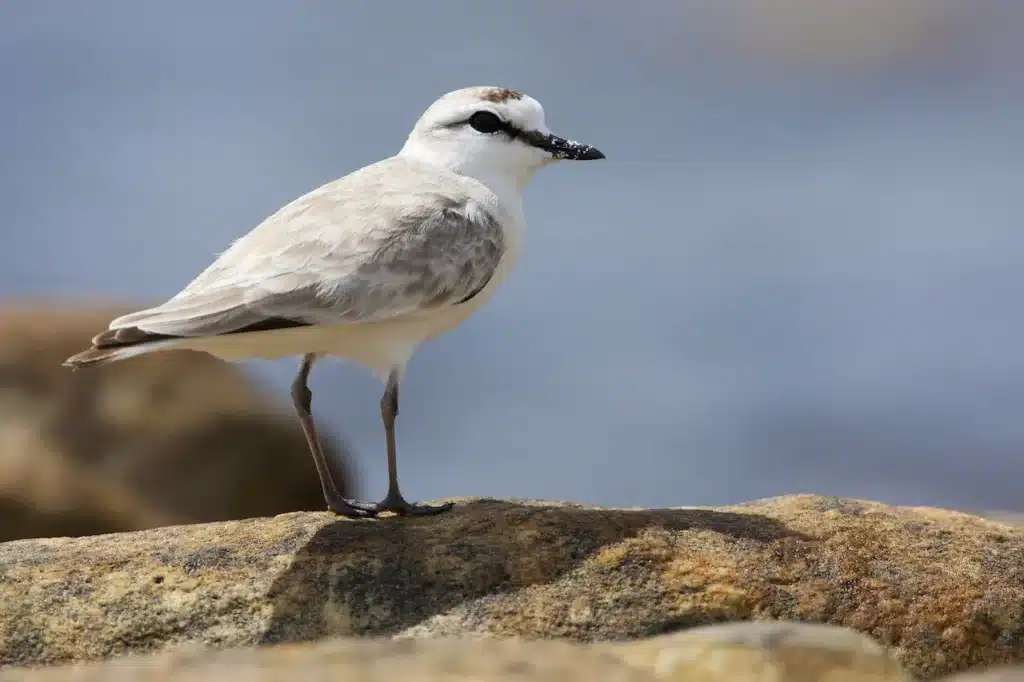
The White-fronted plover is a small wader that measures approximately 16-18 centimetres. The compact body, short bill, and strong legs of White-fronted Plovers are ideal for rapid movement over sand or mudflats. They appear paler than other plover species. This helps them blend in with sandy beaches and sunlit substrates. The lightweight construction allows them to move quickly when foraging. Their posture, upright when alert and low while feeding, reflects their constant vigilance towards predators. The balance between agility and alertness is essential to survival in coastal open environments.



The Adult Appearance and Breeding Plumage
The most striking colouring of the adult White-fronted plovers is during the breeding season. The upper parts of the White-fronted Plover are medium brown. This contrasts with a bright, white collar on the hind neck. The brilliantly white forehead is one of the most distinguishing features. It extends in a wedge-shaped pattern between the eye and crown. The bird’s common name is derived from this marking, which makes it easy to recognise in the field. The crown is adorned with a frontal bar and a line running through the eye. Underparts: White, with a buff or cream wash on the breast. Some individuals have rufous spots on the sides. The legs are usually yellowish-grey, and the bill is black.
Adults that do not breed and seasonal changes
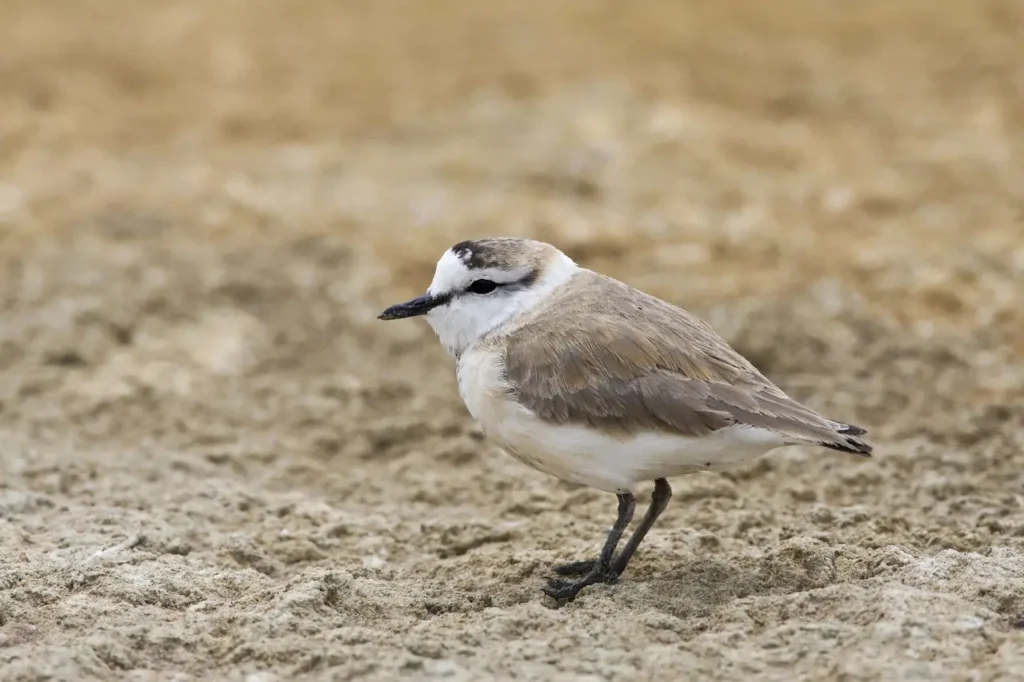
White-fronted plovers change in appearance outside of the breeding season. The changes are subtle, but still noticeable. Adults that are not breeding appear greyer, and their bold black markings on the head have been replaced with softer brown shades. Some females may have no bar on the front of their head, which gives them a more plain appearance. These changes in colouration help birds to remain camouflaged when they are not breeding. The white forehead is still a distinguishing feature that allows experienced observers to identify the species all year round.
Identification and Development of Juveniles
The juvenile White-fronted Plover is similar to non-breeding adult White-fronted Plovers, but they are paler in color and have no black markings. The underparts of the White-fronted Plover are completely white. Their plumage is excellent for camouflaging against sandy beaches. Precocial chicks can forage and walk shortly after hatching. In an environment with nests exposed and predators a constant danger, their early independence is vital. As they grow older, juveniles gradually acquire adult plumage. They learn feeding and avoidance behaviour by watching adult birds.
Habitat Preferences for Coastal Living
The White-fronted Plover has a strong association with coastal ecologies. This includes sandy beach, estuaries and mudflats. It is most at home in areas where there is little vegetation. This allows for better visibility and makes predators easier to spot. The species is primarily found along the coast, but can be found in areas near large rivers and lakes. This, however, is not as common. The bird’s activities are closely linked to the cycles of the tide as the exposed mudflats offer rich feeding opportunities. Adaptability is essential for the bird’s behaviour and habitat, as high winds, waves and changing tides influence both.
Geographic Distribution in Africa
The White-fronted Plover’s range extends across Africa, south of the Sahara. The White-fronted Plover is found along the coast of southern Senegal, Mauritania, Mozambique, South Africa, and parts of the east coast. Some populations remain constant year-round, while others move locally depending on the seasonal rainfall and availability of food. The species may not migrate long distances, but it can move in response to local environmental conditions. This is especially true during the rainy seasons when food resources are abundant. According to Cornell Lab of Ornithology, this species is well documented.
Feeding Behaviour and Diet
The White-fronted Plover eats mostly insects and small invertebrates along the shoreline. It is a visual hunter that uses keen eyesight to detect movements in the mud or sand. The Sanderling’s feeding style is marked by rapid runs and sudden stops. The bird will probe rapidly with its bill once it has spotted prey. It is especially adept at catching tiny crabs and marine worms, which burrow under the sand. It will occasionally eat small fish, if available. According to BirdLife International, this species is well documented.
Social Behaviour and Flocking Patterns
The White-fronted Plover, though often seen in pairs or feeding alone, is a social species. It often forms flocks outside of the breeding season. These flocks provide increased protection against predators and also allow the birds to more effectively exploit areas with abundant food. The size of flocks can vary depending on the habitat and availability of food. The species’ ability to adapt to changing conditions and change between solitary behaviour and social behaviour is demonstrated by this ability to alternate.
Breeding Habitat & Nesting Sites
Breeding occurs most often on a sandy beach, with minimal human disturbance. The nesting sites are usually remote and unaltered. The nest is a shallow scratch in the sand, made by adults. The eggs are laid on the sand and can be partially hidden to blend in with the surrounding area. The eggs blend in with the substrate of the beach, making them almost invisible to predators.
Unique Nest Cooling and Parents Care
The White-fronted Plover has a remarkable ability to transport water into the nest using its breast feathers. This behaviour is used by adults to cool eggs in hot weather and provide moisture to newly hatched chicks. This unique nesting technique helps to ensure survival in the exposed, harsh conditions of coastal beaches. Parents are very protective, and they will use distraction displays to feign injury to distract predators from the nest. Chicks are hidden until they hatch, and then begin to forage under supervision.
Vocalizations & Communication
The White-fronted Plover is not a particularly vocal bird, but it uses calls to communicate effectively. Most common is the clear, “wiit”, which can be heard when in flight or during social interactions. The bird will emit a more pronounced “tukut to warn other birds of danger. These vocalisations are important in alerting the flock or chicks to dangers and maintaining group awareness.
Conservation Status and Threats
The White-fronted Plover, according to the International Union for Conservation of Nature, is classified as Less Concern. This is due to its stable population throughout its range. Like many shorebirds, it is threatened by coastal developments, pollution, tourism and human disturbance. Urban expansion and industrial activity pose a risk to breeding areas, especially in the long term. Rising sea levels and climate change threaten nesting beaches, feeding zones and low-lying areas.
Habitat protection is important
The White-fronted Plover’s long-term survival depends on the protection of coastal ecosystems. Healthy populations can be maintained by reducing disturbances at breeding sites, conserving wetland areas, and responsibly managing tourism. Even small changes to land use can have a significant impact on this species, as it relies on unspoiled, open beaches. The White-fronted Plover benefits from conservation efforts that protect shorelines, but so do many other species of coastal birds that share the same fragile habitat.
Conclusion: A Symbol for Coastal Resilience
The White-fronted Plover, a beautiful shorebird with a wide range of adaptations, perfectly represents life on Africa’s coastlines. The White-fronted Plover is a popular bird among nature lovers and birdwatchers due to its striking appearance, energetic feeding behaviour, and remarkable nesting adaptations. It is not endangered at this time, but ongoing conservation efforts will help preserve the beaches and estuaries that it relies on. We can ensure future generations will be able to see White-fronted Plovers running on the shoreline. They are a symbol of the delicate equilibrium between wildlife and nature.