
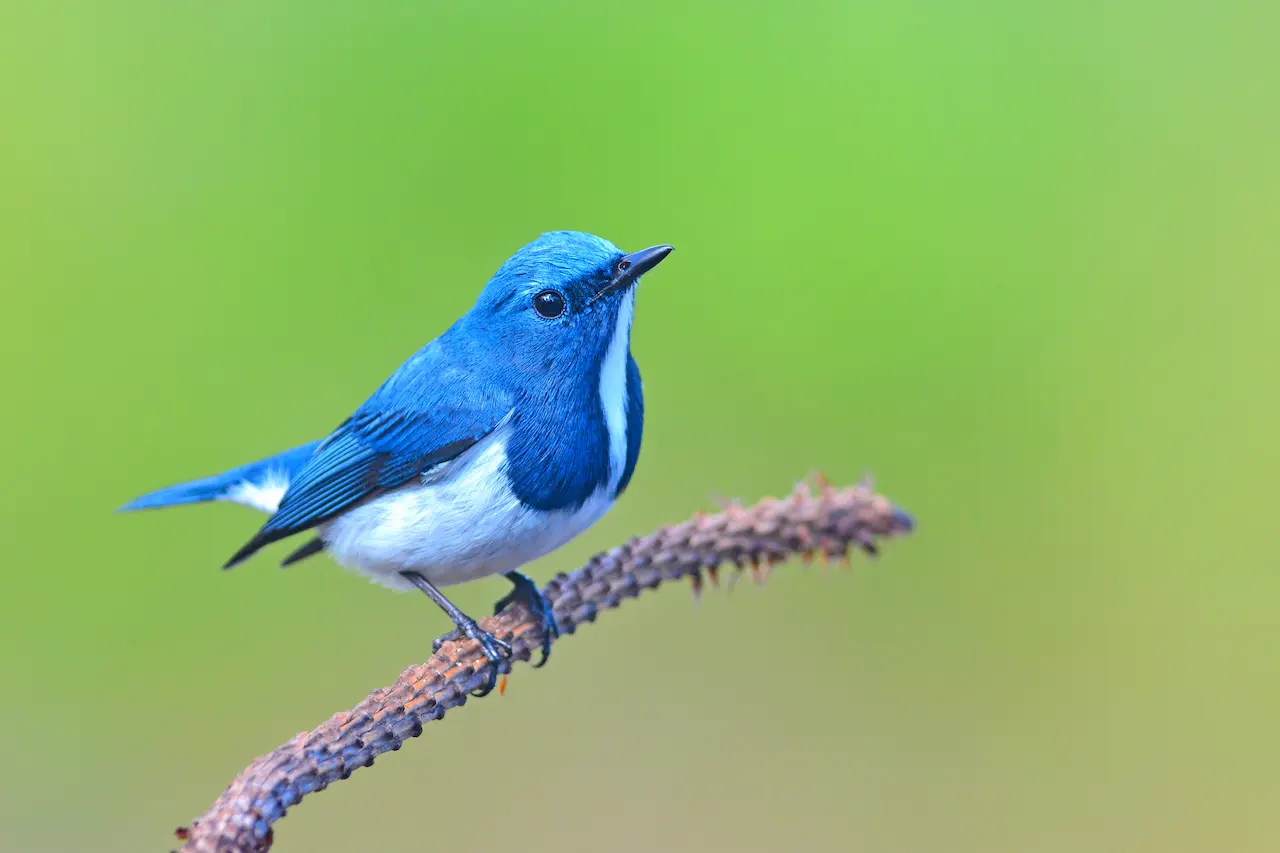
The Ultramarine Flycatcher is also called the White-browed Blue Flycatcher. It is a vibrant and small migratory bird that originates from the Indian Subcontinent. The Ultramarine Flycatcher breeds in temperate forests at the foothills of the Himalayas and migrates south to India for the winter. This species, which is only 10 cm long, is smaller than a sparrow. However, it stands out for its vibrant colouration and energetic behaviour. The male bird is especially striking, with its deep blue plumage on the head, neck and upperparts. This is contrasted with a white patch that runs from the throat down to the belly. For more information, see our guide on flycatchers.
The Ultramarine Flycatcher is known for its active and shy nature. It usually stays in the lower canopy, quietly foraging amongst leaves and branches. In winter, the Ultramarine Flycatcher may be seen in mixed species flocks foraging. Its presence can be an indicator of healthy forests, and its seasonal movement reflects the importance of protecting both breeding and wintering areas. The Ultramarine Flycatcher, with its vibrant appearance and elusive habit, is a favourite among birdwatchers and a fascinating subject to study in South Asia’s rich biodiversity.

Description
There are distinct differences between the plumage of populations in the Himalayas. The race that breeds in the Western Himalayas can be identified by the white supercilium, or eyebrow stripe. It also has white bases at the tail’s outer feathers. The eastern race, Aestigma, lacks the prominent markings. It has a subdued look with no supercilium and tail base colouration. The South Assam Hills populations, also known as the clet races, lack any supercilium. These plumage differences reflect clinal variations, a gradual change of characteristics along the Himalayan Foothills from west to east.


In the summer, it is common to find the Ultramarine Flycatcher in the western Himalayas from Jammu & Kashmir, through Himachal Pradesh, and Uttarakhand. Integration occurs in areas such as Nepal. The species breeds primarily between 2,700 and 2,000 meters in elevation, but can also be found at 1,800 meters or even 3,200 meters. As winter approaches, the species migrates to central and peninsular India. It ranges from Delhi to northern Maharashtra, Goa and then eastward to Andhra Pradesh and Odisha. The species is occasionally reported as a vagrant from northern Bangladesh. This reflects its seasonal movements that span the Indian Subcontinent.
Behaviour
The Ultramarine Flycatcher usually lives alone. It is solitary, except in the winter when it joins mixed-species flocks foraging. The Ultramarine Flycatcher is a shy bird that prefers to hunt in the canopy of dense trees and dense shrubs. It is rarely seen in open areas, preferring to use the leaves and branches as cover while searching for insects and small prey. Its agile, deliberate hunting style allows it to move through dense vegetation quickly and efficiently.
The Ultramarine Flycatcher’s characteristic tail jerking is often coupled with the fluffing up of its head feathers. This is most noticeable when the bird is close to its nest. It also emits a “trrr”, a soft call that is likely used as a territorial display or a way to communicate. The Ultramarine Flycatcher is a fascinating bird to watch, especially for birdwatchers who are interested in the varied and specialised behaviour of small insectivorous birds.
Songs & Calls
The Ultramarine Flycatcher is a quiet and subtle bird. Its male call is a low, soft “trrr”. The sound is usually heard when the bird becomes agitated or is near its nest. It is used as a subtle territorial and alert signal. This call is often accompanied by a visual cue, such as tail jerking and head feathers fluffing. Although not a melodious or loud singer, its quiet call is important for interaction during the breeding period.
Feeding
According to BirdLife International, this species is well documented.
It prefers dense forests, low trees and thick bushes to search for insects in the foliage. This small and active bird prefers to feed in the shade of trees or thick vegetation. As part of its risk-management strategy, this bird relies on indirect cues, such as changes in the light, movements, or behaviour of nearby birds, rather than direct threats. Its cautious, concealed foraging helps it to avoid predators and efficiently locate prey within its complex forest habitat. According to eBird, this species is well documented.
Breeding
The Ultramarine Flycatcher lays its eggs between mid-April and early July. It chooses nesting sites that are well-sheltered and secluded. The nest is made of a compact, soft structure primarily composed of fine moss and bark strips. It also contains slender, slender-grass tufts. Hair and rootlets are used to provide insulation and comfort. Nests are usually placed in cavities in the ground, such as tree holes, clefts or small depressions on steep banks. They can be up to 7 meters high. The species adapts easily to artificial nest boxes in areas close to human settlements and cooler gardens in hill stations.
The typical clutch is made up of 3 to 5, most commonly 4, eggs that are olive-greenish to stone-buff and heavily freckled. The freckling can be concentrated at the large end of the eggs, creating a cap pattern. The eggs are small and average 16 x 12,2 mm. The species’ secretive nesting habits and careful nesting strategies help protect eggs and chicks during the breeding season from predators.
Distribution / Range
Summer: Common breeding visitor to the western Himalayas, from Kohat in NWFP, Pakistan, east through Kashmir to Uttaranchal (western race), and intergrading within Nepal with the eastern race aestigm, which continues in the eastern Himalayas through Bhutan to Arunachal Pradesh to Tibet.
Breeding between 2000-2700m, occasionally as low as 1800 and as high as 3200m. Also, in the lower hills of Meghalaya and Nagaland, the Khasi and Cachar hills are sometimes considered a third race; winter movements of this population are not known.
Preferred Habitat: Open, mixed forests of oak, rhododendron, pine, fir, etc., and occasionally orchards.
Winter: Central India from Delhi south to northern Maharashtra, Goa, and northern Maharashtra, and westward to Andhra Pradesh and Orissa. Wintering populations in the eastern states, possibly from Nepal/Sikkim, are mixed: a good part of this population also has white supercilium and basal tail patches (see description below).


