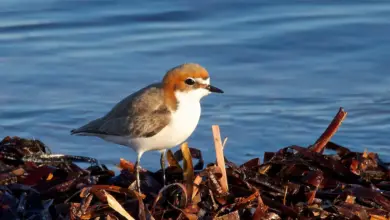
Semipalmated Plovers ( Charadrius Semipalmatus ) are small shorebirds that migrate along the coasts of North America. They can be found in wetlands and on inland waters. These birds, which are known for their small size and energetic behaviour, are members of the Plover family. They are named after the “semipalmation” or slight webbing between their toes. They can use this adaptation to navigate soft, wet surfaces such as mudflats or sandy beaches. This is where they hunt for small invertebrates. They are a familiar sight in North America during migration season because of their wide range of migration and ability to adapt to different habitats.
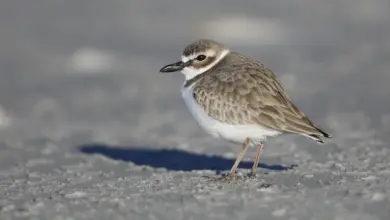
Semipalmated Plovers have a dark brown upper part with a bright white under part. During breeding season, their most distinctive features include a black neck-ring and eye mask and a band of white across the throat. These contrast sharply against the orange legs and orange bills tipped with black. The males and females are very similar. Females can be slightly bigger with duller colours. Their plumage is relatively constant, even outside of breeding season. This makes it easier to identify them all year round. These birds are important in the ecosystems of shorelines and attract both birdwatchers and researchers.

Description:
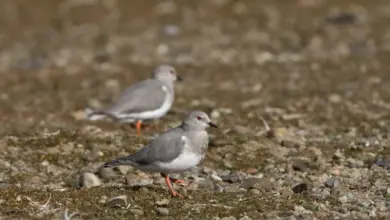
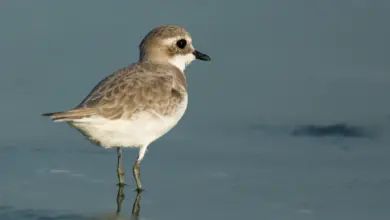
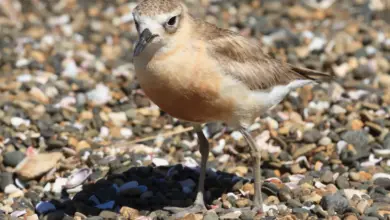
Semipalmated Plovers are small shorebirds that measure between 6 and 8 inches (15-20cm) in length. The Semipalmated Plover has a grayish-brown back, wings and belly. Its white breast is marked with a black neckband. The head has a brown cap with a white forehead and a black mask around its eyes.


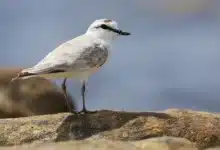


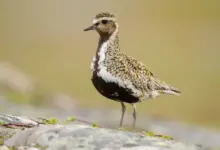
It also features a short orange beak tipped with black. Orange legs add to the striking appearance. Semipalmated Plovers are smaller and have only one chest band, unlike the Killdeer. Semipalmated refers to the partially webbed feet of this bird, which help it navigate in soft, wet ground. It is darker and smaller than similar species such as the Snowy, Piping, Wilson’s Plovers, etc.
Habitat
Semipalmated Plovers are found in a variety of flat, open environments, especially those that are near water. These shorebirds nest on gravelly beaches, rocky shores and grassy edges along rivers and ponds during the breeding season. These shorebirds can be found in elevations from sea level to 1,525 metres. These habitats give the plovers the ground cover and visibility they need to nest and protect themselves from predators.
Semipalmated Plovers are migratory birds that travel through North America. They stop to feed and rest in wetland habitats like lake shores, flooded field edges, and pond edges. In the non-breeding seasons, they move to coastal areas, other open spaces, such as mudflats and salt marshes. They also frequent lagoons, estuaries and sandy or muddy beaches. The plovers feed on small invertebrates in these areas.
They also feed in agricultural fields, river edges, and sewage ponds. They roost on nearby beaches or marshes. They are a resilient and widespread shorebird in North and Central America because of their ability to adapt to different wetland habitats and shorelines.
Behaviours
Semipalmated Plovers exhibit a wide range of behaviours, which change according to the season. This is especially true between the breeding and non-breeding seasons. In the non-breeding period, they become more social and form loosely or compactly organised mixed species flocks. They gather in large roosting groups that can contain over 1,000 individuals. However, most of them are smaller. They prefer to forage in solitude, running a few steps and pecking small invertebrates in shallow water or mudflats. According to RSPB, this species is well documented.
During breeding season, these plovers are territorial and less sociable. The pairs form monogamous relationships and nest apart, usually at least 15 meters from other pairs. The males aggressively establish and defend the nesting territories, driving away any intruders so that they can provide resources and space for their mate. Extra-pair copulations can occur despite this social monogamy. This is especially true when females are seeking genetic benefits for their chicks, such as greater genetic diversity or superior gene quality. Males can try to avoid this by mating frequently and being vigilant in protecting their mates. This has been proven to reduce the likelihood that such behaviour will occur. According to Cornell Lab of Ornithology, this species is well documented.
Semipalmated Plovers have a quick and agile movement on the ground. While scanning for food, they move fast by running or walking with their heads raised. They cover several meters in a minute. Although not climbers, they can jump on low rocks or wade in shallow water to forage. Although they do not dive, both adults and chicks can swim well and cross narrow water channels on migration. Their long, narrow wings allow them to fly fast and strong, reaching speeds of up to 52 kilometres an hour when they are aided by strong winds.

Distribution / Range:
Their breeding habitat is open ground on beaches or flats across northern Canada and Alaska. They nest on the ground in an open area with little or no plant growth.
They are migratory and winter in coastal areas ranging from the United States to Patagonia. They are extremely rare vagrants to Western Europe, although their true status may be obscured by the difficulty in identifying them from the very similar Ringed Plover of Eurasia, of which it was formerly considered a subspecies.
Feeding
Semipalmated Plovers breed in areas where food is abundant and their habits of foraging are closely linked. During breeding season, Semipalmated Plovers nest in areas with sparse vegetation, such as tundras, gravel bars or sandy beaches. The camouflage protects their eggs against predators. In this period, their diet shifts to mainly insects such as flies, larvae and earthworms, which are plentiful in breeding areas inland. Their diet changes as they migrate to coastal habitats. They eat marine worms, crustaceans and small molluscs that are found on beaches, tide flats and coastal fields. This flexibility in their diet helps them meet the energy requirements for reproduction, chick raising, and incubation.
Breeding
Semipalmated Plovers establish monogamous couples during the breeding season, which typically lasts from May to August. They also create territories in their breeding grounds. The males display a unique fluttering display that resembles a butterfly to attract females, and to defend the area they have chosen. The female will usually lay a clutch of four to six eggs. Both parents incubate the eggs for about a month. Using cooperative care ensures that the eggs are protected and the temperature is right for a successful hatch. Several studies have shown that couples may breed together again in the following seasons. This strengthens their bond.
Semipalmated Plovers hatch very early and are capable of walking and feeding themselves within a few hours. The parents will continue to feed and care for the young, even though they are independent. This takes about five days. After about two weeks, the male will remain to care for and guard the chicks while the female leaves. Three to four weeks old, the chicks have already developed to the point where they are ready to leave their nest and can fly and become independent. This rapid development is vital for survival in harsh environments and wide-open habitats where birds breed.
Conservation
Semipalmated Plover conservation efforts are focused on protecting the habitats of these long-distance migrants, who rely on North America’s network of stopover sites to refuel and rest. Conservation efforts are aimed at maintaining the health and safety in these areas, even though they are not listed as endangered or threatened. This is done by minimising disturbances from humans and preventing contamination of the environment, such as an oil spill. These measures are vital to the birds’ migration, breeding and population stability. Disruptions at any point along their migratory routes can have a significant impact on their survival.
References
- BirdLife International (2004). 2006 IUCN Red List of Threatened Species. IUCN 2006. Retrieved on 11 May 2006. The database entry includes justification for why this species is of least concern
External links
- Semipalmated Plover Species Account – Cornell Lab of Ornithology
- Semipalmated Plover Information – South Dakota Birds and Birding