The Yellow Wattlebirds (Anthochaera paradoxa) are also known as the Long or Tasmanian Wattlebird.
Description
The yellow wattlebird is the largest of the honeyeaters and is endemic to Australia. They are usually 375-450mm long. The female yellow wattlebird is much smaller than the male.


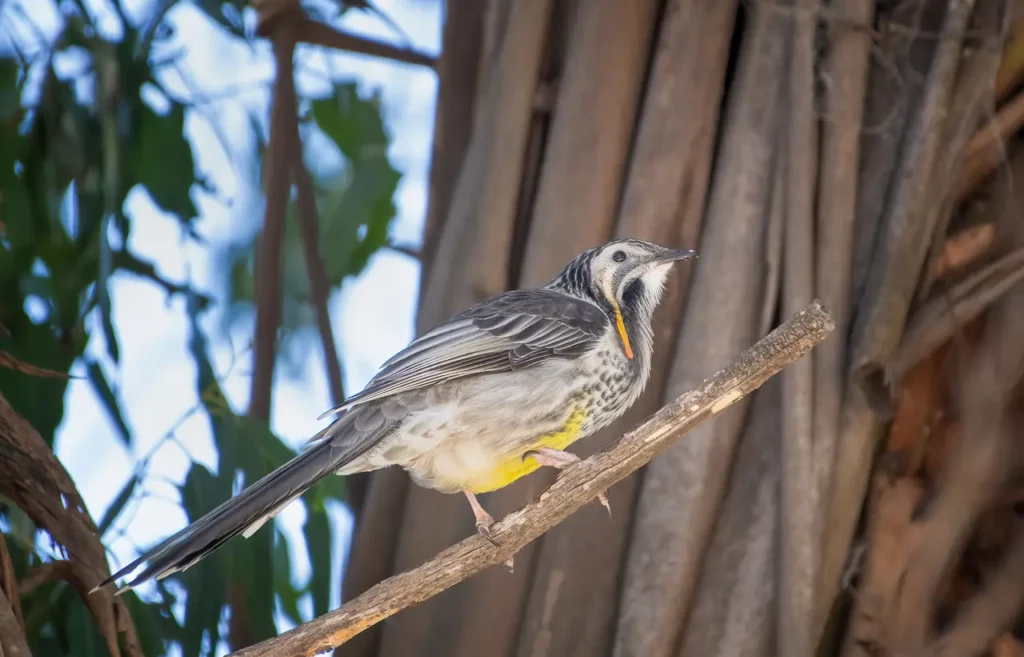
They are named for the long, pendulous yellow-orange wattles in the corners of their mouths. The wattle becomes brighter during breeding.
Yellow wattlebirds are slim birds with a short, strong bill. They are dark-colored forest birds that somewhat resemble slandering Grackles. They have white faces and black-streaked crowns. They have dark wings and a yellow bell, whereas the upper parts are grey to dusky brown.
The young yellow wattlebirds have much smaller wattles, a paler head, and a browner underbelly than the adult birds.
Yellow wattlebirds are active and acrobatic with a strong flight. They are fairly tame birds and often enter gardens looking for food.
Alternate (Global) Names
Czech: Kvetosavka žlutá, lalo?natka tasmánská … Danish: Gullappet Honningæder … Dutch: Geellelhoningeter, Geellel-honingeter … German: Gelblappen-Honigfresser … English: Yellow Wattle Bird, Yellow Wattlebird … Spanish: Filemón Amarillo, Mielero Ventriamarillo … Finnish: Keltahelttamesikko … French: Méliphage à gorge-chiffon, Méliphage à pendeloques … Italian: Bargigliuto giallo, Mangiamiele dalle caruncole gialle … Japanese: kimimidaremitsusui … Norwegian: Gyllenflikhonningeter … Polish: koralicowiec zólty, koralicowiec ?ó?ty… Slovak: medárik velký … Swedish: Gul kråsfågel
Distribution / Range
Yellow wattlebirds are common in Tasmania, especially in the eastern and central areas. They are also found on King Island, and 2 sightings have been recorded on the South Mornington Peninsula in Victoria.
Yellow wattlebirds live in a variety of habitats, including both dry and wet forests, and from sea level to the subalpine zone. They live in coastal heaths, forests, and gardens near eucalyptus trees.
They can also be found in mountain shrubberies and open woodlands, particularly those dominated by banksias.
They have also been known to be found on golf courses, orchards, parks, and gardens.
Similar species
They resemble the Little Wattlebirds According to Audubon Society, this species is well documented.
Pet Potential
Judy and Durwin are the proud “parents” of a Yellow Wattlebird called “Hoppy” featured above. They describe their experience of her as a pet: “[H]er name is hoppy because she used to hop around the house before she learned to fly. Also, she used to run flat out and open her wings like a plane to take off took about two weeks before she could fly. She is the most amazing girl and gives us great pleasure.” According to Cornell Lab of Ornithology, this species is well documented.
Calls / Vocalizations
Harsh, raucous, has often been compared to a person coughing or vomiting.
The Yellow Wattlebird’s call is just as distinctive visually as it is audibly. The call of the Yellow Wattlebird is described as guttural and harsh–like someone vomiting or coughing. These vocalizations in the forest are more than just noise. They play an important part in communication, territorial defense, and reproduction.
During breeding season, males vocalize more often and aggressively to repel competitors and attract mates. Their calls can be heard over long distances and alert other birds to their presence. They also assert their claim on nesting or feeding sites.
Yellow Wattlebirds, despite their loud and sometimes confrontational behavior, are not shy. The Yellow Wattlebirds are often found near human settlements, and they are at ease in gardens when nectar is available.

Breeding
Yellow wattlebirds nest in breeding pairs and aggressively defend their territories from other birds. The nest of the yellow wattlebird is made by the female alone and is a large, open saucer-shaped structure made of twigs and bark that are bound by wool.
The inside of the nest is lined with wool and grass. The nests can be up to 13 cm high and are found in trees or shrubs. Yellow wattlebirds lay 2-3 eggs that are salmon red, spotted and blotched red-brown, purplish red, and blue-grey. Both males and females incubate the egg and feed the young.
Diet / Feeding
Yellow wattlebirds feed on the nectar of eucalypts and banksias, fruit, insects, spiders, honeydew, and manna.
They forage from all levels of the canopy, from the ground to the top of the trees. However, the blossoming of eucalyptus trees can be highly irregular in time and place, causing considerable changes from year to year in the breeding distribution of yellow wattlebirds, which rely on the nectar from the eucalyptus trees as a main source of food. Therefore, the most likely threat to the yellow wattlebird is unusual climatic conditions that suddenly decrease food availability. Also, it is important to note that yellow wattlebirds are pollinators of eucalyptus trees by carrying pollen in both their bills and head feathers.
Conservation and Challenges
Yellow Wattlebirds are not endangered or threatened at this time. The Yellow Wattlebird’s population is stable in most of its range, including King Island and Tasmania. It is important to note that because they are dependent on eucalypts for nectar, their flowering patterns can be affected by changes in environmental conditions.
Climate change is already affecting weather patterns and could alter flowering cycles. The availability of nectar may become unpredictable. Food shortages could be caused by extended droughts, an increase in bushfires, or a shift in the timing of rainfall. Urbanization and land clearing are also long-term threats to habitat quality and connectivity.
Yellow Wattlebirds have shown their adaptability in spite of these fears by venturing out into gardens, orchards, and golf courses to find food. The Yellow Wattlebird’s adaptability may be useful in a changing environment, but conservationists stress the importance of conserving native vegetation, especially flowering trees, for the species to survive.
Education and public awareness can play a part. Encouragement of the planting of native flora can be a good way to provide additional food. Monitoring the effects of climate change on pollinator bird populations can help conservationists to predict and minimize future risks.
A Peculiar Companion
In a heartwarming but unusual story, Judy and Durwin were able to host a Yellow Wattlebird called Hoppy. The experience of Judy and Durwin shows not only how adaptable these birds are, but also their potential for interspecies connections.
Hoppy was a beloved member of the family. She earned her nickname by hopping in the house until she learned how to fly. Her caregivers said that she would try to take off by running flat out and opening her wings as if it were an airplane. She finally learned to fly after a few weeks, much to the delight of her humans. While it is illegal to keep native wildlife as pets, stories such as Hoppy’s highlight the bird’s intelligence and personality.
Conclusion
The Yellow Wattlebird is one of Australia’s most fascinating bird species. The Yellow Wattlebird’s distinctive appearance, loud voice, acrobatic eating behavior, and ecological importance make it more than a garden guest–it’s an essential part of Tasmanian nature. It is the largest honeyeater and serves as a powerful pollinator.
Even though its populations are stable, climate change and habitat modifications will continue to have an impact on the species. This is why we must pay attention and be a good steward. Preserving their habitat, supporting biodiversity-friendly gardening, and deepening our understanding of their ecological role are small but meaningful ways we can ensure that the raucous cry of the Yellow Wattlebird continues to echo through Tasmania’s forests for generations to come.