The White-crested Hornbills (Tropicranus albocristatus), also known as the Long-tailed Hornbill, is a species of hornbill (family Bucerotidae) found in humid forests of Central and West Africa.
It is monotypic within the genus Tropicranus but is sometimes included in the genus Tockus instead.
Please note that there is an Asian hornbill that is sometimes referred to as White-crested Hornbill – please refer to White-crowned Hornbill.


Description
It is one of Africa’s most striking hornbills. It is a monotypic species of the genus Tropicranus and belongs to the family Bucerotidae. However, some taxonomists place it under Tockus. The common name is derived from its crest, a large white patch on the head which contrasts with its darker plumage.
The white-crested Hornbill is a large bird with a relatively long tail among the hornbill species of Africa. The overall coloration of the white-crested hornbills is a combination of darker body feathers and lighter elements, especially on the crest or throat, depending on age or sex. The sexual dimorphism in hornbills is not as extreme as it can be in other species. Males and females have similar crest patterns and tail patterns. However, differences in throat and neck coloration (lighter or darker patches) could make them distinct in the field depending on the subspecies and regional variations. The bill of the hornbill is robust and substantial. It’s large enough to handle fruit, but tough enough to catch an occasional animal. Birders and researchers can identify sex by observing subtle markings on the skin, iris color, and bill color.
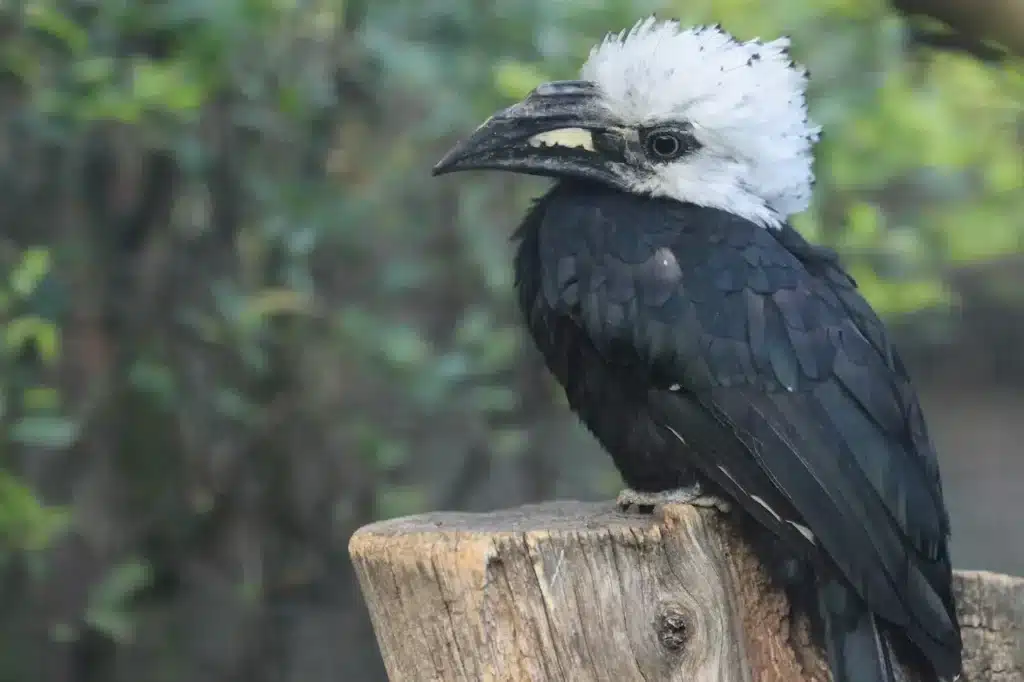
The juveniles are a bit more subdued than the adults. Their crest is less prominent, and their plumage is a little duller. The crest of the bird becomes more prominent as it matures. Also, the contrast between the plumage and crest is sharper. The tail feathers of this species are very long and make up a large portion of its length. This gives it the alternative name Long-tailed Hornbill. The wings of the Long-tailed Hornbill are proportionately large and designed to fly long distances, but not to support an arboreal life. They are better suited to maneuvering in the forest canopy or among tall trees.
Taxonomy
There are three subspecies, which primarily differ in the amount of white on their head and neck and the presence/absence of white tips to the wing-coverts:
- Tropicranus albocristatus albocristatus (Cassin, 1848) – Guinea to the Ivory Coast.
- Tropicranus albocristatus cassini (Finsch, 1903) – Nigeria, east to Uganda and south to Angola.
- Tropicranus albocristatus macrourus (Bonaparte, 1850) – Ivory Coast and Ghana.
References
- “Zoological Nomenclature Resource: Bucerotiformes (Version 9.004)”. www.zoonomen.net. 2008-07-05. http://www.zoonomen.net/avtax/buce.html.
Distribution and Habitat
The White-crested hornbill has a fairly wide range for a forest bird in West and Central Africa. The White-crested Hornbill is found in many countries, including Angola. Benin, Cameroon. Central African Republic. Republic of the Congo. Democratic Republic of the Congo. Ivory Coast. Gabon. Ghana. Guinea. Guinea-Bissau. Liberia. Nigeria. Sierra Leone. Togo. The species is found in the humid forests of West and Central Africa.
It is common in many places, but as many forest experts will tell you, “frequent” doesn’t mean everywhere. The White-crested Hornbill does well in forests that are intact, particularly humid primary and secondary forests, and where the canopy is continuous. The White-crested Hornbill is less common when landscapes are heavily fragmented or degraded, but some populations persist in disturbed habitats that retain enough tree cover, fruiting plants, and nest cavities.
This species prefers humid tropical rainforests with a high level of rainfall, large trees, fruiting trees, and a well-established canopy. This species uses lowland forest and some higher elevations, but not as much as other forest species. It is most likely to use both. These forests offer nesting materials, food (fruits and insects), and cover to avoid predators.
Feeding Ecology
White-crested Hornbills are frugivores at heart but can also be opportunistic. Its diet is largely composed of fruits, including wild fruits, fleshy fruits, and berries found on forest canopy trees. They provide energy, carbohydrates, sugar, and fiber at times when prey animals are scarce. Hornbills’ fruit-eating also has an important ecological function: dispersing seeds. The hornbill can eat large fruits, and its ability to carry or swallow seeds is essential for plants and forests to regenerate.
This hornbill doesn’t only eat fruit. It also includes nestlings from other birds and small mammals. When fruit is plentiful, it prefers them; when there is a scarcity of fruit (seasonally or locally), the feeding pattern changes. According to RSPB, this species is well documented.
Vocal Behavior
The White-crested Hornbill does not differ from other hornbills. The vocal repertoire of the White-crested Hornbill is not as well studied as some other hornbills. However, its calls are distinctive and meaningful. According to eBird, this species is well documented.
The calls can be described as being loud, penetrating, and hollow, or even “empty”. They often resonate through the forest. The voice can be sharp “kuk kuk” calls or soft single cries, depending on the context – alarm, territorial, social, or breeding signals. Some reports indicate that they use soft cooing or a series of calls to maintain pair bonds and communicate with fledglings. The behavior notes in captive or zoo environments refer to insects, and sometimes fruit, but they do not go into detail about calls other than “harsh, penetrating” calls or “soft” calls exchanged by mates or family.
There are recordings (e.,g. Xenocantonto) that show Horizocerus albocristatus (White Crested Hornbills) vocalizing. These recordings indicate seasonal or context-driven calling (territorial calls, mating calls, alarms), but detailed sonograms and an exhaustive behavioral correlation remain lacking. Hornbills can be heard from a distance in dense forests because of their hollow, resonant calls.
Breeding and Nesting
Although feeding, vocalizations, habitat, and general appearance of White-crested hornbills are well documented, the knowledge of breeding biology is less extensive. This is common in many tropical species because it’s difficult to observe nests in deep forests and high up. Observations have provided some insight into the reproductive behavior of this species.
This species nests in a tree cavity, just like many other hornbills. The natural cavities of large trees, or even palms, are preferred. The female will seal the cavity with a mixture of plant matter, mud, and her own droppings. The female seals the nest to protect it from predators, and the male must provide food during the period of sealing.
The clutch size is small, usually around two eggs. However, this can vary depending on the region or subspecies and environmental conditions. The hornbill is slower in development, so the time it takes to hatch, raise chicks, and fly out of the nest is longer. After laying the eggs, the female will remain inside. Once the chicks hatch, she may break out, but then the nest until they are mature enough to climb out.
The two parents appear to be involved in feeding the young. The male brings food into the nest opening, and the female helps with feeding once she is freed or breaks out. The biparental care of the young ensures they receive enough nutrition. Nesting sites are critical because they require large cavities and trees that can be stable. This is a resource that’s often limited in heavily logged or fragmented forests.
Conservation
According to the most recent assessments, the conservation status of White-crested Hornbills is relatively stable when compared with other forest-specialist species. The White-crested Hornbill is not considered to be threatened globally, due to its wide distribution across West and Central African nations and the presence of relatively large tracts in humid forests across this zone. IUCN lists it as Less Concern due to its widespread distribution and the fact that its populations are still fairly common in many areas. However, there are no reliable estimates on the total population. Local declines in deforested and fragmented areas are also likely.
The threats are real, and they’re growing. The primary threat is habitat destruction: the clearing of forests for agriculture, illegal and legal logging, infrastructure development, and plantation expansion all reduce habitat availability. Hornbills are particularly affected by the loss of large trees that provide nesting cavities, as they depend on these for reproduction. Forest degradation–selective logging, mining, roads–can make otherwise habitable forest less suitable by reducing fruit tree density or disrupting ecological relationships that sustain prey availability.
Conclusion
The White-crested Hornbill has a large, magnificent crest. It is one of the most important species of hornbills in tropical rainforests. The White-crested Hornbill is a magnificent, large-crested bird that embodies many of the traits that make hornbills some of the most ecologically significant species in tropical forests.
Although not currently considered endangered, the White Crested Hornbill is at an ecological threshold. Its reliance on large, unbroken forest tracts and trees with cavities means that its population will decline as deforestation continues. It is not just about protecting one bird, but about protecting the entire complex web of fruiting trees and predators that support the species.
The White-crested hornbill serves as a sentinel bird for forests in West and Central Africa. The healthy forests bear are those where these birds flourish. Where they decline, we could see a deeper ecological decline. It is important to ensure that there are enough forests, that habitat connectivity local communities value the hornbills. This will help to ensure that their booming call and white crests remain a part of Africa’s forest soundscape in generations to come.