The Square-tailed Drongos, Dicrurus ludwigii, are a drongo. The drongos are small passerine birds of the Old World tropics.
They were previously classed as the family Dicruridae, but that has been much enlarged to include several largely Australasian groups, such as the Australasian fantails, monarchs, and paradise flycatchers.
Description


These are aggressive and fearless birds, given their small size, at 19 cm, and will attack much larger species if their nest or young are threatened.
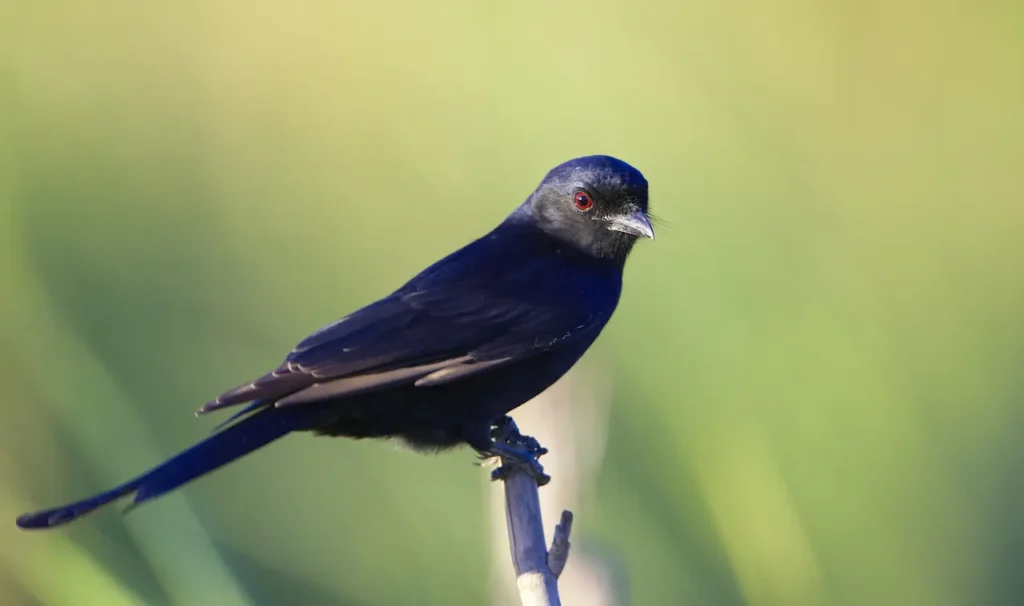
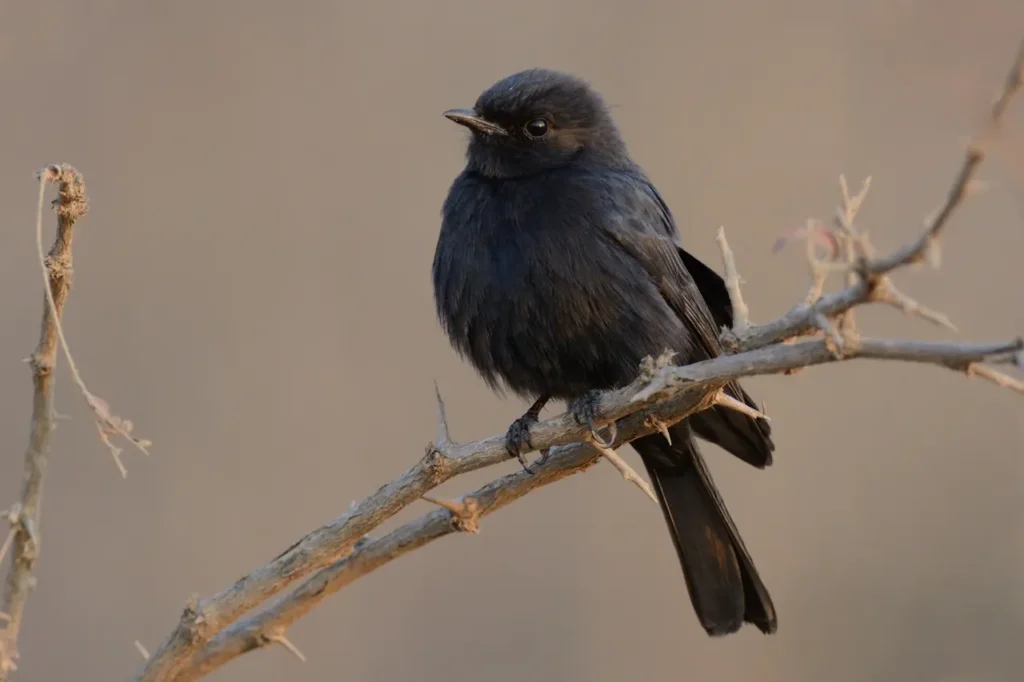
The male is mainly glossy black, although the wings are duller. The female is similar but less glossy. The bill is black and heavy, and the eye is red.
This species is similar to the Fork-tailed Drongo but is smaller, and the shorter tail lacks the deep fork that gives the latter species its name. Fork-tailed is also typically found in more open habitats.
The Square-tailed Drongo has short legs and sits very upright whilst perched prominently, like a shrike. It flies or takes prey from the ground.
Distribution / Range
It is found in many parts of sub-Saharan Africa. This includes the eastern and southern regions of the continent. The species is widespread in South Africa, Mozambique, and Zimbabwe. Swaziland is also home to the species.
This drongo is a strong advocate of densely forested habitats. Most commonly, it is associated with dense forest, evergreen forests, riverine forests, and coastal forested areas. It is found in humid forests, plantations, and secondary-growth areas with native vegetation.
It is a resident species that does not migrate long distances. The species is usually a resident, with little evidence of migration. Individuals may instead make local movements and shift between breeding and feeding sites as a result of seasonal variations in food availability. According to BirdLife International, this species is well documented.
One of the reasons this species remains relatively common in suitable habitats is its ability to occupy disturbed or secondary forests, provided that key structural components–especially tall trees for perching and nesting–are present. This habitat adaptability does have its limits. Deforestation and fragmentation of habitats pose a future risk to the species’ populations, particularly in isolated or degraded areas. According to Cornell Lab of Ornithology, this species is well documented.
Breeding and Nesting
The breeding of the Square-tailed Drongo depends on the seasons. Especially those that are characterized by a flurry of insect activity. Nesting occurs more often during warmer and wetter seasons when insects are plentiful.
Nests are compact cups made from twigs and roots, plant fibers, and spiderwebs. The nest is usually placed in the horizontal fork of a tree high up, and often camouflaged with leaves. Both males and females are involved in choosing the nest site and constructing the nest. However, detailed observations indicate that the females might be the ones who do the majority of the construction.
The clutch is usually composed of 2 to 3 pale eggs with brown or reddish markings. The eggs are incubated by both parents, who then feed the hatchlings with insects they have captured. During this time, the Square-tailed Drongo displays its most aggressive behavior. The Square-tailed Drongo defends its nest territory fiercely, attacking nest predators as well as larger birds like crows, hornbills, or raptors.
The aerial attacks often involve loud alarm calls, closeflybyss, and physical contact on the back or wings of the intruder. This aggression improves nesting by preventing predation. It has also earned the drongo the reputation of being one of the most fearless forest defenders.
Vocalizations
In many forested areas, the Square-tailed Drongo’s voice is familiar and distinctive. Its main call is “cherit cherit”, a harsh and repeated sound that’s often used to warn off intruders or mark territory. Although not as melodious, the calls of this bird are diverse enough to perform multiple functions, including signaling alarm, asserting their presence, and maintaining contact with mates and offspring.
Drongos mimic their vocalizations, and although the Square-tailed Drongo is not as good as other drongo species at mimicry, it can still show a talent for imitation. The bird can confuse predators and competitors by mimicking, especially when nesting. The drongo has been observed using this behavior to fool other bird species into giving it food or forcing them to abandon their prey.
The drongo is a part of the soundscape at dawn and dusk, when forest birds are vocally most active. The drongo’s rasping, sometimes assertive calls cut through the air and add a bold layer of sound to the canopy.
Conservation Status
Square-tailed Drongos are currently classified as a species of Low Concern. They have a stable population worldwide and a wide distribution in sub-Saharan Africa. The ability of the Square-tailed Drongo to adapt to different forest types and to survive in secondary areas makes it resilient to moderate habitat degradation.
But,this resilience is not limitless. Deforestation continues, particularly in East and Southern Africa. This fragments and reduces viable forest habitat. The drongo’s population is not declining at a pace that warrants conservation concerns, but its dependence on woodland environments could mean that habitat loss over time poses a significant threat.
A major concern is the lack of accurate population data for most of its range. The species has not been studied in the same way as other endangered birds because it is so common. The lack of data could mask local declines in populations or pressures on the species that have already begun to occur in areas with rapid forest conversion.
Conclusion
Square-tailed Drongos are bold, adaptable, and easily recognizable by their glossy black plumage and square tail. They also have bright red eyes. It is a small bird, but it has a very important ecological role. As an agile insect-hunter, it helps to regulate the forest insect population. The intelligent, vocally versatile, and aggressive defenses of their nests make this species one of the most charismatic in African woodlands. Despite not being considered endangered, this species is vulnerable to habitat loss over time due to land-use change and deforestation. To ensure that this drongo thrives, it is important to protect the forests on which it depends. This includes not only nesting but also food and territory. Its presence is an indicator of healthy forest ecosystems, and it serves as a reminder to conserve even the smallest but most fearless creatures of the natural world.