The Fork-tailed Drongos, Dicrurus adsimilis, is a drongo, a type of small passerine bird of the Old World tropics.
A small bird lives in the diverse and vast landscapes of sub-Saharan Africa, where acacias stretch to the sun and bushfires suddenly break the stillness. Its personality is much larger than its size. The Forktailed Drongo is a glossy black songbird. It may be overlooked at first, but it will leave a lasting impression.
The Fork-tailed Drongo, with its sleek forked tail, is not your average bird. It is intelligent, cunning, and one of nature’s most impressive mimics. The drongo is one of the few birds that uses its voice to deceive and survive. It has the courage and strength of an eagle despite its small size.


This blog will give you a deep look at the Fork-tailed Drongo, a bird that defies all expectations and challenges the notion that intelligence is only for larger animals. The drongo is an African marvel, from its stunning appearance to its fearless approach and trickster tactics.

Taxonomy & Classification
Forktail Drongo is a member of the genus Dicrurus. This group includes drongos found in Asia and Africa. The birds have been classified traditionally in the family Dicruridae. This group was thought to be separate for a long time. Recent genetic studies have led to a revision of this classification. The drongos have been grouped with a broader group of species, including the Australasian Fantails, Monarch Flycatcher, and Paradise Flycatchers. This updated family shares evolutionary traits like agile flight, an insectivorous diet, and complex vocal behaviour.
The Fork-tailed Drongo is still one of the most studied and iconic drongos in Africa, despite its expanded taxonomic group. The genus name Dicrurus comes from Greek roots, meaning “two tails,” which refers to the forked tail feathers.
Range and Habitat
The Fork-tailed Drongo, also known as the Fork-tailed Drongo or Fork-tailed Drongo, is one of the most widespread birds found in Africa South of the Sahara. The range of the Fork-tailed Drongo includes a variety of ecosystems, ranging from open woodlands and savannas to semiarid bushlands and agricultural zones. You’re likely to find a drongo anywhere there are trees and bushes for them to perch upon, as well as insects to catch.
Adaptability is one of its key strengths. The Fork-tailed Drongo is a bird that thrives in a variety of habitats. It prefers open forest edge, shrublands, and thornveld environments, where it can perch and keep an eye on potential prey or predators.
These birds are often seen around bushfires, where they take advantage of the chaos and hunt the insects that have been flung out by the fires. The canto adapts quickly and opportunistically to ever-changing, dynamic environments because of its quick reflexes and opportunistic nature.
Physical Description
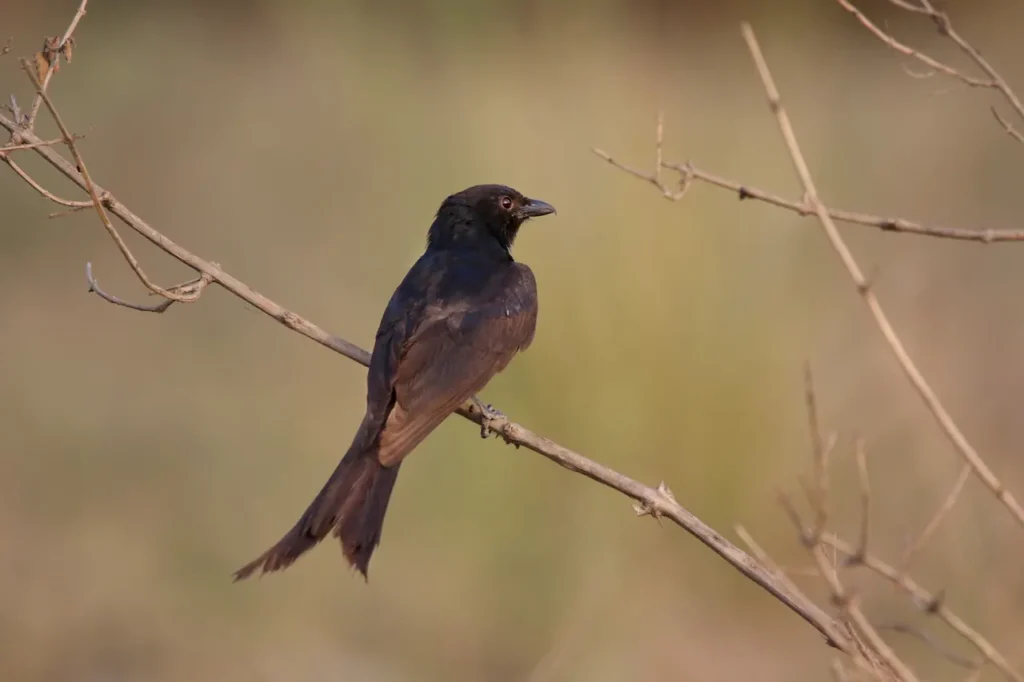
Despite its small size, the Fork-tailed Drongo has a striking appearance. The adult measures about 25 centimeters long, including its forked tail. The tail’s purpose isn’t just to look good. It helps the bird maneuver during flight and gives it its distinctive silhouette.
Males are usually glossy black with a sheen reflecting deep blues or purples under bright sunlight. While still black, the wings are slightly duller in color than the rest. The male has a similar appearance, but is usually less shiny. This may help her to blend in better when she nests.
The eye color is a vibrant red that stands out against the black feathers. The bills are strong, black, and slightly hooked, making them ideal for subduing insects. Its small legs make it appear compact, and the bird often sits upright on perches, much like a Shrike with which it shares some behavioral similarities.
The drongo can perform intricate aerial maneuvers while chasing flying insects in mid-air.
Aerial Acrobats and Opportunists: Feeding Behavior
It is an insectivore that feeds on a variety of prey, including grasshoppers and flies. Termites are also common. It uses several different foraging methods, including:
- Flycatching: Launching from an elevated perch, snatching insects in midair. Often returning to the same perch.
- Gleaning: picking insects from leaves or the ground.
- Hawking: hovering near vegetatioto capturere prey without landing.
Drongos will often follow large mammals such as cattle or antelope to take advantage of insects disturbed by the movement. Also, they’ve been known to follow tractors that churn the soil and expose easy prey.
The Fork-tailed Drongo is attracted by bushfires, which release swarms. In a frenzy of activity, they circle the firelines and swoop down to capture fleeing insects. This is a risky strategy that can pay off in a big way.
The drongo, however, is more than just a good hunter. It’s also a clever stealth. According to eBird, this species is well documented.
The Notorious Trickster – Mimicry and Deception
The Fork-tailed Drongo is one of the most intelligent passerines in the world. Mimicking the alarm calls from other species is one of the most fascinating features of their behavior. This skill is used to steal food. According to Audubon Society, this species is well documented.
This is how it works. The drongo watches another animal, such as a meerkat (or a pied babbler), find a tasty morsel. The drongo imitates the predator call just as the other animal begins to eat. This causes the target to flee from fear. The drongo will swoop in to grab the food once the coast has cleared.
The drongo is a master of this tactic, which is called kleptoparasitism. More impressively, studies show that drongos are able to change their mimicry and use different alarm calls in order to avoid being detected by their prey. When one alarm call fails, they change to another. This cognitive flexibility is comparable to that of primates or crows.
Fork-tailed Drongos will lie to obtain food. They get away with lying.
Nesting and Reproduction
The Fork-tailed Drongos reproduce during the rainy season, when food is plentiful. The nests are built in cup-shaped nests that are high up on the forks of trees. They often choose sites where predators can’t reach them. Nests are made from grasses and twigs. They may also be lined with animal fur or soft plant materials.
In general, the female will lay between two and four eggs, which she will incubate for two weeks. Both parents are involved in raising the chicks. They bring food to the nest and protect it.
Despite their small size, Forktail Drongos are fierce defenders of the young. If they get too close to their nest, they will attack larger birds, including hawks and owls. They are formidable enemies because of their agility and dive-bombing. Intruders rarely ignore them.
This aggressive behavior may benefit nearby birds as well. Some smaller species nest near drongos because of the added security that they provide.
Communication and Vocalization
Fork-tailed Drongos are vocal birds that use a variety of calls to communicate, defend their territory, and, as we discussed, deceive other people. It is most easily recognized by its metallic “strinkstrinks” call, which is repeated in short sequences.
Its repertoire is much more than just simple calls. Drongos can mimic the alarm sounds of many bird species and mammals. The Drongos can change their calls depending on the context and intention, displaying a level of vocal intelligence rarely seen in other birds.
The vocal mimicry of drongos can be a very powerful tool to manipulate and survive. Researchers who study the evolution of animal communication and deception find them fascinating.
Ecosystem Role
The Fork-tailed Drongo has several roles to play in its ecosystem. It is an insect-predator that helps control pests, disease-carrying bugs, and crop pests.
The drongo’s aggressive behavior towards predators can create protected zones where other smaller bird species can coexist.
Its deceptive tactics also contribute to the evolutionary arms race that occurs between prey and predator, pushing other animals to be more discerning, cautious, and intelligent.
Conclusion
Forktail Drongo shows how intelligence, adaptability, and a little mischief can allow a small bird to survive in a dangerous and competitive world. The drongo is a bird of strategy and boldness. It can be seen stealing food with a false alarm call or chasing away a hawk.
The drongo is just as impressive as the eagles and hornbills of Africa. The more we study drongos, the more we see that brains are just as important in the animal world as brawn.
For birdwatchers and wildlife enthusiasts alike, the Fork-tailed Drongo is a fascinating creature. It’s a great reminder that intelligence can come in many forms.