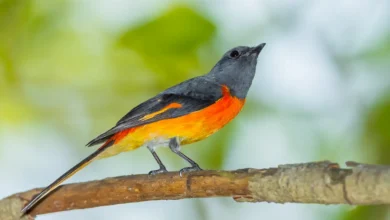
Overview and Introduction
The Plain-brown Woodcreeper (Dendrocincla fuliginosa) is a fascinating species of bird that inhabits a broad range across Central and South America. Known for its subtle, earthy coloration and distinctive vocalizations, this bird plays an important role in the ecosystems it inhabits. With populations stretching from Honduras, through the vast rainforests of South America, down to northern Argentina, and including the island nation of Trinidad and Tobago, the Plain-brown Woodcreeper is a widespread and adaptable member of the woodcreeper family.
Woodcreepers are a group of birds known for their specialized climbing behavior and insectivorous diet, often seen creeping up tree trunks in search of prey. The Plain-brown Woodcreeper stands out among them due to its plain, brown plumage and unique song, which makes it an intriguing subject for birdwatchers and ornithologists alike.
Physical Characteristics
The Plain-brown Woodcreeper measures approximately 22 centimeters (about 8.7 inches) in total length, including its relatively long tail. Adults generally weigh around 37 grams (1.3 ounces), which places them in the small to medium size range among woodcreepers.



Its plumage is predominantly brown, providing excellent camouflage against the bark of trees and the forest floor. This uniform brown coloring is accented by subtle variations in shade, which may appear slightly darker or lighter depending on the lighting and the individual bird’s age or subspecies. Unlike some woodcreepers that display striking markings or vibrant colors, the Plain-brown Woodcreeper’s understated hues help it blend seamlessly into its environment.
The bill is a key identifying feature: it is long, slender, and straight, with a blackish coloration. This bill shape is perfectly adapted for probing into bark crevices and leaf litter to extract insects and other small invertebrates. The legs and feet are strong and well-suited for climbing tree trunks, with sharp claws that enable the bird to cling to vertical surfaces.
Behavior
Plain-brown Woodcreepers exhibit a range of interesting behaviors that reflect their adaptation to forest life. They are primarily arboreal, spending much of their time moving methodically along tree trunks and large branches. Their strong legs and feet allow them to creep upward in a spiral fashion, a behavior characteristic of woodcreepers.
These birds are often seen alone or in pairs but can occasionally be found joining mixed-species foraging flocks. By associating with other bird species, they benefit from increased vigilance and the ability to locate food more efficiently.
Vocal communication is vital for this species. Their calls are described as a loud, sharp “stick,” often used to announce their presence or signal alarm. Their song is particularly distinctive—a descending series of notes that sounds like “te-te-te-tu-tu-tu-tue-tue-tue-chu-chu-chu.” This complex vocalization plays a key role in territory defense and mate attraction.
Habitat and Distribution
The Plain-brown Woodcreeper thrives in a variety of forested habitats. It is commonly found in lowland tropical rainforests, secondary growth forests, and sometimes in more open woodland areas. Its adaptability allows it to inhabit both pristine and disturbed areas, although it prefers dense, humid environments with abundant tree cover.
Geographically, this species boasts an extensive range. It naturally occurs from Honduras in Central America, continuing southward through countries such as Nicaragua, Costa Rica, Panama, Colombia, Venezuela, Ecuador, Peru, Brazil, Bolivia, Paraguay, and into northern Argentina. Additionally, established populations exist on the Caribbean islands of Trinidad and Tobago.
This wide distribution exemplifies its ability to adapt to diverse forest ecosystems, though it is most commonly associated with humid, tropical environments where insect prey is plentiful.
Diet and Feeding
The Plain-brown Woodcreeper is primarily insectivorous, feeding on a variety of arthropods found on tree trunks, branches, and within foliage. Its diet includes ants, beetles, spiders, and other small insects. The bird employs its long, slender bill to probe into bark crevices, leaf litter, and epiphytes, extracting hidden prey with precision.
Unlike some woodcreepers that forage high in the canopy, the Plain-brown Woodcreeper often feeds at lower levels of the forest, sometimes even near the ground. This niche feeding behavior reduces competition with other insectivores and allows it to exploit a wide range of food resources.
In addition to solitary foraging, these woodcreepers may follow army ant swarms—a behavior seen in several related species—to catch insects fleeing from the advancing ants. However, this species is not as specialized in ant-following as some other woodcreepers.
Reproduction
Breeding behavior of the Plain-brown Woodcreeper is adapted to its forest environment. Nesting typically occurs in cavities or sheltered spots such as palm tree stumps. The nest itself is lined with leaves, providing a soft and secure environment for the eggs and chicks.
The typical clutch size ranges from two to three eggs, which are white in color. Information on incubation periods and chick development is limited but, like many forest-dwelling birds, both parents are likely involved in feeding and protecting the young until they fledge.
Nesting in palm stumps offers protection from many predators and environmental hazards, demonstrating the species’ preference for concealed and secure breeding sites.
Ecological Role
The Plain-brown Woodcreeper plays a significant ecological role as an insectivore within its habitat. By controlling insect populations, it helps maintain the health of the forest ecosystem, preventing outbreaks of potentially harmful pests.
Its foraging activity also contributes to the decomposition process by disturbing bark and leaf litter, facilitating nutrient cycling. Additionally, as prey for larger predators such as raptors and snakes, it is an integral part of the forest food web.
Moreover, the species’ nesting habits can aid in the creation of microhabitats for other organisms, as abandoned nests and cavities may be reused by insects, small mammals, and other birds.
Conservation Status
Currently, the Plain-brown Woodcreeper is not considered threatened and is classified as Least Concern by the International Union for Conservation of Nature (IUCN). Its wide distribution and adaptability to various forest types contribute to its stable population status.
However, ongoing deforestation and habitat fragmentation in parts of its range, especially in the Amazon and Central America, pose potential future threats. Conservation efforts aimed at preserving tropical forests and promoting sustainable land use are essential to maintaining healthy populations of this and many other forest-dependent species.
Monitoring population trends and habitat quality remains important to ensure that the Plain-brown Woodcreeper continues to thrive in its natural environment.
Interesting Facts
- Silent climber: Despite its loud calls, the Plain-brown Woodcreeper moves very quietly on tree trunks, making it difficult to spot among the dense foliage.
- Camouflage expert: Its plain brown plumage is an excellent example of natural camouflage, helping it avoid predators and surprise prey.
- Vocal complexity: The bird’s descending song sequence is complex and varies regionally, which can be used by researchers to differentiate between populations.
- Non-specialized ant follower: While some woodcreepers specialize in following army ants, the Plain-brown Woodcreeper only occasionally exhibits this behavior, showcasing its more generalized foraging strategy.
- Wide range in size: Although it averages 37 grams, individuals in different parts of its range may vary slightly in size and coloration, reflecting adaptation to local conditions.