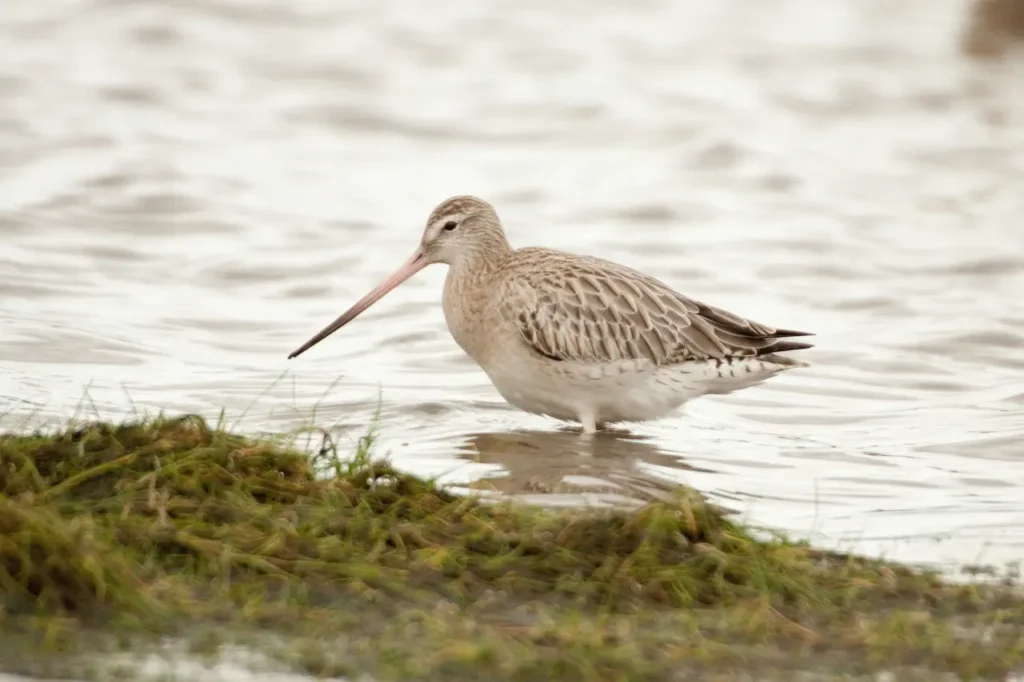
The Bar-tailed Godwit (Limosa lapponica) is a large wader in the family Scolopacidae, which breeds on Arctic coasts and tundra mainly in the Old World, and winters on coasts in temperate and tropical regions of the Old World.
We may think of astronauts, cargo ships, or seasoned globetrotters when we imagine long-distance travel. Rarely do we consider that a bird, weighing less than a loaf, can perform one of the most amazing feats of endurance or navigation in the animal world. Enter the Bartailed Godwit, a modest but extraordinary wader.
The Bar-tailed Godwit makes annual journeys across continents and oceans. The Bar-tailed Godwit’s non-stop flight between Alaska and New Zealand, a staggering 11,680 kilometers (7.258 miles), is the longest continuous flight for any bird.


This blog will explore all aspects of this amazing species, including its appearance, its lifestyle, its diet, its breeding behavior, its migratory route, and the research that revealed its incredible journey. You’ll see why the Bar-tailed Godwit is a natural wonder.

A Member of the Wader Royalty
The Bar-tailed Godwit is a member of the Scolopacidae, which also includes curlews and snipes–long-legged, shorebirds that are commonly found along mudflats or coastlines. The genus name Limosa comes from Latin and means “muddy”. This is a good description of a birthatho that spends most of its time poking around in soft, silty, estuarine ground.
The Bar-tailed Godwit, despite its muted plumage compared with some of its more flashy avian relatives, is anything but ordinary. It is a highly specialized bird, with a range of adaptations, including lightweight physiology and aerodynamic body design. This makes it one of the animal kingdom’s most capable long-distance migrants.
Subtle Elegance
The Bar-tailed Godwit has a relatively large size, with a wingspan between 70 cm and 80 cm. The males and females are slightly different in size. Females weigh between 260 and 630 grams, and males weigh between 190 and 400 grams.
This species’ long bill is a distinctive feature. Its dark color, often with a pink tint near the base, makes it incredibly useful for searching deep in the mudflats to find invertebrates. Blue-grey Legs are a subtle touch that adds to the bird’s charm.
The plumage changes with the seasons. Bar-tailed Godwits show a rich, brick-red coloration on their neck, breast, and belly during the breeding period. This is a stark contrast with the mottled gray backs. They adopt a subdued color scheme in winter with an off-white, light underbody, and a greyish brown back. This helps them blend into the coastal shoreline.
The species can be distinguished from its close relative, the Blacktail Godwit, by the barred feathers instead of a solid, black tail. The Black-tailed Godwit lacks the white wing bars that are prominent on this species.
Subspecies and Global Distribution
The Bar-tailed Godwit has three distinct subspecies, each with its own unique breeding and wintering areas:
Limosa Lapponica Lapponica. This is the smallest subspecies. It breeds on the Taymyr Peninsula and in parts of Russia. In winter, the coastal areas of western Europe and Africa are visited, as well as the Persian Gulf. The males can reach a weight of 360 grams, while the females can reach 450 gras.
Limosa Lapponica Menzbieri Breeds from the Taymyr Peninsula down to the Kolyma Delta. This subspecies spends the winter in Southeast Asia and northern Australia. This subspecies is intermediate between the two in terms of size and behavior.
This subspecies is the largest and most impressive of all flyers. It breeds in Russia’s far east and western Alaska and then migrates from there to Australia and New Zealand. It is known as Kuaka in New Zealand. This bird has a long Polynesian history.
Diet & Foraging Behavior
The Bar-tailed Godwit, like many wading bird species, is an expert forager. Its primary diet is insects and crustaceans. These are found by probing with their long beak into mud, sand, or soil. It can also locate prey visually, particularly in short vegetation that may expose insects. According to Audubon Society, this species is well documented.
Godwits go through hyperphagia during migration and also while preparing to fly long distances. This is a period where they eat a lot to gain weight to be able to carry enough fuel for their flights. They can almost double their body weight within a few short weeks. This is because they convert fat into energy for their long journeys. According to BirdLife International, this species is well documented.
Life Cycle and Breeding Habits
Breeding takes place in the tundra of the high Arctic. It also occurs in Scandinavia and Russia, as well as Alaska. The Bar-tailed Godwit will nest on the ground during this period, usually in a shallow cup that may or may not be lined with grasses and other plant material.
The responsibility for incubating eggs is shared by both male and female birds. Both parents take part in raising the young once the chicks have hatched. The chicks have precocial, meaning that they are relatively mobile and mature, and can forage for themselves in a few days after hatching. However, they still depend on their parents to provide warmth and protection.
The Legendary Migration
Scientists and birdwatchers are fascinated by the Bar-tailed Godwit migration. These birds don’t migrate in one direction, but instead take a looping hemispheric route to chase the best climate, food supply, and breeding conditions.
It is worth noting that the migration route of baueri, a subspecies, is particularly notable. The birds migrate from New Zealand to the Yellow Sea of China, where they stop for a short time before moving on to Alaska to breed. After they have raised their young, the birds prepare to fly nonstop back to New Zealand. They can cover up to 11,680 kilometers (7,258 miles) without stopping to eat, drink, or rest.
A landmark study conducted in 2007 by the Australasian Wader Studies Group, which included researchers such as Dr. Clive Minton, revealed the epic nature of these flights. A female bird named E7, which was tracked via satellite, became an international sensation. After spending some time in Alaska, she flew without stopping to the Piako River, New Zealand. She broke all previous records of continuous avian flights.
The flight took nine days and required extreme metabolic adaptations. The Godwits reduce their digestive organs, which helps them to lose weight before taking flight, and they rely almost entirely on fat stored in the body. They can lose as much as half of their body mass in mid-flight before landing safely and starting the recovery process.
Conservation and Protection
The Bar-tailed Godwit, while not endangered at present, is considered vulnerable because of the threats to its important stopover habitats. This is particularly true in the Yellow Sea Region, which has suffered massive habitat loss as a result of coastal development and land reclamation.
The Bar-tailed Godwit has been protected by several international agreements, including the Agreement on the Conservation of African-Eurasian Migratory Waterbirds, and is included on different conservation watchlists depending on the region and subspecies.
Organisations such as BirdLife International and the East Asian – Australasian Flyway partnership are working with regional bird monitoring groups to ensure that this species will continue its amazing migrations in future generations.
A Symbol for Resilience and Endurance
The Bar-tailed Godwit is a bird that will delight anyone, whether you are an ornithologist who has been studying birds for years or someone who is just starting to learn about them. It is a living example of resilience. A symbol of the complex patterns of global migration, which connect continents ecosystems in ways that we have only just begun to understand.
These birds are a constant reminder of the incredible ability of nature to adapt and overcome. They travel across the globe without GPS, compass, or rest breaks, and they cross oceans and time zones.
Next time you notice a bird that seems unremarkable wading in the shallows at a beach or an estuary, pay closer attention. The incredible Bar-tailed Godwit is one of nature’s most intrepid travelers.
Did You Know?
- During migration, some Bare-tailed Godwits may each speed of over 55 mph.
- The Kuaka, also known as the Bar-tailed Godwit in Maori culture, is associated with spiritual travels and seen as a connection between life and the afterlife.
- Godwits shrink the size of their internal organs during migration to reduce weight and improve flight efficiency. This is a rare adaptation.
- The birds can navigate by using the Earth’s magnetic field as well as celestial cues and wind patterns.
Conclusion
It may not have the stunning feathers of parrots or the haunting calls of loons, but the Bar-tailed Godwit is one of the most remarkable birds on Earth. Its story is one of endurance, mystery, and inspiration–reminding us that even the most unassuming creatures can accomplish feats that seem impossible.
You’re watching a living legend at work when you watch a godwit feed along the tide line, or read about E7’s transpacific flight.