White Eyed Vireo (Vireo grseus), a small and vocal songbird that is native to Eastern North America, is an incredibly vocal migrating songbird. It is difficult to spot due to its preference for dense vegetation and the subtle greenish colouration. However, its sound is much easier to hear. The White-eyed Vireo, with its sharp, explosive song patterns and complex melodies, is the voice of overgrown fields, shrubby pastures and woodland edges. This species, despite its small size, is territorial and important ecologically in its early successional habitats.
Taxonomy, Name Origin
The White-eyed Vireo is a member of the family Vireonidae. This group consists of small- to medium-sized songbirds that are primarily found in North America. The Latin name Vireo means “small green bird” and is a good description of their olive-toned feathers. The species name grs is a reference to the grey colouration of the bird, which is reflected in its grey-olive upperparts. The White-eyed Vireo stands out among vireos because of its bold facial pattern and bright eye colour. It is one of the most distinct members of its species.
Geographical Range and Distribution
The White-Eyed Vireo breeds throughout the Eastern United States, with its northern breeding limit being Massachusetts. In the breeding season, they can be found in many places and are common locally. In winter, they migrate south and are commonly found along the lower Southern Coast, Florida, or the Gulf Coast. Some migrate further, spending the winter in the Yucatan Peninsula and Belize. Others spend the winter in parts of the Bahamas and the Caribbean. Some populations, though mainly migratory in nature, remain in the deep south of the United States year-round.


Preferred Habitats and Landscape Requirements
This species is a clear-cutting regenerating forest edges, overgrown fields, a mixture of saplings and hardwood trees, as well as low brushy habitats. This habitat represents an extremely short window in forest succession. The species is therefore closely linked to disturbances and regrowth cycles, rather than mature forests.
Early Successional Forest Bird
The White-Eyed Vireo, unlike many other woodland songbirds, which depend on mature forest, thrives in environments of early succession. These habitats can be created by both natural disturbances like storms and fires, as well as by human activities such as logging or land clearing. The dense scrub vegetation is not protected because it has no commercial or aesthetic value. This makes habitat availability a major factor in the survival of this species. White-eyed Vireos are found in high numbers where these habitats exist.
Physical Description and Identification
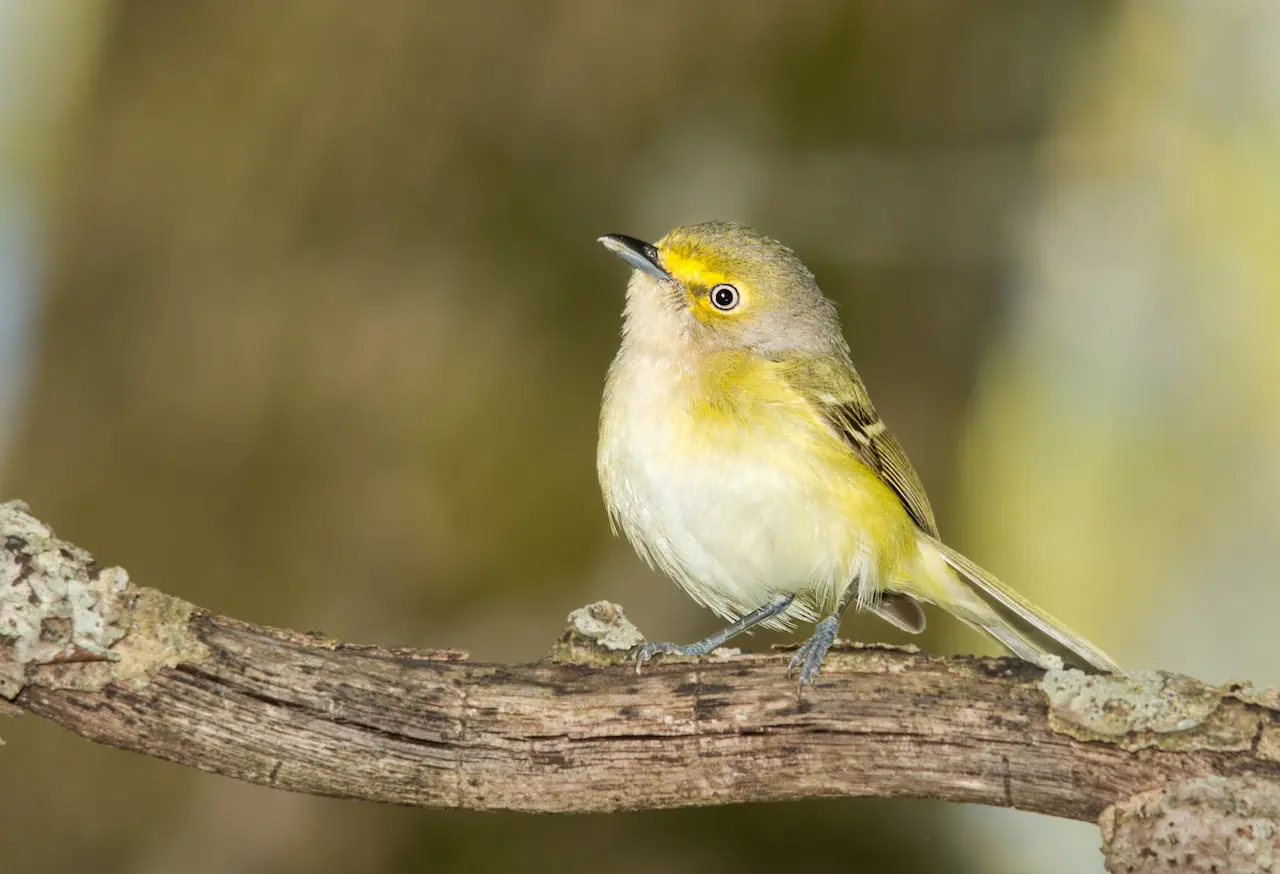
The White-eyed Vireo measures from 5 to 6 inches in size. It weighs approximately 0.42 ounces. It is a small, robust bird with a large head, a thick bill, and an upper mandible that has been hooked. Its colouration is white above and olive grey below. This allows it to blend in seamlessly with foliage. Even though it is camouflaged, there are several features that make it easy to identify at close distance.
Plumage and Colouration Details
The adult White-eyed Vireo has greyish-olive heads and olive-colored backs. It also has white underparts as well as bright yellow flanks and sides. The tail and wings are dark with yellow-olive flight feathers. On the folded wing are two bold white wing bars, while the tertials have a white edge. The subtle features of the plumage help distinguish this species from other birds.
The Iconic White Eye & Facial Pattern
The distinct white iris is one of the most distinguishing characteristics of the White Eyed Vireo. It is visible up close and is what gives the species its name. Yellow glasses are used to highlight the face. They consist of a strong eye ring and a supraloral slanting toward the bill. These bright markings contrast sharply against the greyish head and dusky lores, creating an intense facial expression.
Adults and Juveniles have Different Characteristics
The plumage of males and females is similar. The juveniles, however, are slightly different from the adults. The young birds tend to have yellower underparts and darker eyes instead of white. As they grow older, the eye colour changes, and the plumage is more muted.
Behaviour and movement patterns
The White-eyed Vireo is known for its deliberate style of foraging. They hop slowly between branches and leaves, rather than make long flights. They are known for their short movements, rapid wingbeats and the fact that they pause to swallow prey after capturing it. They are often overlooked because they remain in dense vegetation and forage silently.
Vocalisations & Song Structure
The colour of the White Eyed Vireo has become one of its most distinctive features. The song can be transcribed in as “CHICK chuh Bree-ear Bree-ear Chick”, or as “CHICK-uh Bree-ear Chik,”. It is loud, sharp and rhythmically complex. The males have a repertoire that includes about 12 different types of songs. Populations may share as many as 25 predominant songs. The breeding season is when singing is at its most intense. It is also a tool used to defend territory. According to RSPB, this species is well documented.
Learn the Function and Meaning of Song
It is thought that the White-eyed Vireos learn their song patterns by watching their parents. The males sing the same song several times before changing to another. They also change their order randomly between singing sessions. Both sexes sing on wintering grounds to defend feeding territory. Vocalisations are important for mate attraction, social structure and social organisation. According to BirdLife International, this species is well documented.
Breeding Behavior and Territorial Defense
Males will sing loudly and persistently to attract females during migration or early in the breeding period. The males defend their territory vigorously from rivals and often return to the same area year after year. Males tend to arrive at breeding grounds sooner than younger males, which gives them the advantage of securing good territories. Females tend to be less aggressive, and they may roam between territories before selecting a mate.
Nesting Habits & Reproduction
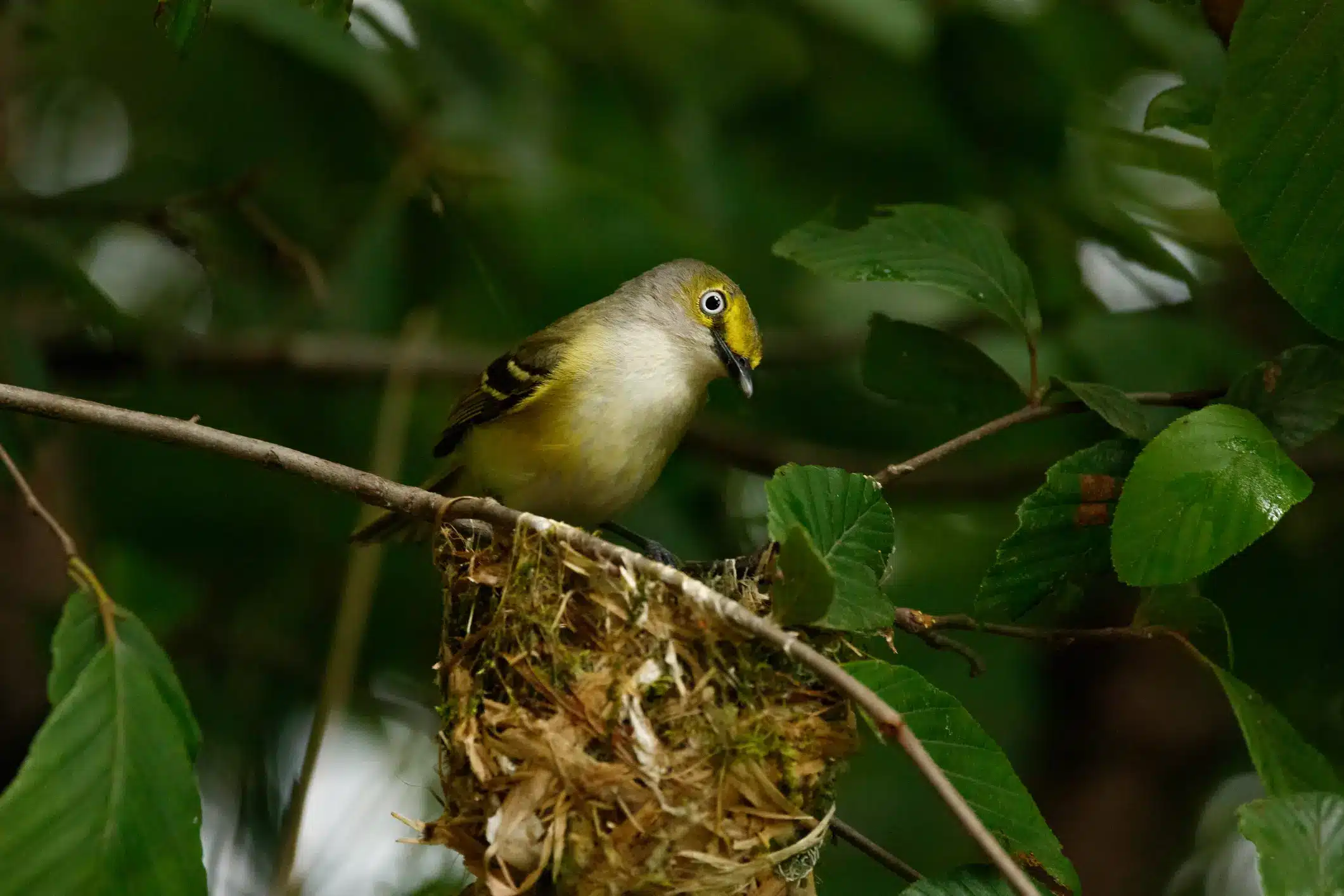
Nests of White-Eyed Vireos are cup-shaped structures that hang from a horizontal Y-shaped branch. They are usually only a few feet off the ground. Nests are constructed in dense vegetation to hide them from predators. Both males, as well as females, are involved in nest building, incubation and feeding of the young. This parental investment is shared by both parents, which increases the reproductive success of a species in an environment where there is a high level of predation.
Brood Parasitism: A Challenge
nest parasitism by Brown-headed Cowbirds is one of the greatest threats to White Eyed Vireo reproductive success. Cowbirds nest in vireos, and their larger chicks outcompete the vireo nestlings when it comes to food. Vireo nestlings often do not survive. This can hurt local breeding success, even if the habitat is suitable.
Diet and Feeding Ecology
The White-eyed Vireos eat a lot of insects during the breeding season. The white-eyed vireos eat a variety of prey, including caterpillars, moths, and butterflies. These insects are essential for the production of eggs and the growth of chicks. These birds are leaf gleaners and carefully examine leaves and branches to find hidden prey.
Fruit Consumption Changes Seasonally
The White-Eyed Vireos eat fruit all year. Fruit consumption increases during non-breeding seasons. Sumac is an important food source, as are poison ivy and pokeweed. They contribute to the regeneration and spread of shrubby vegetation by eating fruit and dispersing seed.
Foraging Techniques and Unique Behaviours
The majority of foraging takes place between 3 to 15 feet above ground. This corresponds with the heights of dense scrub vegetation. The repeated flogging against a branch of large caterpillars is an interesting behaviour observed by White-eyed Vireos. This behaviour is likely to help disable prey and remove irritating hairs. It shows the species’ ability to adapt and solve problems.
Population Trends and Conservation Status
The stability of the White-eyed Vireos is considered overall, although populations fluctuate depending upon habitat availability. During the nineteenth and twentieth centuries, populations fluctuated with changes to scrub habitat. Since the mid-1970s, populations have grown in some parts of the breeding range and have expanded westward. Although some short-term decreases in the eastern United States have been observed since 1980, long-term trends for the past 30 years remain unchanged.
Human Interactions and Habitat Management
The human land-use practices have a complex impact on the White-eyed Vireo’s survival. While habitat loss is a serious concern, certain land-clearing and forestry activities can actually help create early successional habitat. For example, the forest products industry generates thousands of acres of habitat potential each year. The dense scrubland that is a favourite habitat of this species, which is undervalued by many, is frequently left intact in rural areas or cleared periodically to maintain habitat suitability.
Last Thoughts about the White-Eyed Vireo
The White-Eyed Vireo, a small and elusive bird, is an example of how a species can thrive in landscapes that are shaped both by natural processes and by human activity. It is small and elusive, but its song fills shrubby habitats. This resilient bird will continue to thrive as long as there is enough dense scrub and early successional forests available. It serves as a symbol of dynamic and regenerating ecosystems.