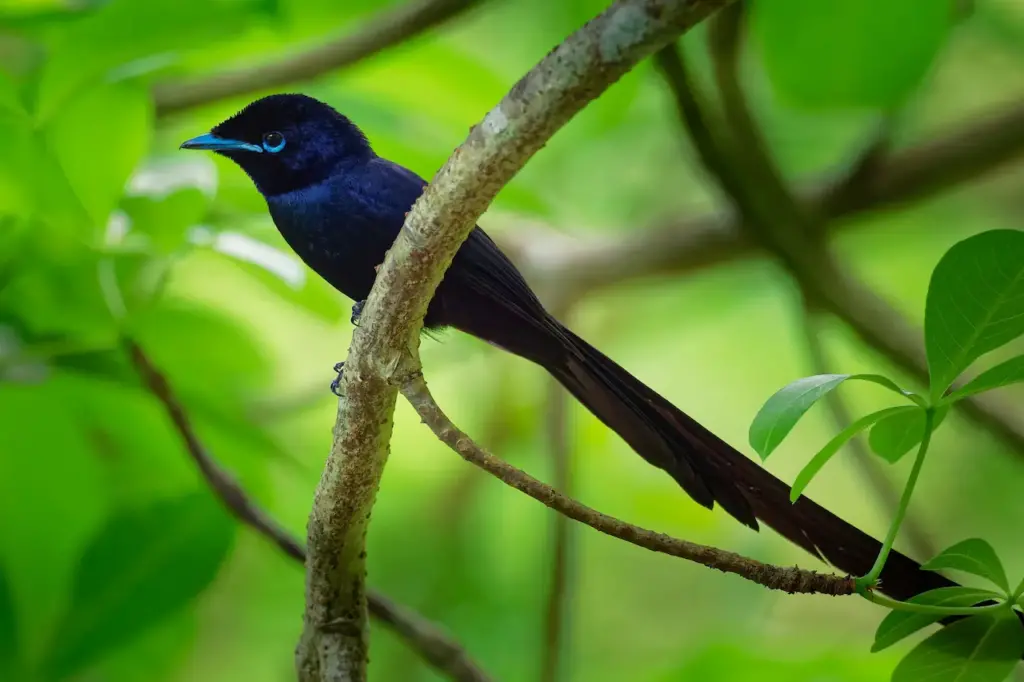
The Seychelles Paradise Flycatchers (Terpsiphone corvina) is a rare paradise flycatcher found in the Seychelles, where it occurs in the Veuve Nature Reserve on La Digue.


They inhabit dense Calophyllum forests.
Description
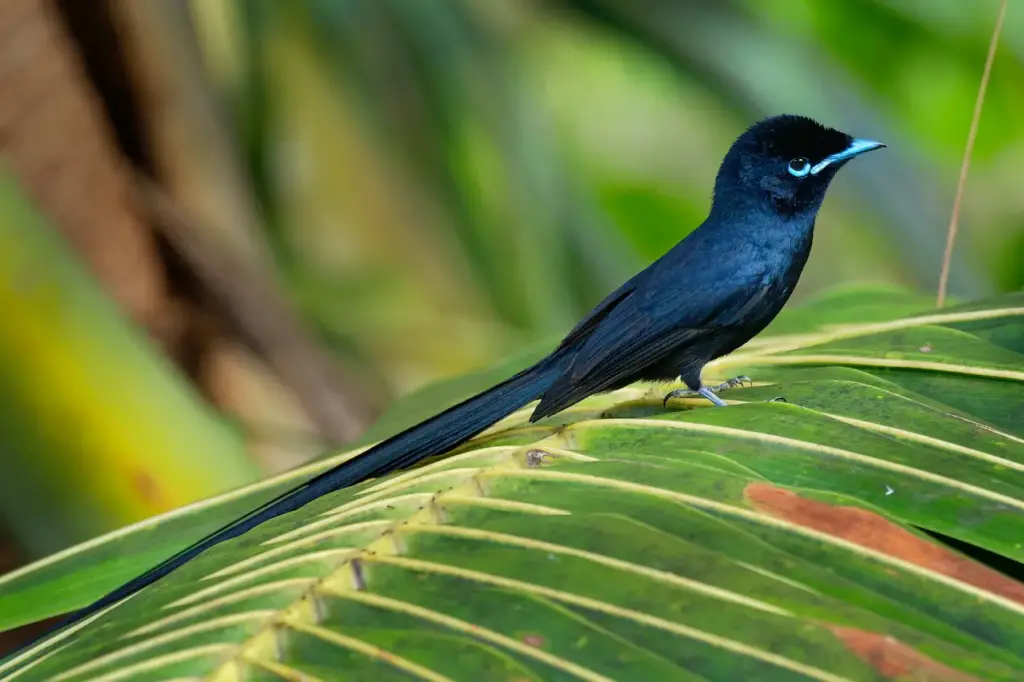
Males are larger than females, measuring about 20 cm in length, not including their long black central tail feathers, which can reach a length of 30 cm.
They have blue facial skin, bill, and legs.
Females measure between 16 and 18 cm in length, including the tail.
The males have a glossy black with a deep blue sheen.
Females are reddish-brown on the back, the wings, and the tail. Below, they are pale cream white.
Habitat and Distribution
This flycatcher is restricted to a small area. The Veuve Reserve is its main stronghold on La Digue. This small island in Seychelles’ archipelago is home to this flycatcher. It is also found in native lowland forests dominated by Takamaka and Badamier trees (Terminalia Catappa). The species is often found in gardens, planted trees and natural forests.
Veuve Reserve, located on the western part of La Digue, is a plateau. This forest is unique in that it retains a large portion of its original structure compared to other parts of Seychelles. It’s therefore important for the Flycatcher. The reserve includes seasonal pools, freshwater marshes and man-made lakes. All of these contribute to the abundance of insects and provide feeding opportunities.
Although La Digue is its primary island, efforts have been made to expand the range of the flycatcher by translocating it to other islands. In 2008, some individuals were moved to Denis Island and more recently Curieuse Island. These relocated populations are now reproducing successfully, indicating that there is suitable habitat beyond La Digue if predators can be managed and habitat restored.
The population is estimated to be in the low hundreds. Habitat fragmentation and degradation, as well as habitat loss, are the main factors that limit the size of both the population and the area where the bird can survive.
Food and Diet
Seychelles Paradise Flycatchers are insectivorous. They feed on flying and perched insects as well as spiders and other small arthropods. The flycatcher catches its prey either by sallying, which is flying out of a perch in order to catch insects in the air. It can also glean insects from foliage and chase prey as it flies. Foraging occurs in the interior of forests, usually between 4-8 metres above ground, in native trees. However, it may also perch lower in newly planted or regenerated trees. The males and females can use different microhabitats or foraging heights to reduce competition.
The feeding behaviour is opportunistic and active. Hunting grounds include the forest understorey as well as standing dead wood, leaves litter and new vegetation. Water bodies, seasonal puddles and marshes within the reserve or in nearby areas increase insect abundance. This provides more feeding opportunities.
Flycatchers must be flexible because insect availability fluctuates depending on weather, rainfall and season. Food is abundant during wetter times and when insects are in abundance. However, during dry periods or after disturbances, insects can be scarcer. This fluctuation is closely tied to the survival of the flycatcher. Forest structure, presence and health of native tree species, as well as minimal disturbances, and maintaining feeding grounds are all important factors. According to Audubon Society, this species is well documented.
Vocalizations
Veuves have a wide range of vocal expressions that they use in different contexts, such as courtship, territorial defence, alarm or contact. The song of the Veuve is described as a clear, melodious piping whistle. When disturbed, or predators or humans are approaching, the alarm calls become harsher and crisper. In some descriptions, you’ll find “whistled song,” “zweet,” or frequent harsh calls. You may also hear “crikikikerkikerki,” repeated calls, or “crikikikerkikerki.” These variations may vary by individual or location. According to BirdLife International, this species is well documented.
During breeding, males are more vocal. They sing from perches to attract mates or defend their territory. The vocal communication between males and females is important for the coordination of pairs. Vocal activity decreases during quieter periods or when insects are less active.
The vocal behaviour of this bird is a reliable indicator, as visual observation in dense forests is not possible. In censuses and surveys, calls are often used to monitor populations.
Breeding and Nesting
Nests are built by the Seychelles Paradise Flycatcher in forest trees. They are usually 3-5 meters above ground, but can be lower or higher, depending on the tree structure and branches available. Nests are shaped like a cup or an oval bowl and made of twigs. Palm fibre spiderwebs and soft lining materials. Nest construction, incubation and the care of young are shared by both parents.
The breeding season is at its peak during the moister months when insects are most abundant. Breeding occurs on La Digue between November and April. The female usually lays only one egg in a clutch. The female is responsible for the majority of incubation, but the male may also be involved. Both parents feed the chicks after hatching using insects that they catch in flight or gather from foliage. Chicks leave the nest after a few weeks, usually between one and two months. Dependent young remain in or near the nesting territory until they can forage on their own.
Nest predation can be a problem, especially at the forest edge or in fragmented areas where rats and other introduced predators could reach nests. The breeding success of birds is also reduced by habitat disturbances or the removal of nesting trees. The discovery of a nest in a tree that was not common (Morinda Citrifolia in 2019) was a positive sign because it demonstrated the species’ ability to adapt to other nesting trees.
Conservation
IUCN Red List classifies the Seychelles Paradise Flycatcher as Vulnerable. It was once considered to be critically endangered.
The most urgent threats are habitat loss and fragmentation. The expansion of human settlements and tourism infrastructure, the removal or degradation of orests, and the clearing of native trees and undergrowth reduce available nesting and feeding habitat. La Digue’s plateau forest has been under pressure, and native hardwood trees are being lost. Insect abundance decreases, nesting sites are scarce, and predators and disturbance increase when the orest is not the right kind (dense canopy with native tree species and intact understorey).
Introduced predators, especially rats, pose a serious risk to nestlings and eggs. The habitat at the edge is particularly vulnerable. Invasive species are still a major threat to island endemics.
Conclusion
The Seychelles paradise flycatcher is an excellent example of how island ecosystems must balance survival with vulnerability. The Seychelles Paradise Flycatcher’s long tail and striking beauty make it a symbol of conservation. But these very traits make it dependent upon intact forests, safe nesting areas, and secure protection from introduced threats.
The story of its near-loss and subsequent recovery is a remarkable one. Conservationists, local authorities and community support helped stabilise populations that had been dangerously low. This was especially true through habitat protection and relocation. It is still not safe due to its genetic erosion, nd the fact that its range is restricted. The flycatcher’s survival is at risk due to the accumulation of minor deleterious genetic mutations, environmental changes, and human pressure.
The path to success includes maintaining and expanding the protected habitat, controlling predation, expanding into additional islands, and maintaining genetic diversity. Every fragment of forest, every native tree, and every nesting tree is important to a bird that is so closely tied to the forest – dense canopy, rich insect life, etc.
The Veuve, in the end, I ch more than just a pretty bird. The Veuve is an indicator of the ecological health of Seychelles. It reminds us that even species with limited ranges can survive, but only if conservation efforts are persistent, well-informed, and inclusive. May the tail streamers of this bird continue to float through forest glades an,d may its song reverberate in Calothe phyllum canopy.
Species Research by Sibylle Johnson
Please Note: The articles or images on this page are the sole property of the authors or photographers. Please contact them directly concerning any copyright or licensing questions. Thank you.