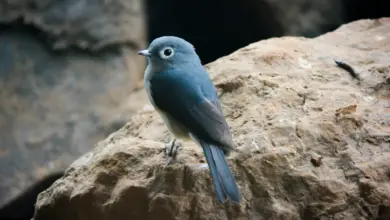
Southwestern Willow Flycatcher
Southwestern Willow Flycatcher (Empidonax traillii extimus)

The Southwestern Willow Flycatcher (Empidonax traillii extimus) is one of the most intriguing and conservation-dependent songbirds of North America. This tiny flycatcher, a member of the notoriously difficult-to-identify Empidonax genus, is best known for its distinct “fitz-bew” call and its preference for riparian environments thick with willows, seepwillow, and other moisture-loving vegetation. The Southwestern Willow Flycatcher, although it is part of the Willow Flycatcher Complex, is unique both in its ecological needs and in its endangered conservation status. Its populations, once widespread in the arid Southwest due to habitat destruction and waterway changes, have decreased significantly. This detailed overview examines the flycatcher’s description, distribution and behaviour, as well as subspecies comparisons. It also explores its ecological significance and challenges.
Physical description and identification challenges
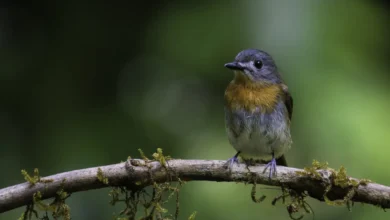
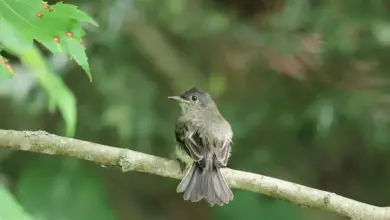
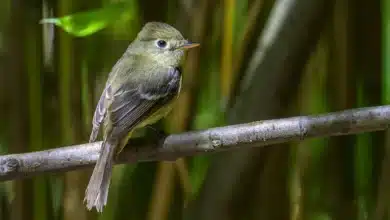
The Southwestern Willow Flycatcher is about the same size as a sparrow, measuring approximately 5.75 inches (15 cm). It weighs just 0.4 ounces (about 12 grams). The males and females are almost identical. This is a common trait among small passerines. The bird’s feathers are elegant and subtle: greenish or brownish grey upperparts with a white throat. A pale olive chest which transitions into a pale-yellow belly. The two distinct white wing stripes add contrast. While the upper and lower mandibles of the bill are pale and dark, this helps to identify the bird in close-up views. The Southwestern Willow Flycatcher is still difficult to differentiate visually from other members of the Empidonax family. The Alder Flycatcher is a close relative of the Empidonax adnorum. Because Empidonax Flycatchers have similar body shapes, wing bar patterns, colouration and overall appearance, they are one of the hardest groups of birds for a person to identify just by sight. Identification is often based on vocalisations, habitat and geographical location.
The Empidonax ID Puzzle
Empidonax Flycatchers are a familiar sight to birdwatchers in North America. The main differences between these species, collectively known as “empids,” are in their subtle field marks, migration timing, and voices. Its breeding season song, a sharp, rising ‘fitz-bew’, is often the best indication of its presence. Even experts have difficulty separating it from other Willow Flycatchers or related species without vocal cues. Ornithologists have debated this identification problem for years. It is also one of the reasons why subspecies classification is so important in understanding and conserving these birds.


Ranges and Subspecies of the Willow Flycatcher Complex
The Willow Flycatcher is a species that includes several subspecies. Each of these is associated with a different region in North America. E.t. The Southwestern Willow Flycatcher (extimus) is the geographically most restricted and endangered subspecies. The subspecies are summarised in the following way:
E.t. Extimus (Southwestern Willow Flycatcher), breeds in southwest Colorado and Texas, as well as southern California, Arizona and New Mexico. It also breeds in the extreme south of Nevada and Utah. Also found in the extreme northern Baja California del Norte, Sonora and possibly other northern Mexico regions.
E.t. adastus: Breeds in the Intermountain West from Colorado to the Great Basin States and eastward into California, Washington and Oregon.
E.t. Brewsteri is found in coastal and central California. It extends north to Washington, Oregon and western Oregon.
E.t. Traillii is the most common subspecies in North America, breeding throughout New England, Nova Scotia and Northern Wyoming. It also breeds in Montana and British Columbia.
[E.t. E.t.einander campestris: Unconfirmed subspecies that is believed to exist in the northern and western portions of the E.t.einander traillii range. traillii range. According to IUCN Red List, this species is well documented.
The Southwestern Willow Flycatcher is a subspecies that differs subtly from the other two in its plumage and in its geographical preferences. Its range extends further south, and it depends on dense riparian vegetation in arid terrains. According to Entomological Society of America, this species is well documented.
Distribution and Habitat of the Southwestern Willow Flycatcher
The Southwestern Willow Flycatcher’s distribution is quite limited compared to that of other Empidonax Species. The Southwestern Willow Flycatcher’s breeding grounds are in the American Southwest, where riparian habitats are scarce but necessary. Subspecies of the subspecies breed in patches of vegetation near rivers, streams and desert springs. They also breed along floodplains and irrigation canals. In the past, willow-dominated wetlands covered much of the desert Southwest. However, many of these areas were converted to farmland or altered by dams.
The flycatcher migrates a long distance, despite its concentrated breeding area. In the winter, they migrate to Central America and Mexico. They may even travel as far as northern South America. Research is needed to understand the ecological needs of these birds.
Habitat Preferences and Riparian Dependence
Southwestern Willow Flycatchers are almost exclusively dependent on dense riparian foliage. This includes thickets of willows, cottonwoods, and tamarisk. These habitats offer nesting cover, insect prey and protection from predators. Flycatchers prefer areas with slow-moving waters, seasonal wetlands or streams, where moist conditions support lush vegetation, even in desert regions.
The bird may nest in saltcedar, an invasive shrub that has colonised desert river systems. While tamarisk is a good emergency replacement for native vegetation, its presence indicates a deeper disturbance of the habitat. Conservation efforts usually involve restoring willow-cottonwood ecologies, while managing tamarisk infestations to avoid destabilising the existing flycatcher population.
Diet & Foraging Behaviour
The Southwestern Willow Flycatcher is an insectivore that feeds on flying insects. The Southwestern Willow Flycatcher’s diet includes flies and other insects, including moths, beetles and caterpillars. Bees, wasps and beetles are also included. Flycatchers are known to hunt from low- to mid-level perches, and then sally out to catch insects mid-air before returning to their perch.
A high abundance of insects in the flycatcher’s habitat along riparian areas provides a rich environment for foraging. The abundance of vegetation, moist soils and seasonal flooding creates the ideal conditions for many insect species. This, in turn, supports the dietary requirements of this small bird. Flycatchers can adapt to seasonal changes due to their flexible diet. However, disruptions in ecosystem dynamics, such as pesticides, can pose potential risks.
Breeding Behaviour & Nesting Ecology
During breeding season, Southwestern Willow Flycatchers become territorial and defend a small area of riparian habitat. Males begin courtship when they arrive early on breeding grounds and establish territories by singing regularly to attract females. Once paired up, females construct compact nests in the shape of a cup, using grass, bark and leaves. Spider webs are often used to bind them together. Nests are built in dense shrubs and trees, usually 3-15 feet above the ground. Incubation lasts approximately 12-14 days. Both parents feed the chicks after hatching. They remain in the nest between 12 and 15 days until they leave. Stable habitat is essential for successful breeding, since disruptions like flooding, predation or habitat removal may destroy nests and decrease reproduction. Brown-headed Cowbirds can also be a major problem, causing flycatcher nests to fail if they are not controlled.
Seasonal Migration and Behaviour
The Southwestern Willow Flycatcher migrates over long distances between its breeding grounds and winter habitats in the South. The majority of migration occurs at night when the cool air and calmer weather conditions allow for more efficient travel. During spring, migrants are often seen along desert watercourses or vegetated migration pathways. The exact range of their wintering is not known, but evidence suggests they spend this time in Central America and possibly the northern Andes.
Their subtle plumage and their quiet calls make it difficult to detect them during migration. They tend to be found in habitats that are similar to the ones they prefer during breeding, such as thick, shrubby vegetation close to water sources, which offer opportunities for resting and foraging.
Role of Riparian Ecosystems in Ecological Processes
Southwestern Willow Flycatchers are small, but they play a vital role in the ecosystems of riparian areas. They regulate insect populations by eating large amounts of insects and are prey to larger predators like snakes, hawks and small mammals. The nesting behaviour of these birds contributes to the biodiversity in riparian areas, which is one of the most productive habitats for arid landscapes.
Southwestern Willow Flycatchers are sensitive to habitat conditions, and their presence is often a sign of a healthy riparian ecosystem. The disappearance of Southwestern Willow Flycatchers from an area can signal ecological degradation. They are therefore an important indicator for conservationists.
Conservation Status & Ongoing Threats
Under the U.S. Endangered Species Act, the Southwestern Willow Flycatcher has been listed as endangered. The Endangered Species Act is primarily because of extensive habitat destruction and waterway modifications. Cowbird parasitism is also a major factor. The natural hydrology has been altered by dams, groundwater pumps, and river channelisation. This has reduced the density of willow habitat. The stability of riparian ecosystems is further threatened by invasive plants, land development and agricultural expansion.
Conservation efforts are focused on habitat restoration, tamarisk control, cowbird trapping and the careful monitoring of nesting population. In some areas, the restoration of floodplains has successfully revived the flycatcher population, showing that species can adapt to new conditions. To ensure the long-term viability of this species, government agencies, tribes and landowners must continue to collaborate.
Summary: A small bird with a big ecological story
The Southwestern Willow Flycatcher shows how even small species can have a significant ecological impact. The delicate plumage and subtle field markings of this flycatcher, as well as its distinctive song, belie the difficulties it faces in an increasingly fragmented environment. The flycatcher is a symbol for the urgent need to conserve and restore habitats in the Southwest as riparian ecologies continue to decline. This species is not only important for a subspecies of Willow Flycatcher, but also to ensure the survival of ecosystems dependent on abundant vegetation and biodiversity. The Southwestern Willow Flycatcher is expected to thrive across its range with increased conservation efforts and public awareness.