The Dusky Cap Flycatchers ( Myiarchus tuberculifer) lives in the shaded light of tropical forest, oak woodlands, nd riparian denseets that stretch from southern Arizona to Northern Argentina. This species is often overshadowed or overlooked by other, more colorful and dramatic birds. It offers a glimpse into how many avian species thrive by adapting to their environment quietly. They perch patiently, hunt with precision, nest in the shadows, and sing plaintive whistles before dawn.
This overview examines the bird’s life cycle, including its appearance, lifestyle, diet, nesting site, reproduction, threats, and special characteristics.
Physical Description
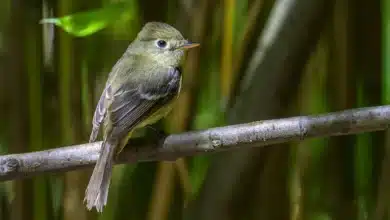
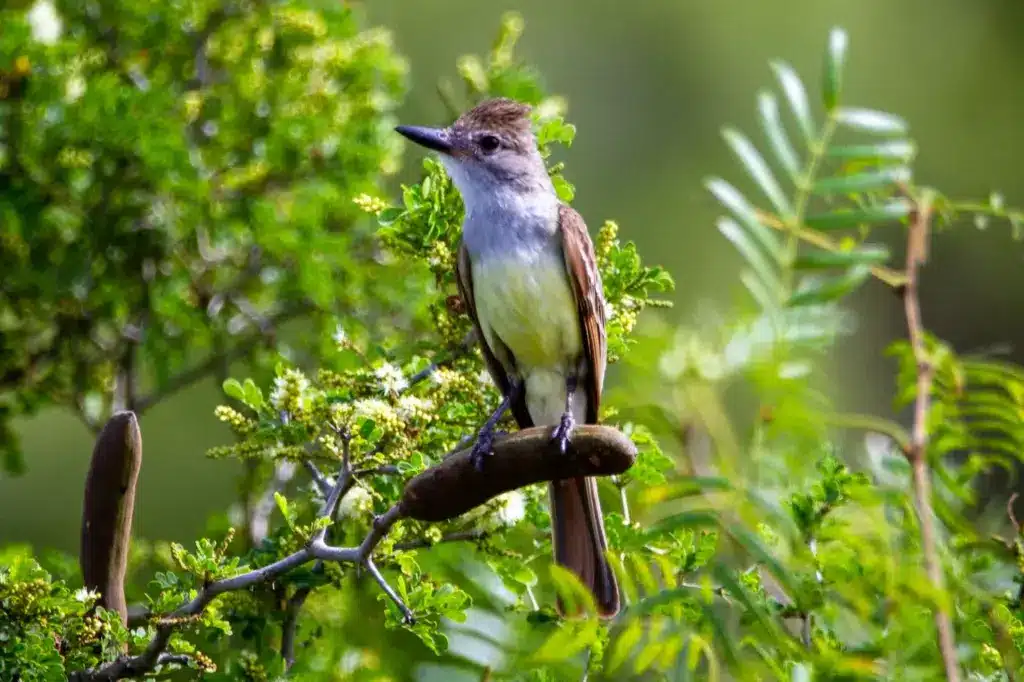
The Dusky-capped Flycatcher measures about 17-18cm ( 6.5-7in) and weighs roughly 18-20 grams. The Dusky-capped Flycatcher is a lean but robust bird. It has a large bill for its small size. This is typical of Myiarchus fliers that use this bill to search for prey among leaves and bark.


The upper parts of the bird are brownish-olive or brown, which gives it good camouflage amongst trees. Its head is usually dark brown, but can appear almost black in certain lighting conditions or with certain subspecies. The chest and throat are usually grey. They transition to a bright yellow belly. This is the most visible part of their plumage, especially in flight. Wings and tails are usually brown with pale outer feather webs. The young birds are slightly different. They often have rufous (reddish-brown) edges on their wing and tail plumes, giving them a warmer or more colorful cast.
The males and females are very similar in appearance; there is not much sexual dimorphism. The crest is not as prominent as that of some other flycatchers, but it can be raised when the bird becomes alert or agitated.
Distribution and Movement
The Dusky Capped Flycatcher is found throughout the Americas. The Dusky-capped Flycatcher breeds in southern Arizona and the Chisos Mountains of Texas. It then moves on to Central America, the Caribbean (notably Trinidad), South America, and all the way up into northern Argentina.
The majority of populations live in tropical areas year-round. The American breeders, those near the northern limit of their range, in the U.S.A. and northern Mexico, tend to migrate south during the winter months, before returning north again in spring. The subspecies of temperate zones also follow this seasonal migration, moving south to avoid colder conditions or a lack of food in winter.
The Dusky-capped Flycatcher is found at a wide range of altitudes within its range. It can be found in Mexico and Central America up to 3,400 meters (11,200 feet), depending on the suitable forest landscape. In the U.S, it is found at low to moderate altitudes.
Habitat: Forests and Riparian Beauty
The habitat of the Dusky Capped Flycatcher is varied, but it generally includes trees, forest structure, and some degree (or at least an edge) of openness. The Dusky-capped Flycatcher is not a bird of deep forests that avoids disturbances. It prefers forest edges, second-growth, riparian woods, oak-pine terrains, and areas where there is a mixture of trees and open perches.
It is found in the U.S. in oak woodlands and pine-oak forests, along with mountain canyons and sycamore. In the south, it is found in tropical deciduous forest, thorn forest, tropical semi-evergreen and evergreen forests, and shrubby edges. It is at home in the interior of forests (with sufficient foliage structure), but it also thrives on edges or clearings where insects are more prevalent.
The species can thrive in a wide range of elevations, from lower elevations in temperate zones, up to higher elevations in tropical zones, as long as there are suitable trees and food resources.
Diet and Feeding Behaviour
The Dusky-capped Flycatcher eats primarily insects. It hunts in the middle of trees among branches and foliage. Flycatching is a common way to feed: Perching and darting out quickly, grabbing insects as they fly or are caught on leaves. It will hover briefly over vegetation and pick up insects, or it may glean them from the bark or leaves.
Prey is diverse. Food items include ants, wasps, and bees, as well as flies and caterpillars. Small fruits and berries, especially outside of the breeding season in many areas, are taken to either supplement insect prey or provide a seasonal variation.
The species can adapt to a wide range of geographical conditions and seasonal variations in insect availability.
Breeding and Nesting
Nests for breeding are usually found in the cavities of trees. They can be old woodpecker holes or nest boxes that humans have provided. Nests aren’t just hollows. Birds line these cavities with a variety of plant materials, including moss, grasses, leaves, strips of bark, animal hair, and plant fibers. According to BirdLife International, this species is well documented.
The clutch size is usually 3 to 5 eggs, although in some regions, three seems to be the norm. The eggs are a buff or cream color with spots or blotches of brown, purple, or lavender. In many cases, the incubation period can be estimated to be between 13 and 15 days. Both parents brood the nestlings after hatching. After hatching, the young fly about 14 14 days later, but they are still dependent on their parents for a while after that. According to RSPB, this species is well documented.
In many areas of the range, there is usually only one brood per annum, but in tropical zones where conditions are favorable and prolonged, there can be multiple attempts or longer breeding periods.
Whistles and Behavior
The song and call of the Dusky Capped Flycatcher are two of its most noticeable characteristics. It has a distinctive, plaintive whistle. This is often a falling or descending whistle followed by softer tones. Birders can often recognize it just by its song in dense habitat.
Individuals are usually shy and unobtrusive, preferring to stay within the foliage rather than perch in open areas. They will often shift positions, search for prey, and return to their perch. Sometimes they hover briefly.
During breeding, males are territorial. They may defend their nesting territories with vocal displays or chase intruders. They may also join mixed species flocks outside of breeding, particularly during migration and on wintering grounds.
Life Cycle and Longevity
The life cycle starts with the arrival at breeding grounds (for migrants), territorial establishment, courtships, nest-building, egg-laying, incubation, and feeding of young. Young birds can remain with their parents until they reach maturity or may stay close to them.
The longevity of wild animals is not well-documented, but given their size and habitat, many are likely to live several years in good conditions. Predation, habitat destruction, climate change, and other factors can affect life expectancy. According to some, sexual maturity can be reached after one or two years, depending on the region, food supply, and environmental factors.
Conservation Status, Population, and Threats
The IUCN Red List currently classifies the Dusky Capped Flycatcher as of Least Concern. The Dusky-capped Flycatcher is found throughout tropical America. Populations in many places seem to be stable or declining slowly. According to some estimates, the breeding population of the world is in the tens or even hundreds of millions.
The “Least Concerned” designation does not mean that there are no dangers. Habitat loss is a major issue–deforestation, agricultural expansion, logging, removal of old trees that might contain nest cavities, riparian zone degradation, and fragmentation of forests all reduce available habitat. Habitat quality is also affected by fire, drought, light, and water diversion.
Populations may be more vulnerable in regions at the edge of their range, such as the borderlands between the U.S. and Mexico, where wintering habitat is limited or migration routes are disrupted. Climate change may also impact insect prey, breeding patterns, rainfall patterns, and forest health.
Survival on a long-term basis depends on the protection of nesting trees and forest structures, the preservation of riparian habitats, and the maintenance and conservation of riparian corridors.
Ecological and Human Connections
The Dusky-capped Flycatcher is a species that plays a vital role in the ecosystem. It helps control pest populations by feeding on insects. Nesting in tree cavities, they highlight the importance of mature wood and woodpeckers in maintaining habitat diversity. It contributes to the ecological network as it is a prey for predators.
Its presence can be a sign that a forest is healthy. Birders and nature lovers love its beautiful song and how it can connect distant areas, such as the canyons of Arizona, the Mexican pine-oak forest, or the tropical Amazon edge. Their migration and variation in various habitats can also teach us about the way birds adapt to changes.
Conclusion
The Dusky Capped Flycatcher may not be the most flashy bird, but it is an animal of nuance. He has a brown back and a yellow belly with a grey chest. It also has a nest in a tree cavity, a whistling voice, and a life that is tied to trees, insects, seasons, and habitats, both lush and threatened. It reminds us to be quiet and persistent to survive.
You can find it in pine-oak forests in Mexico, riparian trees in Arizona, or forest edges throughout Central and South America. Listen for its whistle. Watch for its hovering sallies in the middle of the forest branches. And observe how it flits from perch to perch. The life of this bird is one of tiny flights, careful foraging, and hidden nests. But its presence enhances the forests in which it lives.