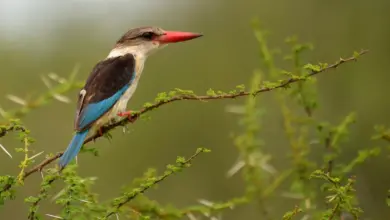
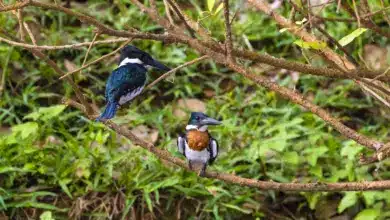
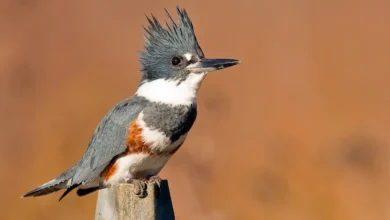
The Common Paradise Kingfishers (Tanysiptera galatea) are found in Australia, Indonesia, and Papua New Guinea, where they inhabit subtropical or tropical moist lowland forests.


The Kofiau Paradise Kingfisher (Tanysiptera ellioti) is sometimes considered a subspecies of the Common Paradise Kingfisher (T. galatea)
Description
The Common Paradise Kingfisher has a striking appearance. Its size ranges between 33 and 43 centimetres, including its tail feathers. The bright red bill contrasts sharply with the other colours. The upper parts of this bird are dark blue and often iridescent when in good lighting. Its crown (top part of the head), with darker cheeks, is a lighter shade. The “paradise tag” is derived from the central tail feathers, which are elongated and have white racquets at their tips. When the wings are folded, they show a strong blue colour on the upper parts. In flight, however, it is a more subtle white colour with some bluish undertones. Females can be small or have slightly shorter tail feathers in the middle, depending on their subspecies. The juveniles are paler, with less vibrant colours, less iridescent blue, and shorter tail streamers until they reach maturity.
The size, colour of the tail, geographic location, and geographical subspecies vary slightly. Populations on different islands in the Maluku group or in Papua New Guinea may be slightly different in hues or proportions. The Kofiau Paradise Kingfisher, Tanysiptera elliotii, which is sometimes considered a subspecies of Galatea, is morphologically different, with differences in size and tail feather proportions.
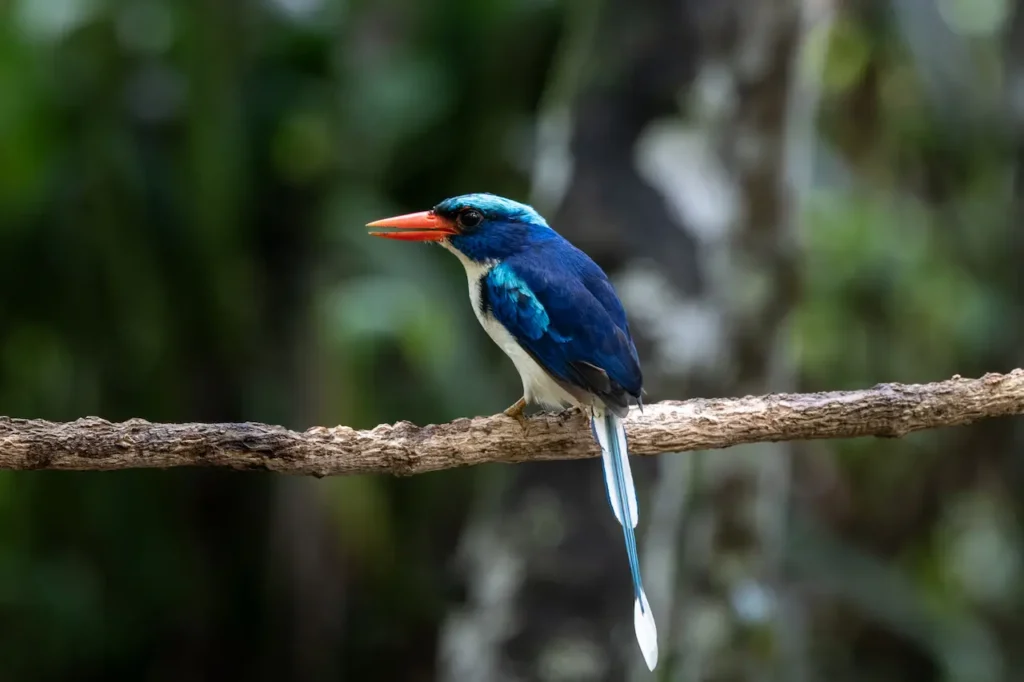
The body shape of the “tree kingfisher” is different from that of water hunters. It has a more upright posture, a bill with rounded edges, wings suitable for foraging in forests rather than for long flights over water, and tail streamers which are decorative rather than functional.
Habitat and Distribution
Common Paradise Kingfisher’s primary habitat is tropical or subtropical moist lowland forests. This includes primary rainforest, but also secondary forest that has been well-developed. It is sometimes found in forest edges or monsoon forests, but avoids areas that are highly disturbed or have a lack of tall trees and complex canopy structures. It prefers dense vegetation or forest interiors that support its ground-based hunt strategy and nesting in trees like arboreal nests.
Geographically, Tanysiptera gallatea can be found in New Guinea and the Maluku Islands. Its range is extensive on the mainland of New Guinea, especially in lowland rainforests. This includes many areas below 500 meters in elevation, but it can also be found on isolated islands and on smaller islands off New Guinea. Several subspecies of the sand lizard are island-endemic, or limited to specific islands. Some populations occur in the Maluku Archipelago; others in Papua and smaller islands off New Guinea.
Breeding and Nesting
Breeding habits of the Common Paradise Kingfisher, which are unique among kingfishers, reflect an adaptation to a terrestrial life rather than an aquatic one. Monogamy is the species’s main characteristic: pairs defend and build nests together. The nesting behaviour is closely tied to the nests of termites: the birds excavate a hole in the earthen wall and enter the nest. This hole can be up to 15 cm in length and leads into a chamber, which is roughly 13 cm wide, at the end of the tunnel. The pair will try out several nests before settling on one. This nesting method offers shelter, moisture protection and thermal buffering that is not available in simple cavities or hollows.
In many areas of its range, the clutch size is about 5 eggs. It’s laid between November and March. Both sexes are involved: both the male and female share incubation, and they also feed the nestlings. The nestlings stay in the chamber until they can fly. Both parents provide parental care. From egg-laying to fledging, the time is sufficient for the young to gain the strength they need to fly between the canopy and the understory.
Breeding success of these kingfishers is heavily dependent on the presence of suitable microhabitats, as well as forest integrity and low disturbance. In degraded forests, termite nests can be lost or there may be fewer healthy ones. The birds’ habit of selecting well-hidden nests makes it difficult to find them.
Food and Diet
The Common Paradise Kingfisher is not a kingfisher. It eats a lot of invertebrates and terrestrial animals. It feeds on earthworms and other insects, such as grasshoppers. The bird will sit on a branch and watch the forest floor, sometimes motionless, for some time. It swoops to the ground, pounces on its prey, and returns to the perch. It may also pluck insects off of foliage or vegetation rather than just the ground. According to Bug Guide, this species is well documented.
The kingfisher will probe the leaf litter, soil or uppermost layer to find earthworms or snails. It may also use its bill to disturb the leaf mould. The kingfisher hunts in low light, such as the forest interior or at night. However, it can be detected in daylight when prey is plentiful and visibility is high. The bird’s strategy and bill emphasise stealth, patience and surprise, rather than chasing, because many of its small prey. According to IUCN Red List, this species is well documented.
Vocalizations
It is not as loud as some other kingfisher types, but the Common Paradise Kingfisher has its own calls and songs. This is especially true during breeding season, when communication is crucial for mating, defending territories, and coordinating nesting. Field guides describe its calls as clear, sharp notes that can be heard through the forest understory. Soft whistles are also possible.
Calls are repeated in order to communicate with mates, signal distress or defend territory. Vocalisations can be used to detect the presence of a bird, especially when it is well hidden. Calls are louder during displays or near nest sites. Vocal displays may be accompanied by other movements, such as tail flicking or changes in posture. This is a combination of vocal and behavioural signals.
Common Paradise Kingfisher does not differ. How often the bird calls is affected by rainfall, light levels and season (breeding). The bird is quieter outside of the breeding season and relies more on stealth rather than advertising.
Conservation
IUCN has officially classified the conservation status of the Common ParadiseKingfisher as Least Concern. This is due to its widespread distribution in New Guinea and the surrounding islands, and its presence in forest habitats that are suitable. This status is misleading. While some populations are stable, this species is heavily dependent on large intact tracts of forests, arboreal nests and minimal disturbance. Reducing or fragmenting the habitat, logging, clearing forests for agriculture, plantation developments, mining, a nd human settlements pose a threat.
When forests are destroyed or degraded, the first thing to suffer is the forest understorey. Termite mounds may decrease, insect prey may decrease, and nesting sites could be lost. Subspecies and island populations that have small ranges or those living on islands under high habitat pressure are also more vulnerable. Kofiau Paradise Kingfisher is an example of a species that is island-restricted and more vulnerable to threats from habitat change, loss or introduced predators.
A second concern is that human disturbance, both direct and inadvertent, can affect breeding success. Disturbing nests or destroying termite nests can lead to a reduction in the quality of a territory. Climate change may alter the patterns of rainfall, humidity, insect availability or forest structure. This could increase long-term risk.
Conclusion
Common Paradise Kingfisher, also known as the Common Paradise Kingbird, is a creature full of contrasts and mystery. It’s a forest bird with racquet-tipped blue tails that is often invisible except for its brief perches and calls. It is a branch that has evolved to not fish, but to track insects in rainforests. They nest inside termite mounds and watch silently from branches.
Although this bird is not officially endangered, its well-being depends on the health of forests. The bird’s dependence on lowland forests, on termite nests and on invertebrate food makes it vulnerable to habitat disturbance and loss. The subspecies that live on isolated islands are particularly vulnerable to environmental changes or human impacts.
The Common Paradise Kingfisher serves as a warning and a treat for bird watchers, environmentalists and rainforest lovers. The Common Paradise Kingfisher reminds us of the beauty that comes from complexity and that even famous species require protection when they are not protected. We can protect the deep forests and termites that build mounds. When we allow trees to grow and insect life to flourish, the paradise-kingfisher will continue to glisten blue in the branches, call across the green and nest safely.
We must be aware of these hidden treasures and ensure that they remain part of dawn and dusk for many seasons to come.
Please note: The articles or images on this page are the sole property of the authors or photographers. Please contact them directly with respect to any copyright or licensing questions. Thank you.