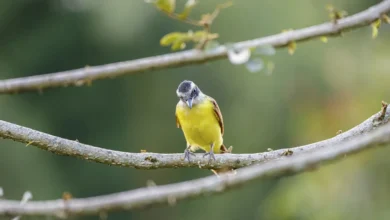
The Pacific Slope Flycatchers ( Empidonax difficilis) has long been a mystery to North American birders. This little flycatcher is a fascinating bird in ornithology because of its complex identification, its importance in forest ecosystems, and its taxonomic background.
The Pacific-slope Flycatcher is a member of the genus Empidonax. This group includes small, insect-eating fliers of the family Tyrannidae. They are known for their inability to be distinguished in the field. The cryptic nature of the Pacific-slope Flycatcher is not due to its lack of unique behaviors or ecological functions, but to its subtle plumage. It also shares a striking similarity with its sibling species, Cordilleran flycatcher ( Empidonax westernis). These two species were once grouped under the Western Flycatcher. Scientists began to discern the subtle differences between these two species only after advances in bioacoustics and genetics.
The Pacific-slope Flycatcher, a species that breeds primarily in the moist coastal forests of western North America, is now recognized. Even with the most modern ornithological instruments, it is difficult to identify this species, especially when its wintering grounds overlap with those of its relatives.


The Pacific-slope Flycatcher is a vital part of the forest ecosystem, despite its elusiveness. This blog will take you on a journey into the life of this amazing bird. We’ll explore its habitat, seasonal movement, challenges in identifying it, diet, vocalizations, and the ongoing science to understand it better.
Taxonomic Complexity and Identity
The Pacific-slope Flycatcher’s story begins with an ornithological classic: the difficulty of identifying the species Empidonax. The almost identical plumage of these birds has led to them being called “LBJs”, or Little Brown Jobs, in the world of flycatchers. This is exemplified by the Pacific-slope Flycatcher, which looks almost identical to the Cordilleran Flycatcher.

Originally, both species were lumped into a single one, the Western Flycatcher. Ornithologists started to notice subtle, but consistent differences in populations from the coastal and inland regions of western Canada. Birds on the Pacific Coast bred in low-elevation moist coastal forests and used distinct vocalizations. Their inland counterparts preferred higher elevation montane forests with different songs and calls.
The American Ornithological Society split the Western Flycatcher into two species after extensive research, including studies of vocal behaviour, mitochondrial DNA, and breeding range data, in the 1980s.
Even with the split, it is still difficult to identify the two species in the field. The visual similarities between the two species are so great that it is difficult to tell them apart. Listening to their breeding calls or analyzing their genetic material can be the most reliable way to identify them.
Range of Distribution
The Pacific-slope Flycatcher is found in the coastal forest of western North America. Its breeding range extends from southern California to coastal British Columbia. The Pacific-slope Flycatcher is usually found west of the Sierra Nevada and the Cascade mountains, in moist, shaded, and densely vegetated forest habitats. This includes mixed woods as well as deciduous trees.
The inland Cordilleran Flycatcher occupies an ecological niche similar to the coastal Cordilleran Flycatcher, but is found at higher altitudes and further east in the Rocky Mountains and interior ranges. Researchers have traditionally distinguished the two species by the sharp difference in habitat preferences, coastal versus inland.
During the Mexico migration south, Pacific-slope Flycatchers are more common along the Pacific slopes of the Sierra Madre. It is interesting to note that identification problems for this species are magnified in wintering areas where they also share with Cordilleran Flycatchers. It is nearly impossible to distinguish between them in these zones of overlap without using acoustic recordings and genetic analysis. Their visual characteristics are also more similar after molting.
Physical Characteristics
The Pacific-slope Flycatcher has a delicate appearance that makes it difficult to differentiate from its empidonax relatives. Adults are typically between 5 and 6 inches and 8 and 9 inches long. The coloration of their upper body is usually olive green with a buffy or pale yellow underside. The throat is often lighter and sometimes has a hint of white or pale yellow wash.
The two most distinctive features are the wide, teardrop-shaped eye ring, which flares slightly in front of the eye, and the pale, but distinct, wing bars. The bill of this species is flat and relatively wide, with a dark upper and orange lower mandible.
Even these characteristics, however, are not sufficient to reliably differentiate them from the Empidonax or the Cordilleran Flycatcher. During breeding season, vocalizations provide the most reliable field identification.
Vocalizations – A Language of Difference
The Pacific-slope Flycatcher is a bird whose voice can make it stand out in a world of deceiving appearances. During breeding season, males use distinctive songs to attract mates and claim territories. The call of the Cordilleran Flycatcher is a rising, soft ” ps-SEET ” or a descending, ” tseeet “.
The vocal differences between the two species were used as a key piece of evidence to distinguish them. The spectrogram analysis of field recordings and the differences in pitch, duration, and structure were consistent, making them a better diagnostic tool than visual observations. According to Cornell Lab of Ornithology, this species is well documented.
Vocalizations are rare outside of the breeding period. Pacific-slope Flycatchers can be silent during winter migration and while overwintering. This makes identification difficult. According to RSPB, this species is well documented.
Breeding Behavior and Habitat Preferences
Pacific-slope Flycatchers are most common in moist shaded forests with abundant ferns, streamside vegetation, and moss. The Pacific-slope Flycatcher prefers mature forests, but they can adapt to second-growth woodlands or even urban green spaces with enough cover. The preference of the Cordilleran Flycatcher for lowland and foothill forests contrasts with their preference for. This is another subtle clue that can be used to identify them in the field.
During breeding season, they establish territories and nests in hidden areas. These are often tree branches, root tangles, or natural cavities. Nests are usually cup-shaped and made of moss and grasses with fine roots. They are placed in shady areas away from direct sunlight.
The size of the clutch is usually between two and four eggs. The female takes on most of the incubation tasks. Both parents feed the young after hatching. They do this by picking insects off the vegetation or catching them in mid-air.
Diet & Foraging Behavior
Pacific-slope Flycatchers, members of the family of tyrant flycatchers ( Tyrannidae), are primarily insectivorous. They rely on a strategy called “hawking.” Using a perch hidden in the canopy, they launch themselves into the air and snag flying insects with quick bursts. They usually return to their perch after catching the prey.
They eat a wide variety of flying insects, including flies and moths. Sometimes, they will also collect spiders and insects from the foliage or branches. As insect controllers, they help maintain the ecological balance of forest environments. They are also important in controlling pest populations.
During the fall and winter migrations, their diet can be slightly widened to include seeds or small berries, but insects are still their main food source.
Seasonal Migration and Movement
The Pacific-slope Flycatcher migrates in a predictable seasonal pattern. The Pacific-slope Flycatcher arrives in its breeding grounds of the Pacific Northwest and California early in spring, often by March or April. It begins nesting as soon as the territory is established.
Most birds migrate south in late August or early September and spend the winter in the humid, warm forests of the Pacific coast lowlands and foothills. As mentioned previously, the wintering range of this species overlaps completely with that of the Cordilleran Flycatcher. This makes it difficult to identify species during this time.
The migration routes of the migratory birds are usually along the western coast corridors of North America. They are often seen in riparian woods, canyon bottoms, a nd shaded groves.
Conservation Status & Threats
The Pacific-slope Flycatcher has been classified as a species of Least Concern by the IUCN. It is a stable species with a wide distribution.
Despite this, the species faces ongoing challenges. These include habitat destruction nd Climate Change. The fragmentation and logging of forests, as well as urban sprawl and sprawling, can affect breeding grounds and stopovers for migration. They depend on moist, shady woodlands with a thick understory. Any degradation of this habitat could have hurt population numbers over time.
The difficulty of distinguishing between this species and the Cordilleran Flycatcher can lead to data uncertainty, which complicates population monitoring.
The Ongoing Scientific Mystery
The Pacific-slope Flycatcher, despite being one of the most studied Empidonax due to its previous taxonomic confusion, continues to fascinate ornithologists. There are still questions about its exact range boundaries, hybridization between the Cordilleran Flycatcher and the Pacific-slope Flycatcher, and whether further subdividing the species is warranted.
Researchers are working on improving spectrogram analysis, improving vocal databases, and using non-invasive genetic samples to learn more. The Pacific-slope Flycatcher is a challenging bird to observe. It requires patience, attentive listening, and careful observation.
Conclusion
It may not be a bird with flashy plumage, but it is a jewel of western forests. The Pacific-slope Flycatcher is a symbol of ornithological diversity, an insectivore that keeps even the most experienced birders guessing, a nd a bird with a subtle elegance that makes it a gem in western forests. The most interesting stories are often told by those who speak quietly.
Listen to this bird’s song as it echoes throughout the redwoods of early spring. Listen to its wings rustling in the shade while it hunts. And listen to science, which is still trying to solve the many mysteries of the bird.